July 11, 2012

The Bran Flakes are a sound collage pop group with members in the United States and Canada who specialize in creating music from pre-existing sources. The group’s members include Otis Fodder, Mildred Pitt, Susan DeLint, and The GRDNR. Along with other bands such as Negativland and Evolution Control Committee, the Bran Flakes make extensive use of sampling, recontextualizing the samples into new works. The group scours thrift shops for obscure and quirky LPs; some of their songs also make use of recognizably famous basslines, television shows, and soundtracks from video games. The unauthorized nature of much of their output has precluded wide commercial release.
Following the 1998 release of ‘I Remember When I Break Down’ on Ovenguard Music, on which Otis Fodder was sole writer, the group’s first album as a duo (Otis Fodder and Mildred Pitt) was in 1999, with ‘Hey Won’t Somebody Come and Play’ on Ovenguard Music. 2001 saw the release of ‘I Don’t Have a Friend’ on Lomo Records. Their 2002 album ‘Bounces!’ was released on the band’s own Happi Tyme Records, and contained one of their most popular songs; ‘Good Times a Goo Goo’, which sampled extensively from Kermit the Frog and Fozzie Bear’s performance of ‘Moving Right Along’ from ‘The Muppet Movie.’ In 2008 the band signed with the label Illegal Art, known for such acts as Girl Talk and Steinski.
Posted in Art, Technology |
Leave a Comment »
July 11, 2012

Top 40 is a music industry shorthand for the currently most-popular songs in a particular genre. When used without qualification, it typically refers to the best-selling or most frequently broadcast popular music songs of the previous week. Top 40 became the dominant radio format of the 1960s, 1970s, and 1980s. Its popularity coincided with the rapid changes in recording technology in the 1950s and 1960s. In 1954, the recording industry agreed upon a standard recording format for higher fidelity music, so any new record player could play any new record.
Also in that year, new single records were released on 45 rpm records, and the Top 40 thereafter became a survey of the popularity of these records (and their airplay on the radio). Tape recording had become perfected, allowing artists more freedom as they composed songs, especially novelty songs. By the late 1980s and the early 1990s, the 45 rpm record would decrease in popularity and other means would be used to evaluate the popularity of new songs, such as cassette-single, CD single, and digital MP3/AAC sales (plus radio airplay).
Posted in Art, Money, Technology |
Leave a Comment »
July 9, 2012

Futurism was a modern art and social movement which originated in Italy in the early 20th century. It was largely an Italian phenomenon, though there were parallel movements in Russia, England, and elsewhere.
The Futurists practiced in every medium of art, including painting, sculpture, ceramics, graphic design, industrial design, interior design, theater, cinema, fashion, textiles, literature, music, architecture, and even gastronomy.
read more »
Posted in Art, Politics, Technology |
Leave a Comment »
July 9, 2012

‘The Art of Noises‘ (‘L’arte dei Rumori’) is a Futurist manifesto, written by Luigi Russolo in a 1913 letter to friend and Futurist composer Francesco Balilla Pratella. Futurism was an artistic and social movement that originated in Italy in the early 20th century. It emphasized and glorified themes associated with contemporary concepts of the future, including speed, technology, youth, and violence, and objects such as the car, the airplane, and the industrial city.
In his letter, Russolo argues that the human ear has become accustomed to the noise of the bustling urban industrial soundscape; furthermore, this new sonic palette requires a new approach to musical instrumentation and composition. He proposes a number of conclusions about how electronics and other technology will allow futurist musicians to ‘substitute for the limited variety of timbres that the orchestra possesses today the infinite variety of timbres in noises, reproduced with appropriate mechanisms.’ ‘The Art of Noises’ is considered to be one of the most important and influential texts in 20th century musical aesthetics.
read more »
Posted in Art, Language, Technology |
Leave a Comment »
July 9, 2012

The Age of Spiritual Machines is a book by futurist Ray Kurzweil about the future course of humanity, particularly relating to the development of artificial intelligence and its impact on human consciousness. It is also a study on the concept of technological singularity, the hypothetical future emergence of greater-than-human superintelligence through technological means.
Originally published in 1999, the book predicts that machines with human-like intelligence will be available from affordable computing devices within a couple of decades, revolutionizing most aspects of life, and that eventually humanity and its machinery will become one and the same.
read more »
Posted in Language, Philosophy, Technology |
Leave a Comment »
July 7, 2012
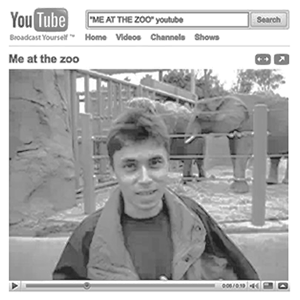
Me at the zoo is the first video ever to be uploaded to YouTube. It was uploaded at 8:27 pm on Saturday, April 23, 2005 by Jawed Karim, one of the co-founders of the site, under the username ‘jawed.’ Described by ‘The Observer’ as ‘poor-quality,’ the video was shot by Yakov Lapitsky at the San Diego Zoo; it features Karim in front of the elephants, explaining how interesting their ‘really, really, really long trunks’ are, and is 19 seconds long.
‘The Los Angeles Times’ states: ‘as the first video uploaded to YouTube, it played a pivotal role in fundamentally altering how people consumed media and helped usher in a golden era of the 60-second video.’
Posted in Technology |
Leave a Comment »
July 7, 2012
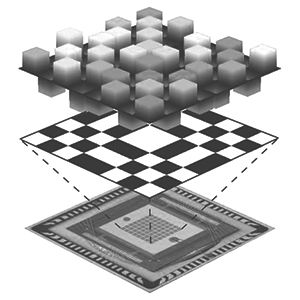
Metamaterials are artificial materials engineered to have properties that may not be found in nature, such as the ability to interact with and control electromagnetic waves. Naturally occurring matter exhibits behavior based on the molecules that make it up — the atomic material that composes the finished product determines what properties the product will have.
For instance, take the relationship between wood and light. Wood, like all natural matter, reflects and refracts light. But just how much light it reflects and refracts depends on how the electromagnetic waves of the light interact with the particles — like electrons — that make up the wood. With metamaterials, the sum of the parts, not the parts themselves, determines how the material behaves.
read more »
Posted in Technology |
Leave a Comment »
July 5, 2012

‘Conductive ink‘ is an ink that conducts electricity. These materials may be classed as fired high solids systems or PTF (polymer thick film) systems that allow circuits to be drawn or printed on a variety of substrate materials such as polyester or paper.
These types of materials usually contain conductive materials such as powdered or flaked silver and carbon like materials. Conductive inks can be a more economical way to lay down a modern conductive traces when compared to traditional industrial standards such as etching copper from copper plated substrates to form the same conductive traces on relevant substrates, as printing is a purely additive process producing little to no waste streams which then have to be recovered or treated.
read more »
Posted in Money, Technology |
Leave a Comment »
July 3, 2012
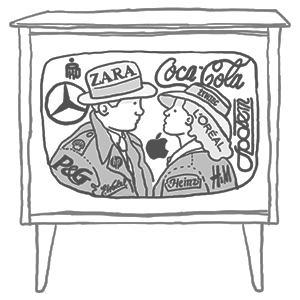
‘Four Arguments for the Elimination of Television‘ is a 1978 book written by liberal activist Jerry Mander which argues that there are a number of problems with the medium of television. Mander argues that many of the problems with television are inherent in the medium and technology itself, and thus cannot be reformed. Mander spent 15 years in the advertising business, including five as president and partner of Freeman, Mander & Gossage, San Francisco, a nationally-known advertising agency.
‘Four Arguments for the Elimination of Television’ argues that the technology of television is not a neutral or benign instrument or tool. The author argues that in varied technologies and institutions such as militaries, automobiles, nuclear power plants, mass production, and advertising, the basic form of the institution and the technology determines its interaction with the world, the way it will be used, the kind of people who use it, and to what ends.
read more »
Posted in Language, Politics, Technology |
2 Comments »
July 3, 2012

‘The medium is the message‘ is a phrase coined by Marshall McLuhan meaning that the form of a medium embeds itself in the message, creating a symbiotic relationship by which the medium influences how the message is perceived. The phrase was introduced in his most widely known book, ‘Understanding Media: The Extensions of Man,’ published in 1964.
McLuhan proposes that a medium itself, not the content it carries, should be the focus of study. He said that a medium affects the society in which it plays a role not only by the content delivered over the medium, but also by the characteristics of the medium itself. McLuhan frequently punned on the word ‘message’ changing it to ‘mass age,’ ‘mess age,’ and ‘massage’; a later book, ‘The Medium is the Massage’ was originally to be titled ‘The Medium is the Message,’ but McLuhan preferred the new title which is said to have been a printing error.
read more »
Posted in Language, Politics, Technology |
1 Comment »
July 3, 2012


A Video Synthesizer is a device that electronically creates a video signal. A video synthesizer is able to generate a variety of visual material without camera input through the use of internal video pattern generators. It can also accept and ‘clean up and enhance’ or ‘distort’ live television. Video pattern generators may produce static or moving or evolving imagery. Examples include geometric patterns ( in 2D or 3D ), subtitle text characters in a particular font, or weather maps.
The history of video synthesis is tied in to a ‘real time performance’ ethic. The equipment is usually expected to function on input camera signals the machine has never seen before, delivering a processed signal continuously and with a minimum of delay in response to the ever changing live video inputs.
read more »
Posted in Art, Technology |
Leave a Comment »
July 3, 2012

Kim Dotcom, real name Kim Schmitz (b. 1974) is a German-Finnish businessman who rose to prominence during the dot-com bubble and was convicted of insider trading and embezzlement in its aftermath. He is the founder of Megaupload and its associated websites. He legally changed his surname to Dotcom in 2005. in 2012, the New Zealand Police placed him in custody in response to US charges of criminal copyright infringement in relation to his Megaupload Web site.
Dotcom has spoken out against his negative portrayal in the media, claiming to be a reformed character and a legitimate businessman who has been unfairly demonized by United States authorities and industry trade groups such as the RIAA and MPAA. He contends that the services offered by his Megaupload site were not significantly different from those of comparable services such as Rapidshare or YouTube, and he has just been used as a scapegoat because of his hacker past.
read more »
Posted in Money, Politics, Technology |
Leave a Comment »



