July 2, 2012

Everything is Terrible! is a Chicago-based video blogging website launched in 2007 that features clips of VHS tapes from the late 20th century. The project was founded in 2000 by a group of friends while at Ohio University. They search at thrift stores, garage sales, and ‘bargain bins’ for the worst and most outrageous VHS tapes in which to share with each other. The website has also been attempting to amass the largest collection of tapes that feature the film ‘Jerry Maguire’; according to member Ghoul Skool: ‘We always have noticed since the beginning that there seems to be nothing but just ‘Jerry Maguire’ tapes filling our nation’s thrift stores. I don’t know why.’
The people behind ‘Everything is Terrible’ also perform live shows wearing cloaks and gold VHS tapes around their necks to showcase their new VHS discoveries. In 2009, the website released a video titled ‘Everything is Terrible! The Movie,’ which featured the same type of VHS clips that would be featured on their website. The ‘A.V. Club’ called the video ‘a portal into a world halfway between showbiz and real life—a look at how the people who make entertainment for a living think the rest of us saps actually live,’ adding that it’s ‘simultaneously enlightening, hilarious, and deeply sad.
Posted in Art, Humor, Technology |
Leave a Comment »
July 2, 2012

Connectionism [kuh-nek-shuh-niz-uhm] is the theory that the connections (such as between brain cells) mediate thought and govern behavior. It is a set of approaches in the fields of artificial intelligence and cognitive science that model mental or behavioral phenomena as the emergent processes of interconnected networks of simple units. There are many forms of connectionism, but the most common forms use neural network models (artificial brains).
The central connectionist principle is that mental phenomena can be described by interconnected networks of simple and often uniform units. The form of the connections and the units can vary from model to model. For example, units in the network could represent neurons and the connections could represent synapses. Neural networks are able to learn by themselves, unlike normal computers, which cannot do anything for which they are not programmed.
read more »
Posted in Health, Science, Technology |
Leave a Comment »
July 2, 2012
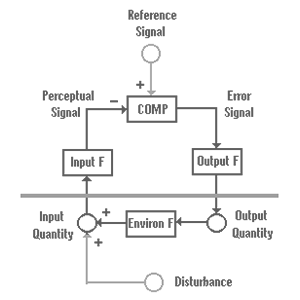
Perceptual control theory (PCT) is a model of behavior based on the principles of negative feedback (when the output of a system acts to oppose changes to the input of a system, acting to stabilize it). It differs in a number of respects from standard engineering control theory, which deals with the behavior of dynamical systems like feedback loops. From the PCT perspective, an organism controls neither its own behavior, nor external environmental variables, but rather its own perceptions.
According to the standard catch-phrase of the field, ‘behavior is the control of perception.’ While the adoption of PCT in the scientific community has not been widespread, it has been applied to a number of areas, and has led to a method of psychotherapy called the Method of Levels.
read more »
Posted in Health, Science, Technology |
Leave a Comment »
June 29, 2012

Control theory is an interdisciplinary branch of engineering and mathematics. It deals with the behavior of dynamical systems. The desired output of a system is called the reference. In a control system a controller manipulates the inputs to a system. In the control systems one or more output variables of a system need to follow a certain reference over time.
By manipulating the input, the controller wants to obtain the desired effect on the output of the system. The usual objective of a control theory is to calculate solutions for the proper corrective action from the controller that result in system stability, that is, the system will hold the set point and not oscillate around it.
read more »
Posted in Science, Technology |
Leave a Comment »
June 29, 2012


Cybernetics [sahy-ber-net-iks] is the theory of communication and control based on regulatory feedback. This is the original definition of the term; in popular culture the term refers to the study of cyborgs and robotic implants and prosthetics. Cybernetics is only applicable when the system being analyzed is involved in a closed signal loop; that is, where action by the system causes some change in its environment and that change is fed to the system via information (feedback) that enables the system to change its behavior.
A very simple model of cybernetics is that of a central heating system with four elements: a Sensor (to test the system’s environment); a Goal (the specification of the desired state of the system); Error Detection (a method for finding the difference between the present state and the goal state); and an Effector (operations the system can make to get the environment closer to the goal). A more complicated example is the Honda android ASIMO, which uses sensors and sophisticated algorithms to avoid obstacles and navigate stairs.
read more »
Posted in Health, Science, Technology |
Leave a Comment »
June 29, 2012
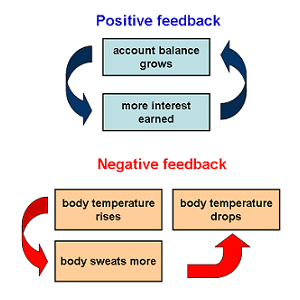
Negative feedback occurs when the output of a system acts to oppose changes to the input of a system, acting to stabilize it. The classic example is a central heating system which cuts off when a (suitably placed) temperature sensor hits a pre-set mark. The negative feedback part is the thermostat. Negative feedback is a basic concept of cybernetics (the theory of communication and control based on regulatory feedback in animals and machines).
In biology negative feedback is known as homeostasis (the property of a system, either open or closed, that regulates its internal environment and tends to maintain a stable, constant condition). Virtually all aspects of living systems involve homeostasis (e.g. blood pressure, glucose level, liver functions, cell division). The disruption of feedback loops can lead to undesirable results: in the case of blood glucose levels, if negative feedback fails, the glucose levels in the blood may begin to rise dramatically, thus resulting in diabetes.
read more »
Posted in Health, Science, Technology |
Leave a Comment »
June 29, 2012

Mirrored sunglasses are sunglasses with a reflective optical coating (called a mirror coating or flash coating) on the outside of the lenses to make them appear like small mirrors. The lenses typically give the wearer’s vision a brown or grey tint. The mirror coating decreases the amount of light passing through the tinted lens by a further 10–60%, making it especially useful for conditions of sand, water, snow, and higher altitudes.
Mirrored sunglasses are one-way mirrors. The color of the mirror coating is independent of the tint of the lenses. It is determined by the thickness and structure of the layer. Their popularity with police officers in the United States has earned them the nickname ‘cop shades.’ Characters in the cyberpunk genre frequently wear mirrorshades, and they are considered a hallmark of the subculture. Many characters in the movie series ‘The Matrix’ exclusively wear mirrored sunglasses, Morpheus in particular.
Posted in Art, Technology |
Leave a Comment »
June 28, 2012

OSx86 is a collaborative hacking project to run the Mac OS X computer operating system on non-Apple personal computers with x86 architecture and x86-64 compatible processors. The effort started soon after the 2005 Worldwide Developers Conference announcement that Apple would be transitioning its personal computers from PowerPC to Intel microprocessors. Apple uses a Trusted Platform Module, or TPM, to tie Mac OS to the systems it distributed to developers after announcing its switch to Intel’s chips. A computer built to run this type of Mac OS X is also known as a Hackintosh.
Hackintoshed notebook computers are also referred to as ‘Hackbooks.’ The Apple software license does not allow Mac OS X to be used on a computer that is not ‘Apple-branded.’ The legality of this form of tying is disputed. While the methods Apple uses to prevent Mac OS X from being installed on non-Apple hardware are protected from commercial circumvention in the United States by the DMCA, specific changes to the law regarding the concept of jailbreaking has thrown such and similar circumvention methods when carried out by end-users for personal use into a legal grey area.
Posted in Money, Politics, Technology |
Leave a Comment »
June 28, 2012

Asymmetric warfare is war between belligerents whose relative military power differs significantly, or whose strategy or tactics differ significantly. Such struggles often involve strategies and tactics of unconventional warfare (such as subversion and sabotage); the ‘weaker’ combatants use strategy to offset their deficiencies. Such strategies may not necessarily be militarized, involving combatants with widely varying degrees of training and support.
This is in contrast to symmetric warfare, where two powers have similar military forces and resources and rely on tactics that are similar overall, differing only in details and execution. The term is frequently used to describe what is also called ‘guerrilla warfare,’ ‘insurgency,’ and ‘terrorism’ (as well as ‘counterinsurgency’ and ‘counterterrorism’), essentially violent conflict between a formal military and an informal, poorly-equipped, but resilient opponent.
read more »
Posted in Technology, War, World |
Leave a Comment »
June 28, 2012

A sixteen-segment display, sometimes called a ‘Union Jack’ display (because it resembles the British Flag), is a type of display based on 16 segments. It is an extension of the more common seven-segment display, adding four diagonal and two vertical segments and splitting the three horizontal segments in half (A fourteen-segment display splits only the middle horizontal segment). A sixteen-segment display can have 65,536 different states; they were were originally designed to display alphanumeric characters (Latin letters and Arabic digits).
Later they were used to display Thai numerals and Persian characters. Before the advent of inexpensive dot-matrix displays, sixteen and fourteen-segment displays were some of the few options available for producing alphanumeric characters on calculators and other embedded systems. However, they are still sometimes used on VCRs, car stereos, microwave ovens, telephone Caller ID displays, and slot machine readouts.
Posted in Language, Technology, World |
Leave a Comment »
June 27, 2012

The M1911 is a .45 caliber pistol originally made by Colt, and is now the most copied pistol design in the world. It was made in the early 1900s and was used in World War I, World War II, The Korean War, and in the Vietnam War. It is semi-automatic and can fire a bullet each time the trigger is pulled. It can hold seven rounds inside its magazine and one more in the chamber. It was standard-issue side arm for the United States armed forces from 1911 to 1985 when it was replaced by the 9mm Beretta M9 (though the M1911 is still carried by some U.S. forces).
The M1911 is a common pistol design for police special teams because it is reliable in function, easy to modify by a gunsmith, and effective. The ‘1911’ in the name is because the pistol was adopted by the United States Army in the year 1911. M1911A1 pistols have an ‘A1’ added because they were changed from the original design in the 1920s in military service.
read more »
Posted in Money, Technology, War |
Leave a Comment »
June 26, 2012

Boombox is a colloquial expression for a portable music player with two or more loudspeakers. It is a device capable of receiving radio stations and playing recorded music (usually cassettes or CDs), usually at relatively high volume. Many models are also capable of recording (onto cassette) from radio and (sometimes) other sources. Designed for portability, most boomboxes can be powered by batteries, as well as by line current.
The first Boombox was developed by the inventor of the C-Cassette, Philips of the Netherlands. Their first ‘Radiorecorder’ was released in 1969. The Philips innovation was the first time that radio broadcasts could be recorded onto C-Cassette tapes without cables or microphones. Early sound quality of tape recordings was poor but as the C-Cassette technology evolved, with stereo recording, Chromium tapes and noise reduction, soon HiFi quality devices become possible. Several European electronics brands such as Grundig also introduced similar devices.
read more »
Posted in Art, Money, Technology |
Leave a Comment »



