April 19, 2012

The Beatnik Bandit is a custom car created in 1961 by ‘Big Daddy’ Ed Roth, originally as a project for ‘Rod & Custom magazine’; instead of a steering wheel, it was controlled by a joystick.
A Hot Wheels car was made based on the Beatnik Bandit. The car is a representation of ‘Kustom Kulture,’ a neologism used to describe the oeuvre of those who drove and built custom cars and motorcycles in the US from the 1950s through today.
Posted in Art, Technology |
Leave a Comment »
April 18, 2012

Food miles is a term which refers to the distance food is transported from the time of its production until it reaches the consumer. Food miles are one factor used when assessing the environmental impact of food, including the impact on global warming. The concept originated in the early 1990s in the UK. It was conceived by Professor Tim Lang, at the Sustainable Agriculture Food and Environment (SAFE) Alliance and first appeared in print in a report ‘The Food Miles Report: The dangers of long-distance food transport,’ by Angela Paxton.
Some scholars believe that an increase in the miles food travels is due to the globalization of trade; the focus of food supply bases into fewer, larger districts; drastic changes in delivery patterns; the increase in processed and packaged foods; and making fewer trips to the supermarket. At the same time, most of the greenhouse gas emissions created by food have their origin in the production phases, which create 83% of overall emissions of CO2.
read more »
Posted in Food, Politics, Technology |
Leave a Comment »
April 18, 2012

Rooftop farming is the practice of cultivating food on the rooftop of buildings. Rooftop farming is usually done using green roof, hydroponics, aeroponics, or air-dynaponics systems or container gardens. Besides using the already present space at the roof itself, additional platforms could possibly be created between high-rise buildings called ‘aero-bridges.’ Besides the decorative benefit, roof plantings may provide food, temperature control, hydrological benefits, and habitats for wildlife.
‘In an accessible rooftop garden, space becomes available for localized small-scale urban agriculture, a source of local food production.’ At Trent University in Ontario, there is currently a working rooftop garden which provides food to the student café and local citizens.
read more »
Posted in Food, Money, Technology |
Leave a Comment »
April 18, 2012

Vertical farming is a concept that argues that it is economically and environmentally viable to cultivate plant or animal life within skyscrapers, or on vertically inclined surfaces.
The idea of a vertical farm has existed at least since the early 1950s and built precedents are well documented by John Hix in his canonical text ‘The Glass House.’
read more »
Posted in Food, Money, Technology |
1 Comment »
April 18, 2012

A spectrum auction is a process whereby a government uses an auction system to sell the rights (licences) to transmit signals over specific bands of the electromagnetic spectrum and to assign scarce spectrum resources. Depending on the specific auction format used, a spectrum auction can last from a single day to several months from the opening bid to the final winning bid.
With a well-designed auction, resources are allocated efficiently to the parties that value them the most, the government securing revenue in the process. Spectrum auctions are a step toward market-based spectrum management, and are a way for governments to allocate scarce resources. Alternatives to auctions include administrative licensing, such as the comparative hearings conducted historically (sometimes referred to as ‘beauty contests’), or lotteries.
read more »
Posted in Money, Politics, Technology |
Leave a Comment »
April 17, 2012

Lorin Ashton, better known by the stage name Bassnectar, is a freeform electronic music and dubstep artist, DJ, and producer based in San Francisco. He is best known for his live performances, light shows, and community engagement. Bassnectar was originally influenced by heavy metal and grunge groups such as Metallica, Megadeth, and Nirvana, bringing these influences with him into his own musical career. He’s also mentioned that early IDM and Ambient artists like Orbital also played a major influence.
He has been creating genre-bending music since the 1990s, using a variety of programs such as Vision/OpCode, Reason, and Ableton Live. Bassnectar describes his music as amorphous and ever-changing, which is reflected in the distinct sounds and personalities of his numerous albums, EPs, and podcasts. He has collaborated with and remixed a host of artists and producers, including Lupe Fiasco, Ellie Goulding, Gogol Bordello, Sound Tribe Sector 9, Datsik, ill.Gates, and Jantsen, among others.
Posted in Art, Technology |
1 Comment »
April 13, 2012

Sager Midern Computer, Inc., is an American OEM (original equipment manufacturer) computer manufacturer specializing in laptop computers. Sager laptops are manufactured by Clevo which are also sold under many other brand names. Sager is the biggest Clevo retailer. In addition to selling physical hardware, Sager also offers support and repair services for all Clevo based Laptops. This service is offered even if the laptop was not ordered through Sager, although in that case the user must pay in full for all services provided.
The company was founded in 1985 by Shung Song Yuan in City of Industry, California. While ‘A-brands’ such as Dell, Toshiba, IBM, or HP are manufactured on a contract basis where so-called contract manufacturers assemble laptop computers as specified by the brand, Sager instead purchases finished and generic chassis designed and built by Original Design Manufacturers or ODMs (such as Clevo). Sager then assembles the laptop with parts chosen by the final customer, puts its logo on the chassis and sells them under the brand Sager. Sager then provides support to these computers.
Posted in Games, Money, Technology |
Leave a Comment »
April 13, 2012

Clevo is a Taiwanese OEM/ODM (original equipment and design manufacturer) computer manufacturer which exclusively produces laptop computers. They manufacture and sell complete laptops under their own brand; they also sell laptop chassis to other OEMs who build laptops on the chassis, often customized for each customer.
Companies which rebrand Clevo chassis or have in the past include Sager, iBuypower, and OriginPC. Alienware also used to sell rebranded Clevo notebooks, although it is unclear whether they still do.
Posted in Money, Technology, World |
Leave a Comment »
April 12, 2012
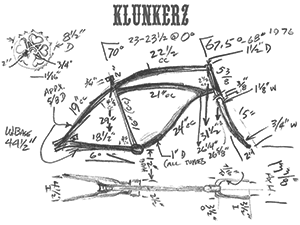

User innovation refers to innovation by intermediate users (e.g. user firms) or consumer users (individual end-users or user communities), rather than by suppliers (producers or manufacturers).
Eric von Hippel of MIT and others observed that many products and services are actually developed or at least refined, by users, at the site of implementation and use. These ideas are then moved back into the supply network. This is because products are developed to meet the widest possible need; when individual users face problems that the majority of consumers do not, they have no choice but to develop their own modifications to existing products, or entirely new products, to solve their issues. Often, user innovators will share their ideas with manufacturers in hopes of having them produce the product, a process called free revealing.
read more »
Posted in Money, Technology |
Leave a Comment »
April 12, 2012
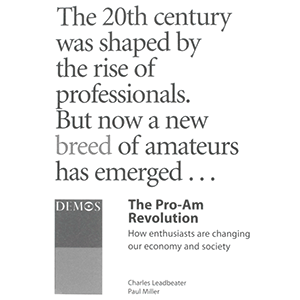
Amateur professionalism is a socioeconomic concept that describes a blurring of the distinction between professional and amateur within any endeavour or attainable skill that could be labelled professional, whether it is in the field of writing, computer programming, music, film, etc. The idea is distinct from the sports term ‘pro–am’ (professional–amateur), though related to and ultimately derived from it.
The concept and terms have been used, since 2004, as a descriptor for an emerging sociological and economic trend of ‘people pursuing amateur activities to professional standards,’ as described by Demos, a British think tank, in the 2004 book ‘The Pro-Am Revolution’ co-authored by eclectic writer Charles Leadbeater. Leadbeater has evangelized the idea (in ‘amateur professional’ order this time) by presenting it at TEDGlobal 2005.
read more »
Posted in Games, Money, Technology |
Leave a Comment »
April 12, 2012

Good Copy Bad Copy is a documentary about copyright and culture in the context of Internet, peer-to-peer file sharing and other technological advances, directed by Andreas Johnsen, Ralf Christensen, and Henrik Moltke. It features interviews with copyright lawyers, producers, artists, and filesharing service providers.
A central point of the documentary is that ‘creativity itself is on the line’ and that a balance needs to be struck, or that there is a conflict, between protecting the right of those who own intellectual property and the rights of future generations to create. Artists interviewed include Girl Talk and Danger Mouse, popular musicians of the mashup scene who cut and remix sounds from other songs into their own. The interviews with these artists reveal an emerging understanding of digital works and the obstacle to their authoring copyright presents.
read more »
Posted in Money, Politics, Technology |
1 Comment »
April 11, 2012

Vidding is the fan labor practice in media fandom of creating music videos from the footage of one or more visual media sources, thereby exploring the source itself in a new way. The creator may explore a single character, support a particular romantic pairing between characters, criticize or celebrate the original text, or point out an aspect of the TV show or film that they find under-appreciated. The creators refer to themselves as ‘vidders,’ their product as ‘vids,’ ‘fanvids,’ or ‘songvids,’ and the act itself as ‘vidding.’
Vidding can occur within a fandom; however, it is also often considered its own fandom, as vidding fans will often watch vids simply because they are vids. (This is distinct from fan fiction readers and other fans, for instance, who tend to choose what to engage based on source text more than form.) Accordingly, vidding has its own dedicated fan convention, Vividcon. Fan videos within the world of anime fandom are distinct from the videos created by vidders. A fan-made music video using anime footage fans is called an anime music video or AMV, not a fanvid. While a large number of anime video makers are male, the bulk of vidders in media fandom are women.
read more »
Posted in Art, Money, Technology |
1 Comment »