March 19, 2012
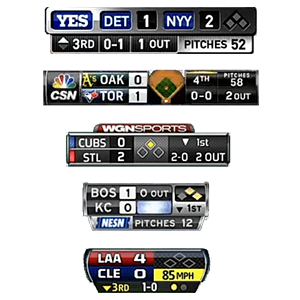
A score bug (or, in an expanded form, a score banner or scorebar) is a digital on-screen graphic which is displayed at either the top or lower third bottom of a television screen during the broadcast of a sports game in order to display the current score and other statistics. The first television network in the United States to produce a score bug (digital on-screen graphic) was ABC, which used one on the telecast of the 1994 Purolator 500 NASCAR event. A transparent digit counted down the number of laps remaining in the race.
ABC also incorporated the Sports Bug for their 1994 World Cup coverage, providing the time and score on the game as well as enabling advertiser sponsorship to broadcast games without interruptions. Later that fall, Fox introduced a full-score bug for its NFL coverage, known as the ‘FoxBox,’ as did cable network ESPN. ABC expanded theirs to ‘Monday Night Football’ in 1997. CBS introduced theirs upon returning to the NFL in the fall of 1998, and NBC in 2001 during its coverage of the XFL.
Posted in Games, Money, Technology |
Leave a Comment »
March 17, 2012
Okayplayer is an online hip-hop and alternative music website and community. The group was co-founded by The Roots’ drummer Ahmir ‘Questlove’ Thompson as a loose musical collective in 1987, and evolved into an online community in 1999. In 2004, Questlove launched Okayplayer Records as a spin-off of the community, in partnership with Decon. The community is made up of recording artists (who keep their official internet homes there) and message board users. Artists and staff, as well as those who post to the site’s message board, call themselves ‘okayplayers’ or ‘OKPs.’
Okayplayer has been identified as an online community that allows people to bypass traditional media. An example of such a collaboration fostered by the site is the Foreign Exchange project, with Little Brother’s vocalist Phonte Coleman and Dutch producer named Nicolay meeting on Okayplayer, and making an album together by sending tracks and verses back and forth over the Internet. The album, ‘Connected,’ was released before the pair had met in real life. Okayplayer organize regular tours and an annual ‘Roots Picnic’ all day event. Okayplayer artists include: The Roots, Mos Def, Lupe Fiasco, Common, Erykah Badu, India.Arie, and RJD2.
Posted in Art, Technology |
Leave a Comment »
March 17, 2012


reCAPTCHA is a system originally developed at Carnegie Mellon University’s main Pittsburgh campus, and aquired by Google in 2009. It uses CAPTCHA (Completely Automated Public Turing test to tell Computers and Humans Apart) to help digitize the text of books while protecting websites from bots attempting to access restricted areas. reCAPTCHA is currently digitizing the archives of ‘The New York Times’ and books from Google Books.
reCAPTCHA supplies subscribing websites with images of words that optical character recognition (OCR) software has been unable to read. The subscribing websites present these images for humans to decipher as CAPTCHA words, as part of their normal validation procedures. They then return the results to the reCAPTCHA service, which sends the results to the digitization projects. The reCAPTCHA program originated with Guatemalan computer scientist Luis von Ahn, aided by a MacArthur Fellowship. An early CAPTCHA developer, he realized ‘he had unwittingly created a system that was frittering away, in ten-second increments, millions of hours of a most precious resource: human brain cycles.’
Posted in Language, Technology |
Leave a Comment »
March 16, 2012
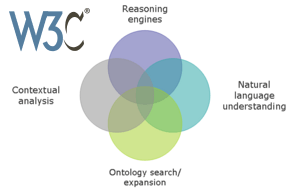

Semantic search seeks to improve search accuracy by understanding searcher intent and the contextual meaning of terms as they appear in the searchable dataspace, whether on the Web or within a closed system, to generate more relevant results. There are two major forms of search: Navigational and Research. In navigational search, the user is using the search engine as a navigation tool to navigate to a particular intended document.
Semantic Search is not applicable to navigational searches. In Research Search, the user provides the search engine with a phrase which is intended to denote an object about which the user is trying to gather/research information. There is no particular document which the user knows about that he is trying to get to. Rather, the user is trying to locate a number of documents which together will give him the information he is trying to find. Semantic Search lends itself well here.
read more »
Posted in Language, Science, Technology |
Leave a Comment »
March 16, 2012

Roku [roh-koo] is an American, privately-held, consumer electronics company that sells home digital media products. The company is based in California, and was founded in 2002, by ReplayTV founder Anthony Wood. ‘Roku’ means ‘six’ in Japanese, a reference to the six companies Wood has launched. Their current product is the ‘Roku 2’ series of digital video players (DVP).
Content on the Roku DVP is provided by Roku partners, and are identified using the ‘channel’ vernacular. Each channel supports content from one partner (though some content partners have more than one channel). Premium channels include Netflix, HBO Go, Hulu Plus, EPIX, and Amazon Instant Video. Users can add or remove different channels from the Roku Channel Store. Both on-demand content and live streaming are supported by the devices. For live TV streams, Roku supports Apple HLS (HTTP Live Streaming) adaptive streaming technology.
Posted in Money, Technology |
Leave a Comment »
March 16, 2012
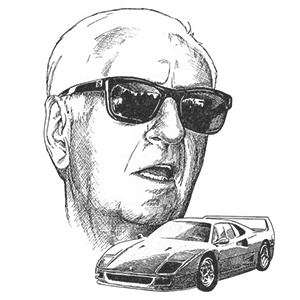
Enzo Ferrari (1898 – 1988) was an Italian race car driver and entrepreneur, the founder of the Scuderia Ferrari Grand Prix motor racing team, and subsequently of the Ferrari car manufacturer.
He was often referred to as ‘il Commendatore.’ Ferrari’s management style was autocratic and he was known to pit driver against driver in the hope of improving performance. He did not often get close to his drivers. Enzo Ferrari spent a reserved life, and rarely granted interviews.
read more »
Posted in Games, Money, Technology |
1 Comment »
March 14, 2012

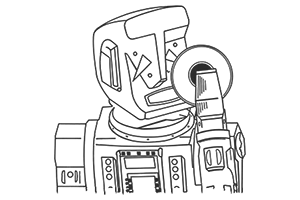
A superintelligence is a hypothetical entity which possesses intelligence surpassing that of any existing human being. Superintelligence may also refer to the specific form or degree of intelligence possessed by such an entity. The highest ranges of Intelligence are evaluative. The possibility of superhuman intelligence is frequently discussed in the context of artificial intelligence. Increasing natural intelligence through genetic engineering or brain-computer interfacing is a common motif in futurology and science fiction.
Collective intelligence is often regarded as a pathway to superintelligence or as an existing realization of the phenomenon. Superintelligence is defined as an ‘intellect that is much smarter than the best human brains in practically every field, including scientific creativity, general wisdom and social skills.’ The definition does not specify the means by which superintelligence could be achieved: whether biological, technological, or some combination. Neither does it specify whether or not superintelligence requires self-consciousness or experience-driven perception.
read more »
Posted in Technology |
Leave a Comment »
March 14, 2012
Omega Point is a term coined by the French Jesuit Pierre Teilhard de Chardin (1881–1955) to describe a maximum level of complexity and consciousness towards which he believed the universe was evolving.
In this theory, developed by Teilhard in ‘The Future of Man’ (1950), the universe is constantly developing towards higher levels of material complexity and consciousness, a theory of evolution that Teilhard called the Law of Complexity/Consciousness. For Teilhard, the universe can only move in the direction of more complexity and consciousness if it is being drawn by a supreme point of complexity and consciousness.
read more »
Posted in Language, Philosophy, Technology |
Leave a Comment »
March 14, 2012

In futures studies and the history of technology, accelerating change is a perceived increase in the rate of technological (and sometimes social and cultural) progress throughout history, which may suggest faster and more profound change in the future. While many have suggested accelerating change, the popularity of this theory in modern times is closely associated with various advocates of the technological singularity (the emergence of greater-than-human intelligence through technological means), such as Vernor Vinge and Ray Kurzweil.
In 1938, Buckminster Fuller introduced the word ephemeralization to describe the trends of ‘doing more with less’ in chemistry, health and other areas of industrial development. In 1946, Fuller published a chart of the discoveries of the chemical elements over time to highlight the development of accelerating acceleration in human knowledge acquisition. In 1958, Stanisław Ulam wrote in reference to a conversation with John von Neumann: One conversation centered on the ever accelerating progress of technology and changes in the mode of human life, which gives the appearance of approaching some essential singularity in the history of the race beyond which human affairs, as we know them, could not continue.’
read more »
Posted in Science, Technology, World |
Leave a Comment »
March 14, 2012

Metcalfe’s law states that the value of a telecommunications network is proportional to the square of the number of connected users of the system. First formulated in this form by George Gilder in 1993, and attributed to Robert Metcalfe in regard to Ethernet, Metcalfe’s law was originally presented, circa 1980, not in terms of users, but rather of ‘compatible communicating devices’ such as telephones.
Only more recently with the launch of the internet did this law carry over to users and networks, in line with its original intent. The law has often been illustrated using the example of fax machines: a single fax machine is useless, but the value of every fax machine increases with the total number of machines in the network, because the total number of people with whom each user may send and receive documents increases. Likewise, in social networks, the greater number of users with the service, the more valuable the service becomes to the community.
Posted in Money, Technology, World |
Leave a Comment »
March 13, 2012
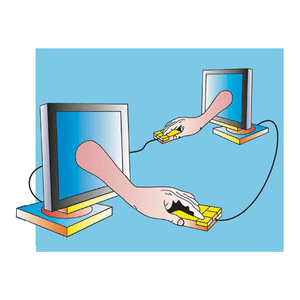
Reversible computing is a model of computing where the computational process to some extent is reversible, i.e., time-invertible. There are two major, closely related, types of reversibility that are of particular interest for this purpose: physical reversibility and logical reversibility. A process is said to be physically reversible if it results in no increase in physical entropy; it is isentropic.
These circuits are also referred to as charge recovery logic or adiabatic computing. Although in practice no nonstationary physical process can be exactly physically reversible or isentropic, there is no known limit to the closeness with which we can approach perfect reversibility. The motivation for the study of technologies aimed at actually implementing reversible computing is that they offer what is predicted to be the only potential way to improve the energy efficiency of computers beyond the fundamental von Neumann-Landauer limit.
read more »
Posted in Science, Technology |
1 Comment »
March 13, 2012

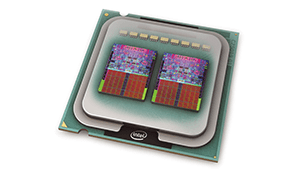
A multi-core CPU is a single computing component with two or more independent actual processors (called ‘cores’), which are the units that read and execute program instructions. Multiple cores can run multiple instructions at the same time, increasing overall speed for programs amenable to parallel computing.
Processors were originally developed with only one core. After a certain point, multi-processor techniques are no longer efficient, largely because of issues with congestion in supplying instructions and data to the many processors. The threshold is roughly in the range of several tens of cores; above this threshold network on chip technology is advantageous. Tilera processors feature a switch in each core to route data through an on-chip mesh network to lessen the data congestion, enabling their core count to scale up to 100 cores.
read more »
Posted in Money, Technology |
Leave a Comment »



