March 23, 2012

Perceptual adaptation is the means by which the brain accounts for the differences that the subject may witness, particularly alternations in the visual field. For example, if an individual’s visual field is altered forty five degrees left, the brain accounts for the difference allowing the individual to function normally. The brain plays a crucial role in the inner workings of vision. The world that one perceives is processed via the brain. Images sensed through the eyes is relayed to the visual cortex of the brain, and if vision is altered slightly, the brain accounts for the difference and will allow one to perceive the world as ‘normal.’ Over time, the brain processes even acute difference as normal.
Psychologist George M. Stratton was intrigued by the idea of perceptual adaptation. Because the retina receives images upside down, he was intrigued to see what happens when the brain receives an image that is right side up. Stratton conducted experiments in the 1890s in which he wore a reversing telescope for 21½ hours over three days. To his disappointment, his vision was unchanged. After removing the glasses, ‘normal vision was restored instantaneously and without any disturbance in the natural appearance or position of objects.’ Determined to find results, Stratton wore the telescoping glasses for eight days straight. By day four, his vision was upright (not inverted). However on day five, images appeared upright until he concentrated on them; then they became inverted again.
Posted in Health, Science, Technology |
Leave a Comment »
March 21, 2012

Pirate radio is illegal or unregulated radio transmission. The term is most commonly used to describe illegal broadcasting for entertainment or political purposes, but is also sometimes used for illegal two-way radio operation.
Its etymology can be traced to the unlicensed nature of the transmission, but historically there has been occasional but notable use of sea vessels – fitting the most common perception of a pirate – as broadcasting bases.
read more »
Posted in Money, Politics, Technology |
Leave a Comment »
March 20, 2012


A walled garden is an analogy used in various senses in information technology. In the telecommunications and media industries, a ‘walled garden’ refers to a carrier or service provider’s control over applications, content, and media on platforms (such as mobile devices) and restriction of convenient access to non-approved applications or content. For example, in telecommunications, the services and applications accessible on any device on a given wireless network were historically tightly controlled by the mobile operators. The mobile operators determined which applications from which developers were available on a device’s home portal or home page. This has long been a central issue constraining the telecommunications sector, as developers face huge hurdles in getting their applications onto devices and into the hands of end-users.
More generally, a ‘walled garden’ refers to a closed or exclusive set of information services provided for users. This is in contrast to giving consumers unrestricted access to applications and content. Similar to a ‘real’ walled garden, a user in a walled garden is unable to escape this area unless it is through the designated entry/exit points or the walled garden is removed. Removing the walled garden is typically done by complying with the terms of removal, such as updating firmware, registering an account, or cleaning machine from infected files.
Posted in Money, Technology |
Leave a Comment »
March 20, 2012

The SynthAxe is a fretted, guitar-like MIDI controller, created by Bill Aitken, Mike Dixon, and Tony Sedivy and manufactured in England in the 1980s. It uses electronic synthesizers to produce sound and is controlled through the use of an arm resembling the neck of a guitar in form and in use.
The neck of the instrument is angled upwards from the body, and there are two independent sets of strings. The fretboard is continuously scanned and sends signals to synthesizers which produce the sound. The left set determine the pitch played, through contact with the frets on the neck and by sensing the side-to-side bending of the string. The right set of strings are velocity sensitive; these strings can be plucked, strummed or damped in the same manner as a guitar’s. A keyboard made up of nine keys can also be used to trigger notes instead of the strings. An electronic tremolo bar can be used for standard whammy bar effects, or can be redefined to produce different MIDI output (e.g., filter cutoffs, volume, etc).
Posted in Art, Money, Technology |
Leave a Comment »
March 20, 2012

Let It Be… Naked is a remixed and edited version of the 1970 ‘Let It Be album’ by The Beatles released in 2003. The album is presented in a form which Paul McCartney considers closer to its original artistic vision: to ‘get back’ to the rock and roll sound of their early years rather than the orchestral overdubs and embellishments which were added by Phil Spector in the production of the final ‘Let It Be’ album.
McCartney in particular was always dissatisfied with the ‘Wall of Sound’ production style of the Phil Spector remixes, especially for his song ‘The Long and Winding Road,’ which he believed was ruined by the process. George Harrison gave his approval for the Naked project before he died. McCartney’s attitude contrasted with Lennon’s from over two decades earlier. In his 1971 interview with Rolling Stone magazine, Lennon had defended Spector’s work, saying, ‘He was given the shittiest load of badly recorded shit with a lousy feeling to it ever, and he made something of it.’
read more »
Posted in Art, Technology |
Leave a Comment »
March 20, 2012

The Wall of Sound is a music production technique for pop and rock music recordings developed by record producer Phil Spector at Gold Star Studios in Los Angeles during the early 1960s. Working with such audio engineers as Larry Levine and the session musicians who became known as The Wrecking Crew, Spector created a dense, layered, reverberant sound that came across well on AM radio and jukeboxes popular in the era. He created this sound by having a number of electric and acoustic guitarists perform the same parts in unison, adding musical arrangements for large groups of musicians up to the size of orchestras, then recording the sound using an echo chamber.
To attain Spector’s signature sound, his arrangements called for large ensembles (including some instruments not generally used for ensemble playing, such as electric and acoustic guitars), with multiple instruments doubling many of the parts to create a fuller, richer sound. Spector also included orchestral instruments – strings, woodwind, brass and percussion – not previously associated with youth-oriented pop music. Spector himself called his technique ‘a Wagnerian approach to rock & roll: little symphonies for the kids.’
read more »
Posted in Art, Money, Technology |
Leave a Comment »
March 20, 2012

A talk box is an effects unit that allows a musician to modify the sound of a musical instrument. The musician controls the modification by lip syncing, or by changing the shape of the mouth. The effect can be used to shape the frequency content of the sound and to apply speech sounds (in the same way as singing) onto a musical instrument, typically a guitar (its non-guitar use is often confused with the vocoder) and keyboards.
A talk box is usually an effects pedal that sits on the floor and contains a speaker attached with an airtight connection to a plastic tube; however, it can come in other forms, such as the ‘Ghetto Talkbox’ (a crude homemade version). The speaker is generally in the form of a compression driver, the sound-generating part of a horn loudspeaker with the horn replaced by the tube connection.
read more »
Posted in Art, Technology |
Leave a Comment »
March 20, 2012

Auto-Tune is an audio processor created by Antares Audio Technologies, which uses proprietary software to alter pitch in vocal and instrumental performances. It was originally intended to disguise off-key inaccuracies, allowing vocal tracks to be perfectly tuned despite originally being slightly off-key. The processor slightly blends pitches to the nearest true semitone (to the exact pitch of the nearest tone in traditional equal temperament). Auto-Tune can also be used as an effect to distort the human voice when pitch is raised or lowered significantly. The overall effect to the discerning ear can be described as hearing the voice leap from note to note stepwise, like a synthesizer.
Auto-Tune was initially created by Andy Hildebrand, an engineer working for Exxon. Hildebrand developed methods for interpreting seismic data and subsequently realized that the technology could be used to detect, analyze, and modify pitch. Auto-Tune was used to produce the prominent altered vocal effect on Cher’s ‘Believe.’ Recorded in 1998, ‘Believe’ was the first commercial recording to use the software for this purpose. In an early interview, the producers claimed that they had used a Digitech Talker FX pedal, in an attempt to preserve a trade secret. After the success of the single, the technique became known as the ‘Cher Effect.’ The use of Auto-Tune as a musical effect was revived in the late-2000s by R&B singer T-Pain, who elaborated on the effect and made active use of Auto-Tune in his songs.
Posted in Art, Money, Technology |
Leave a Comment »
March 20, 2012
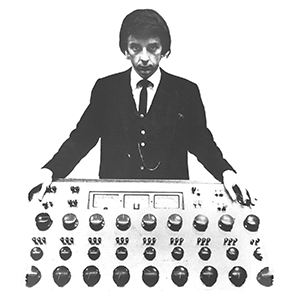
Overproduction is the excessive use of audio effects, layering, or digital manipulation in music production. Common traits include: audio processing effects such as reverb, delay, or dynamic range compression; heavy layering or multi-tracking (in the context of pop and rock music, this may refer to the addition of elements such as chorused vocals or backing strings).
Other modifications include pitch correction, time correction, and quantization (correcting to perfect notes). Records are sometimes overseen by a producer who ‘imposes’ his or her own distinctive ‘sound’ or techniques on a band or artist (producers frequently accused of this kind of ‘overproduction’ include Phil Spector and Mutt Lange). The term ‘overproduction’ implies that a producer or mastering engineer has made ‘unnecessary’ additions or changes to a record in the production process, and in doing so has decreased the quality or enjoyability of the music.
Posted in Art, Money, Technology |
Leave a Comment »
March 20, 2012
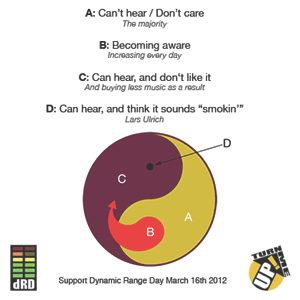
The loudness war is a pejorative term for the apparent competition to digitally master and release recordings with increasing loudness. Older music typically has a very diverse dynamic, that is, there are quiet parts of the track and much louder parts. For example, acoustic interludes leading up to the body of a song might be produced at a very quiet level, with some of the loudest sounds being snare drums and other kinds of percussion.
While the rationale for the loudness war is often described as an attempt to make the quieter parts of music more accessible to a listener, the overall effect is that that dynamic between sounds becomes leveled out, with no sound standing out from the track as a much louder sound. This results in a loss of clarity, where it’s no longer possible to experience music as a distinct interplay of louder and quieter parts.
read more »
Posted in Art, Money, Technology |
Leave a Comment »
March 20, 2012


A needle drop is a common term used to describe a version of a music album that has been transferred from a vinyl record to digital audio or other formats. Needle drops are sometimes traded among music collectors, especially when the original vinyl recording has not been released officially on a subsequent consumer format.
Other reasons for trading needle drops include the lack of availability of certain recordings on digital media, the non-availability of less compressed versions in digital form, or the lack of availability of certain versions or mixes of that record, e.g. mono or stereo versions, or the loss of the master tape. The term is thought to have been coined in 1949 by recording engineer Peter Goldmark during the first rush of transfers of lacquer and 78 rpm records to the then-new long playing 33 ⅓ RPM format.
Posted in Art, Technology |
Leave a Comment »
March 19, 2012
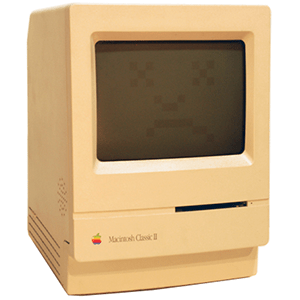
Screen burn-in, or ghost image, is a permanent discoloration of areas on an electronic display such as a cathode ray tube (CRT) display or computer display monitor or television set caused by cumulative non-uniform usage of the pixels. With phosphor-based electronic displays (for example CRT-type computer monitors or plasma displays), non-uniform use of pixels, such as prolonged display of non-moving images (text or graphics), gaming, or certain broadcasts with tickers and flags, can create a permanent ghost-like image of these objects or otherwise degrade image quality.
This is because the phosphor compounds which emit light to produce images lose their luminance with use. Uneven usage results in uneven light output over time, and in severe cases can create a ghost image of previous content. Even if ghost images are not recognizable, the effects of screen burn are an immediate and continual degradation of image quality.
read more »
Posted in Technology |
1 Comment »



