February 25, 2012

Moneybomb is a neologism coined in 2007 to describe a grassroots fundraising effort over a brief fixed time period, usually to support a candidate for election by dramatically increasing, concentrating, and publicizing fundraising activity during a specific hour or day. The term was first applied to a supporter-led fundraiser on behalf of presidential candidate Ron Paul.
The effort combines traditional and Internet-based fundraising appeals focusing especially on viral advertising through online vehicles such as YouTube, Facebook, and online forums. In the case of lesser-known candidates it is also intended to generate significant free mass media coverage the candidate would otherwise not receive. The term has also been used as a verb and apparently arose from analogy with the neologism ‘googlebomb,’ a method of search engine optimization.
Posted in Money, Politics, Technology |
Leave a Comment »
February 21, 2012

The Beginning of Infinity is a popular science book by physicist David Deutsch that was published in 2011. Deutsch views the enlightenment of the 18th century as near the beginning of an infinite sequence of purposeful knowledge creation. Knowledge here consists of information with good explanatory function that is resistant to falsifiability. Any real process physically possible is able to be performed provided the knowledge to do so has been acquired.
The enlightenment set up the conditions for knowledge creation which disrupted the static societies that previously existed. These conditions are the valuing of creativity and the free and open debate that exposed ideas to criticism to reveal those good explanatory ideas that naturally resist being falsified due to their having basis in reality. Deutsch points to previous moments in history, such as Renaissance Florence and Plato’s Academy in Golden age Athens, where this process almost got underway before succumbing to their static societies’ resistance to change.
read more »
Posted in Language, Science, Technology |
1 Comment »
February 21, 2012

The Turing test is a test to see if a computer can trick a person into believing that the computer is a person too. Alan Turing thought that if a human could not tell the difference between another human and the computer, then that computer must be as intelligent as a human. No one has made a computer that can pass the Turing test. A chatterbot called Elbot came close in 2008. The test was introduced by Alan Turing in his 1950 paper ‘Computing Machinery and Intelligence,’ which opens with the words: ‘I propose to consider the question, ‘Can machines think?” Since ‘thinking’ is difficult to define, Turing chooses to ‘replace the question by another, which is closely related to it and is expressed in relatively unambiguous words’:
‘Are there imaginable digital computers which would do well in the imitation game?’ (a party game in which a man and a woman go into separate rooms and guests try to tell them apart by writing a series of questions and reading the typewritten answers sent back; both the man and the woman aim to convince the guests that they are the other). This question, Turing believed, is one that can actually be answered. In the remainder of the paper, he argued against all the major objections to the proposition that ‘machines can think.’ In the years since 1950, the test has proven to be both highly influential and widely criticized, and it is an essential concept in the philosophy of artificial intelligence.
read more »
Posted in Games, Language, Technology |
Leave a Comment »
February 21, 2012

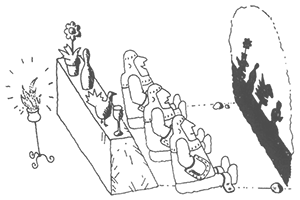
Simulated reality is the proposition that reality could be simulated—perhaps by computer simulation—to a degree indistinguishable from ‘true’ reality. It could contain conscious minds which may or may not be fully aware that they are living inside a simulation.
This is quite different from the current, technologically achievable concept of virtual reality. Virtual reality is easily distinguished from the experience of actuality; participants are never in doubt about the nature of what they experience. Simulated reality, by contrast, would be hard or impossible to separate from ‘true’ reality.
read more »
Posted in Philosophy, Technology, World |
3 Comments »
February 21, 2012

‘Slaves to Armok: God of Blood, Chapter II: Dwarf Fortress,’ most commonly known simply as Dwarf Fortress, is a freeware video game by Bay 12 Games for Microsoft Windows, Linux, and Mac OS X set in a high fantasy universe that combines aspects of roguelike (a sub-genre of role-playing video games, characterized by randomization for replayability, permanent death, and turn-based movement) and city-building games.
It is primarily known for its unique level of complexity and difficulty. The title of the game is inspired by its primary focus on the construction, management, and exploration of dwarven fortresses within the game world. Development started in 2002; the game’s first public release was in 2006.
read more »
Posted in Art, Games, Technology |
Leave a Comment »
February 21, 2012

Electronica includes a wide range of contemporary electronic music designed for a wide range of uses, including listening, dancing, and background music for other activities. Unlike electronic dance music, which is sub-genre in the category, all examples of electronica are not necessarily made for dancing. Genres such as techno, drum and bass, downtempo, and ambient are among those encompassed by the umbrella term, entering the American mainstream from ‘alternative’ or ‘underground’ venues during the late 1990s.
With newly prominent music styles such as reggaeton, and subgenres such as electroclash, indie pop, and favela funk, electronic music styles in the current decade are seen to permeate nearly all genres of the mainstream and indie landscape such that a distinct ‘electronica’ genre of pop music is rarely noted.
read more »
Posted in Art, Language, Technology |
1 Comment »
February 18, 2012

The Limits to Growth is a 1972 book modeling the consequences of a rapidly growing world population and finite resource supplies, commissioned by the Club of Rome (a global think tank) and firstly presented at the 3. St. Gallen Symposium (an annual conference taking place at the University of St. Gallen in Switzerland, aimed at fostering intergenerational and intercultural dialogue between the decision makers of today and tomorrow). The book echoes some of the concerns and predictions of the Reverend Thomas Robert Malthus in ‘An Essay on the Principle of Population’ (1798).
Its authors were Donella H. Meadows, Dennis L. Meadows, Jørgen Randers, and William W. Behrens III. The book used World3, a computer model to simulate the consequence of interactions between the Earth’s and human systems. Five variables were examined in the original model, on the assumptions that exponential growth accurately described their patterns of increase, and that the ability of technology to increase the availability of resources grows only linearly. These variables are: world population, industrialization, pollution, food production and resource depletion.
read more »
Posted in Politics, Technology, World |
Leave a Comment »
February 18, 2012

‘In the Year 2525 (Exordium and Terminus)’ is a hit song from 1969 by American pop-rock duo Zager and Evans. It opens with the words ‘In the year 2525, If man is still alive, If woman can survive, They may find…’ Subsequent verses pick up the story at 1,010-year intervals from 2525 to 6565. Disturbing predictions are given for each selected year. In the year 3535, for example, all of a person’s actions, words and thoughts will be preprogrammed into a daily pill. Then the pattern as well as the music changes, going up a half step in the key of the song, after two stanzas, first from A flat minor, to A minor, and, then, finally, to B flat minor, and verses for the years 7510, 8510 and 9595 follow.
The overriding theme, of a world doomed by its passive acquiescence to and overdependence on its own overdone technologies, struck a resonant chord in millions of people around the world in the late 1960s. The song describes a nightmarish vision of the future as man’s technological inventions gradually dehumanize him. It includes a colloquial reference to the Second Coming (In the year 7510, if God’s a-coming, He ought to make it by then.), which echoed the zeitgeist of the Jesus Movement.
Posted in Art, Politics, Technology |
1 Comment »
February 17, 2012
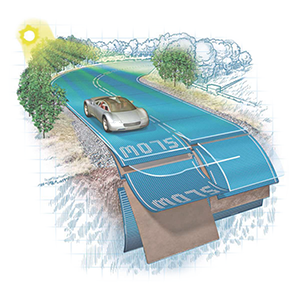
A solar roadway is a road surface, that generates electricity by solar photovoltaics. One current proposal is for panels including solar panels and LED signage, that can be driven on. Parking lots, driveways, and eventually highways are all targets for the panels. If the entire United States Interstate Highway system were surfaced with Solar Roadways panels, it would produce more than three times the amount of electricity currently used nationwide.
The United States Department of Transportation awarded Solar Roadways Incorporated a $100,000 research contract in 2009. This Small Business Innovation Research (SBIR) contract enabled Solar Roadways to prototype Solar Road Panels. After successful completion of the Phase I SBIR contract, it was awarded it a follow-up $750,000 Phase II contract to take it to the next step: a solar parking lot. Constructed out of multiple 12′ x 12′ panels, this smart parking lot will also warm itself in cold weather to melt away snow and ice.
read more »
Posted in Money, Politics, Technology |
1 Comment »
February 17, 2012

VitaliV (or ‘Vitali V,’ real name Vitali Vinogradov) is a Soviet-born painter and sculptor now living in the United Kingdom, who has developed an artistic style based on the designs of computer microchips. Some works have been laser-cut in relief and then hand-painted as 3D objects.
His style, ‘Via Art,’ was created in the late 90’s while attempting to imprint an unusual, digital circuit-like pattern upon jewelry. In appreciation of the simplicity and logic of digital circuits, the artist decided to use the pattern as the structural basis for a new style. The following decade led to the creation of over 1000 designs including jewelry, furniture sketches, fashion collections, and hundreds of porcelain wares. The essence of the Via Art style are simple geometrical patterns—circles and lines connected at 45° angles.
Posted in Art, Technology |
2 Comments »
February 16, 2012

The three individuals most closely associated with the birth of Detroit techno as a genre are Juan Atkins, Kevin Saunderson and Derrick May, also known as ‘The Belleville Three.’ High school friends from Belleville, Michigan, the trio created electronic music tracks in their basement(s). Eventually, they were in demand at local dance clubs, thanks in part to seminal Detroit radio personality ‘The Electrifying Mojo.’
Ironically, Derrick May once described Detroit techno music as being a ‘complete mistake…like George Clinton and Kraftwerk caught in an elevator, with only a sequencer to keep them company.’ The location of Belleville was key to the formation of the three as musicians. Because the town was still ‘pretty racial at the time,’ according to Saunderson, ‘we three kind of gelled right away.’
read more »
Posted in Art, Technology |
1 Comment »
February 16, 2012

Kraftwerk (German: ‘power plant’ or ‘power station’) is an influential electronic music band from Germany. The group was formed by Ralf Hütter and Florian Schneider in 1970, and was fronted by them until Schneider’s departure in 2008. The signature Kraftwerk sound combines driving, repetitive rhythms with catchy melodies, mainly following a Western Classical style of harmony, with a minimalistic and strictly electronic instrumentation.
The group’s simplified lyrics are at times sung through a vocoder or generated by computer-speech software. Kraftwerk were one of the first groups to popularize electronic music and are considered pioneers in the field. In the 1970s and early 1980s, Kraftwerk’s distinctive sound was revolutionary, and has had a lasting effect across many genres of modern music.
read more »
Posted in Art, Technology, World |
Leave a Comment »




