February 16, 2012

‘Trans-Europe Express‘ is the title track of Kraftwerk’s 1977 album of the same name, and released as a single at the time. The music was written by Ralf Hütter, and the lyrics by Hütter and Florian Schneider. The track is ostensibly about the Trans Europ Express rail system, with technology and transport both being common themes in Kraftwerk’s ouvre. The track has since found further influence, both in hip-hop by its interpolation by Afrika Bambaata (via Arthur Baker) on the seminal ‘Planet Rock’ and by modern experimental bands such as the electroclash bands of the early 2000s.
The musical elements of the suite have been described as having a haunting theme with ‘deadpan chanting of the title phrase’ which is ‘slowly layered over that rhythmic base in much the same way that the earlier ‘Autobahn’ was constructed.’ The song’s lyrics reference the album Station to Station and meeting with musicians Iggy Pop and David Bowie. Hütter and Schneider had previously met up with Bowie in Germany and were flattered with the attention they received from him. Ralf Hütter was interested in Bowie’s work as he had been working with Iggy Pop, who was the former lead singer of the Stooges; one of Hütter’s favorite groups.
Posted in Art, Technology, World |
Leave a Comment »
February 16, 2012


8-Bit Operators: The Music of Kraftwerk was released in 2007 by the group 8-Bit Operators on Kraftwerk’s US homelabel Astralwerks and EMI Records worldwide. It features cover versions of Kraftwerk songs by several prominent chiptune artists. Inspiration for the project as quoted by Jeremy Kolosine (credited as Executive Producer of the release, and noted founder of the early 80’s electronic group Futurisk and chipmusic band Receptors.) ‘Well the first thing that comes to my mind when I saw a gameboy show was Kraftwerk’s Computer World Tour from 1981, where four of them played various handheld devices during the song ‘Pocket Calculator.’ Plus it came up in a print from a Glomag quote, and an 8 Bit Weapon April Fool’s joke that backfired.’
This Kraftwerk covers compilation was somewhat unique in the fact that Kraftwerk’s Ralf Hütter selected the final track line-up, ‘So Jeremy was a little nervous when meeting Kraftwerk’s Ralf Hütter after a concert by the group in New York last year. He passed along to him a sample of the compilation. Later Hutter said he enjoyed it and even offered some editing suggestions.’ In a subsequent interview, when asked about the 8-Bit Operators release, Ralf Hütter responded, ‘It is mind stimulating, the minimum/maximum coming from sound levels and thoughts and ideas. Like ‘Autobahn’ and ‘Trans-Europe Express’ are very basic and elementary ideas, but they offer a pattern or concept for improvisation.’
Posted in Art, Technology |
Leave a Comment »
February 16, 2012

The Blip Festival is a festival that celebrates chiptune music with musical performances, workshops, and screenings of movies. It has been held annually since 2006 in New York City. In recent years, there have been international versions of Blip Festival held in Europe (Blip Festival Europe) and Asia (Blip Festival Tokyo).
The festival is curated and organized by 8bitpeoples, one of the foremost labels in the chiptune scene, as well as local arts organization The Tank. The New York festival (referred to simply as Blip Festival) has switched venues several times, beginning in 2006 at 15 Nassau Street in Manhattan, then moving to Eyebeam Art and Technology Center in 2007, and then being held in Brooklyn at the Bell House in 2008 and 2009.
Posted in Art, Technology, World |
Leave a Comment »
February 16, 2012


8bitpeoples is a DIY record label/arts collective centered in New York City that focuses around the 8-bit aesthetic, which is heavily influenced by vintage videogames. 8bitpeoples was founded in 1999 by Jeremiah ‘Nullsleep’ Johnson and Mike ‘Tangible’ Hanlon. It is currently run by Johnson and labelmate Joshua ‘Bit Shifter’ Davis. Many artists who have appeared on 8bitpeoples have also appeared on compilations on other labels, most notably Astralwerks’ ‘8 Bit Operators’ compilation, a collection of Kraftwerk songs as done in the 8-bit style. 8bitpeoples is also involved in the organization of the Blip Festival, which features 8-bit musicians, often including those on the 8bitpeoples roster.
They provide the vast majority of their releases for free via their website, including printable covers and inserts so that anyone can manufacture a hard copy of their releases.
Posted in Art, Technology |
Leave a Comment »
February 16, 2012


The Feiler Faster Thesis (FFT) is a theory in modern journalism that the increasing pace of society is matched by (and perhaps driven by) journalists’ ability to report events and the public’s desire for more information. The idea is credited to American author Bruce Feiler and first defined by journalist Mickey Kaus in a 2000 ‘Slate’ article, ‘Faster Politics: ‘Momentum’ ain’t what it used to be.” Kaus describes two trends: the speeding up of the news cycle and the compression of the schedule of primaries for the 2000 U.S. general election, writing: ‘Feiler’s point is that we should put these two trends together–and that when we do, Trend 1 considerably softens the impact of Trend 2.’ Kaus uses the observation to reassess the concept of momentum in politics, suggesting that there are now simply more opportunities for turns of fortune and that voters are able, for the most part, to keep up.
The idea is based on James Gleick’s 1999 book ‘Faster,’ which makes the argument that the pace of Western society, and American society in particular, has increased and that ‘a compression of time characterizes the life of the century now closing.’ Gleick documents the ways technology speeds up work and the time people spend doing various tasks, including sleeping. He points out that ‘we have learned to keep efficiency in mind as a goal, which means that we drive ourselves hard.’ Gleick’s key observation is that ‘some of us say we want to save time when really we just want to do more.’
Posted in Language, Politics, Technology |
Leave a Comment »
February 15, 2012

An exocortex is a theoretical artificial external information processing system that would augment a brain’s biological high-level cognitive processes. An individual’s exocortex would be composed of external memory modules, processors, IO devices and software systems that would interact with, and augment, a person’s biological brain. Typically this interaction is described as being conducted through a direct brain-computer interface, making these extensions functionally part of the individual’s mind. Individuals with significant exocortices could be classified as cyborgs or transhumans.
Cortex (Latin: bark) is used in neuroscience for the outer bark-like layer of the brain that is the site of most sophisticated cognitive information processing. It was coined in allusion to the neocortex (literally ‘new bark’), the newest part of the mammalian brain (in evolutionary history), believed to be responsible for the highest human cognitive abilities including conscious thought, spatial reasoning, and sensory perception. Thus the terminology suggests a progression from reptilian thought (the older parts of the brain) through human (neocortex) to high-level human or even supra-human cognitive processing capabilities (exocortex).
Posted in Health, Technology |
Leave a Comment »
February 15, 2012

Robopocalypse is a science fiction book by Daniel H. Wilson published in 2011. The author has a PhD in robotics from Carnegie Mellon University, and many of the robots in the novel were inspired by real-world robotics research. The setting of the novel is the near future, where an increasingly robot-reliant society faces extinction after a computer scientist accidentally unleashes a sentient artificial intelligence named Archos.
After failed attempts at AI, Archos becomes self aware and immediately takes steps to stop his destruction. By infecting all devices that are chip controlled (cars, elevators, robots, etc.), Archos begins a systematic attack on mankind. Small bands of survivors find ways to circumvent the eradication. This is a story of those survivors in the months and days leading up to and following Archos’ self-awareness. Steven Spielberg has committed to direct a film based on the novel.
Posted in Art, Language, Technology |
Leave a Comment »
February 15, 2012
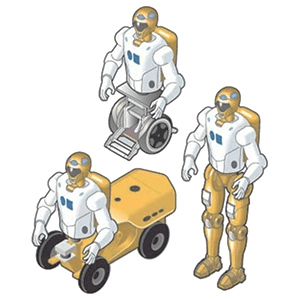
Robonaut is a humanoid robotic development project conducted by the Dextrous Robotics Laboratory at NASA’s Johnson Space Center (JSC) in Houston. Robonaut differs from other current space-faring robots (such as robotic arms, cranes and exploration rovers), which are designed to move large objects; Robonaut’s tasks require more dexterity. The core idea behind the Robonaut series is to have a humanoid machine work alongside astronauts. Its form factor and dexterity are designed such that Robonaut can use space tools and work in similar environments suited to astronauts.
The latest Robonaut version, R2, the first US-built robot on the ISS, delivered by the Space Shuttle in 2011, is a robotic torso designed to assist with crew EVA’s. However, Robonaut 2 does not have adequate protection needed to exist outside the space station and enhancements and modifications would be required to allow it to move around the station’s interior.
read more »
Posted in Money, Technology |
Leave a Comment »
February 15, 2012
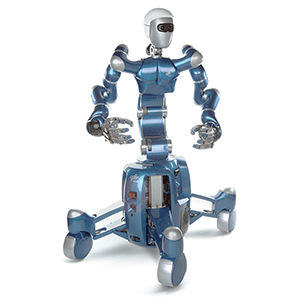
Justin is a humanoid robot developed by the German Aerospace Center (DLR) controlable through telepresence. Justin will be mounted on its own satellite and will be able to maneuver in orbit and fix other satellites.
The European Space Agency (ESA) plans to have astronauts aboard the International Space Station teleoperate Justin while he is on Earth.
Posted in Technology, World |
Leave a Comment »
February 14, 2012

Human Flesh Search (HFS) is a primarily Chinese internet phenomenon of massive researching using Internet media such as blogs and forums. It has generally been stigmatized as being for the purpose of identifying and exposing individuals to public humiliation, usually out of Chinese nationalistic sentiment, or conversely, to break the Internet censorship in China.
More recent analyses, however, have shown that it is also used for a number of other reasons, including exposing government corruption, identifying hit and run drivers, and outing scientific fraud, as well as for more entertainment related items such as identifying people seen in pictures. The system is based on massive human collaboration. The name refers both to the use of knowledge contributed by human beings through social networking, as well as the fact that the searches are usually dedicated to finding the identity of a human being who has committed some sort of offense or social breach online. People conducting such research are commonly referred to collectively as ‘Human Flesh Search Engines.’
read more »
Posted in Politics, Technology, World |
Leave a Comment »
February 14, 2012

On the Internet, nobody knows you’re a dog‘ is an adage which began as the caption of a cartoon by Peter Steiner published by ‘The New Yorker’ in 1993. Steiner, a cartoonist and contributor to ‘The New Yorker’ since 1979, said the cartoon initially did not get a lot of attention, but later took on a life of its own, and that he felt similar to the person who created the ‘smiley face.’ In fact, Steiner was not that interested in the Internet when he drew the cartoon, and although he did have an online account, he recalled attaching no ‘profound’ meaning to the cartoon; it was just something he drew in the manner of a ‘make-up-a-caption’ cartoon.
In response to the comic’s popularity, he stated, ‘I can’t quite fathom that it’s that widely known and recognized.’ The cartoon marks a notable moment in Internet history. Once the exclusive domain of government engineers and academics, the Internet was now a subject of discussion in general interest magazines like ‘The New Yorker.’ Lotus 1-2-3 founder and early Internet activist Mitch Kapor commented in a ‘Time’ magazine article in 1993 that ‘the true sign that popular interest has reached critical mass came this summer when the ‘New Yorker printed a cartoon showing two computer-savvy canines.’
read more »
Posted in Humor, Politics, Technology |
1 Comment »
February 14, 2012


A sockpuppet is an online identity used for purposes of deception. The term—a reference to the manipulation of a simple hand puppet made from a sock—originally referred to a false identity assumed by a member of an internet community who spoke to, or about himself while pretending to be another person.
The term now includes other uses of misleading online identities, such as those created to praise, defend or support a third party or organization. A significant difference between the use of a pseudonym and the creation of a sockpuppet is that the sockpuppet poses as an independent third-party unaffiliated with the puppeteer.
read more »
Posted in Language, Money, Technology |
2 Comments »