September 6, 2011


Sunscreen (also known as sunblock) is a lotion, spray or other topical product that helps protect the skin from the sun’s ultraviolet (UV) radiation, and which reduces sunburn and other skin damage, with the goal of lowering the risk of skin cancer. However in the United States, the term suntan lotion usually means the opposite of sunscreen, and instead refers to lotion designed to moisturize and maximize UV exposure and tanning rather than block it. These are commonly called indoor tanning lotions when designed for use with tanning beds or just suntan lotion if designed for outdoor use and may or may not have SPF protection in them.
The most effective sunscreens protect against both UVB, which can cause sunburn, and UVA, which damages the skin with more long-term effects, such as premature skin aging. Most sunscreens work by containing either an organic chemical compound that absorbs ultraviolet light (such as oxybenzone) or an opaque material that reflects light (such as titanium dioxide, zinc oxide), or a combination of both. Typically, absorptive materials are referred to as chemical blocks, whereas opaque materials are mineral or physical blocks. The sun protection factor (SPF) of a sunscreen is a laboratory measure of the effectiveness of sunscreen — the higher the SPF, the more protection a sunscreen offers against UVB.
read more »
Posted in Health, Politics, Technology |
Leave a Comment »
August 26, 2011

The Venus Project is an organization that advocates American futurist Jacque Fresco’s visions of the future with the aim of improving society by moving towards a global sustainable social design that they call a ‘resource-based economy.’ Such a system incorporates sustainable cities and values, energy efficiency, collective farms, natural resource management and advanced automation, focusing on the benefits they claim it will bring to humanity.
The name of the organization originates from Venus, Florida, where its research center is located, near Lake Okeechobee. Within the center are ten buildings, designed by Fresco, which showcase the architecture of the project.
read more »
Posted in Money, Politics, Technology |
Leave a Comment »
August 26, 2011

Cyanotype [sahy-an-uh-tahyp] is a photographic printing process that gives a cyan-blue print. The process was popular in engineering circles well into the 20th century. The simple and low-cost process enabled them to produce large-scale copies of their work, referred to as blueprints. Two chemicals are used in the process: Ammonium iron(III) citrate and Potassium ferricyanide.
The English scientist and astronomer Sir John Herschel discovered this procedure in 1842. Though the process was developed by Herschel, he considered it as mainly a means of reproducing notes and diagrams, as in blueprints. It was Anna Atkins who brought this to photography. She created a limited series of cyanotype books that documented ferns and other plant life from her extensive seaweed collection. Atkins placed specimens directly onto coated paper, allowing the action of light to create a silhouette effect. By using this photogram process, Anna Atkins is regarded as the first female photographer.
read more »
Posted in Art, Technology |
1 Comment »
August 25, 2011

Snow Crash is Neal Stephenson’s third novel, published in 1992. Like many of Stephenson’s other novels it covers a large range of topics including: history, linguistics, anthropology, archaeology, religion, computer science, politics, cryptography, memetics, and philosophy. Stephenson explained the title of the novel in his 1999 essay ‘In the Beginning… was the Command Line’ as his term for a particular software failure mode on the early Apple Macintosh computer, ‘When the computer crashed and wrote gibberish into the bitmap, the result was something that looked vaguely like static on a broken television set — a ‘snow crash.”
The book presents the Sumerian language as the firmware programming language for the brainstem, which is supposedly functioning as the BIOS for the human brain. According to characters in the book, the semetic goddess Asherah is the personification of a ‘linguistic virus,’ similar to a computer virus. The Sumerian god Enki created a counter-program which he called a ‘nam-shub’ that caused all of humanity to speak different languages as a protection against Asherah (a re-interpretation of the ancient Near Eastern story of the Tower of Babel).
read more »
Posted in Art, Money, Technology |
Leave a Comment »
August 22, 2011
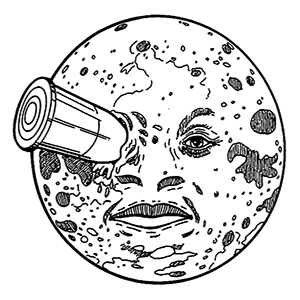
Georges Méliès [mey-lyes] (1861 – 1938) was a French filmmaker famous for leading many technical and narrative developments in the earliest cinema. He was very innovative in the use of special effects. He accidentally discovered the ‘stop trick,’ or substitution, in 1896, and was one of the first filmmakers to use multiple exposures, time-lapse photography, dissolves, and hand-painted color in his films. Because of his ability to seemingly manipulate and transform reality through cinematography, Méliès is sometimes referred to as the First ‘Cinemagician,’ and before making films, he was a stage magician at the Theatre Robert-Houdin.
His most famous film is ‘A Trip to the Moon’ (‘Le voyage dans la Lune’) made in 1902, which includes the celebrated scene in which a spaceship hits the eye of the man in the moon.
read more »
Posted in Art, Money, Technology |
Leave a Comment »
August 22, 2011

Compositing [kuhm-poz-it-ing] is the combining of visual elements from separate sources into single images, often to create the illusion that all those elements are parts of the same scene. Live-action shooting for compositing is variously called ‘blue screen,’ ‘green screen,’ ‘chroma key,’ and other names. Today, most, though not all, compositing is achieved through digital image manipulation. Pre-digital compositing techniques, however, go back as far as the trick films of Georges Méliès in the late 19th century; and some are still in use.
All compositing involves the replacement of selected parts of an image with other material, usually, but not always, from another image. In the digital method of compositing, software commands designate a narrowly defined color as the part of an image to be replaced. Then every pixel within the designated color range is replaced by the software with a pixel from another image, aligned to appear as part of the original. For example, a TV weather person is recorded in front of a plain blue or green screen, while compositing software replaces only the designated blue or green color with weather maps.
read more »
Posted in Art, Technology |
Leave a Comment »
August 22, 2011

Cinemagraphs are still photographs in which a minor and repeated movement action occurs. They are produced by taking a series of photographs or a video recording, and, using image editing software, compositing the photographs or the video frames into an animated GIF file in such a manner that motion in part of the subject between exposures (for example, a person’s dangling leg) is perceived as a repeating or continued motion.
The term was coined by U.S. photographers Kevin Burg and Jamie Beck, who used the technique to animate their fashion and news photographs beginning in early 2011.
Posted in Art, Technology |
Leave a Comment »
August 17, 2011
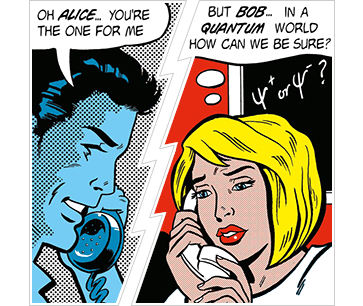
The names Alice and Bob are commonly used placeholder names for archetypal characters in fields such as cryptography and physics. The names are used for convenience; for example, ‘Alice sends a message to Bob encrypted with his public key’ is easier to follow than ‘Party A sends a message to Party B encrypted by Party B’s public key.’ Following the alphabet, the specific names have evolved into common parlance within these fields—helping technical topics to be explained in a more understandable fashion.
In cryptography and computer security, there are a number of widely used names for the participants in discussions and presentations about various protocols. The names are conventional, somewhat self-suggestive, sometimes humorous, and effectively act as metasyntactic variables. In typical implementations of these protocols, it is understood that the actions attributed to characters such as Alice or Bob need not always be carried out by human parties directly, but also by a trusted automated agent (such as a computer program) on their behalf. Despite the advantage of Alice and Bob’s distinct genders in reducing ambiguity, there has been little tendency to introduce inanimate parties so they could be referred by neuter pronouns.
read more »
Posted in Language, Science, Technology |
1 Comment »
August 17, 2011
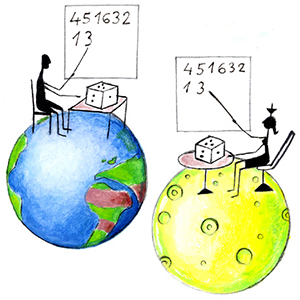
An ansible [an-si-bull] is a hypothetical machine capable of instantaneous or superluminal (faster-than-light) communication. They are used as science fiction plot devices and in thought experiments of theoretical physics. The word was coined by American author Ursula K. Le Guin in her 1966 novel, ‘Rocannon’s World.’
She derived the name from ‘answerable,’ as the device would allow its users to receive answers to their messages in a reasonable amount of time, even over interstellar distances. The name of the device has since been borrowed by authors such as Orson Scott Card and Vernor Vinge; similar devices are present in the works of numerous others, such as Frank Herbert. One ansible-like device which predates Le Guin’s is the ‘Dirac communicator’ in James Blish’s 1954 short story ‘Beep.’ The device received the sum of all transmitted messages in universal space-time, in a single pulse, so that demultiplexing yielded information about the past, present, and future.
read more »
Posted in Language, Science, Technology |
Leave a Comment »
August 16, 2011

Raymond Loewy [loh-ee] (1893 – 1986) was an industrial designer. Born in France, he spent most of his professional career in the United States. Among his work were the Shell and former BP logos, the Greyhound bus, the Coca-Cola bottle, the Pennsylvania Railroad GG1 and S-1 locomotives, the Lucky Strike package, Coldspot refrigerators, the Studebaker Avanti and Champion, and the Air Force One livery. His career spanned seven decades.
Loewy was born in Paris in 1893, the son of a Jewish Viennese journalist and French woman. He served in the French army during World War I, attaining the rank of captain. He boarded a ship to America in 1919 with only his French officer’s uniform and $50 in his pocket. He lived in New York and found work as a window designer for department stores, including Macy’s, Wanamaker’s and Saks in addition to working as a fashion illustrator for Vogue and Harper’s Bazaar.
read more »
Posted in Art, Money, Technology |
Leave a Comment »
August 16, 2011
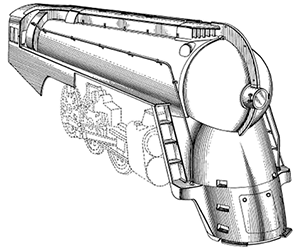

Henry Dreyfuss (1904 – 1972) was an American industrial designer. Dreyfuss was a native of Brooklyn, New York. As one of the celebrity industrial designers of the 1930s and 1940s, Dreyfuss dramatically improved the look, feel, and usability of dozens of consumer products.
As opposed to Raymond Loewy and other contemporaries, Dreyfuss was not a stylist: he applied common sense and a scientific approach to design problems. His work both popularized the field for public consumption, and made significant contributions to the underlying fields of ergonomics, anthropometrics, and human factors.
Posted in Art, Money, Technology |
Leave a Comment »
August 15, 2011
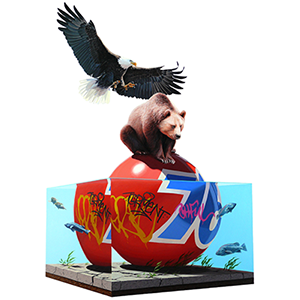
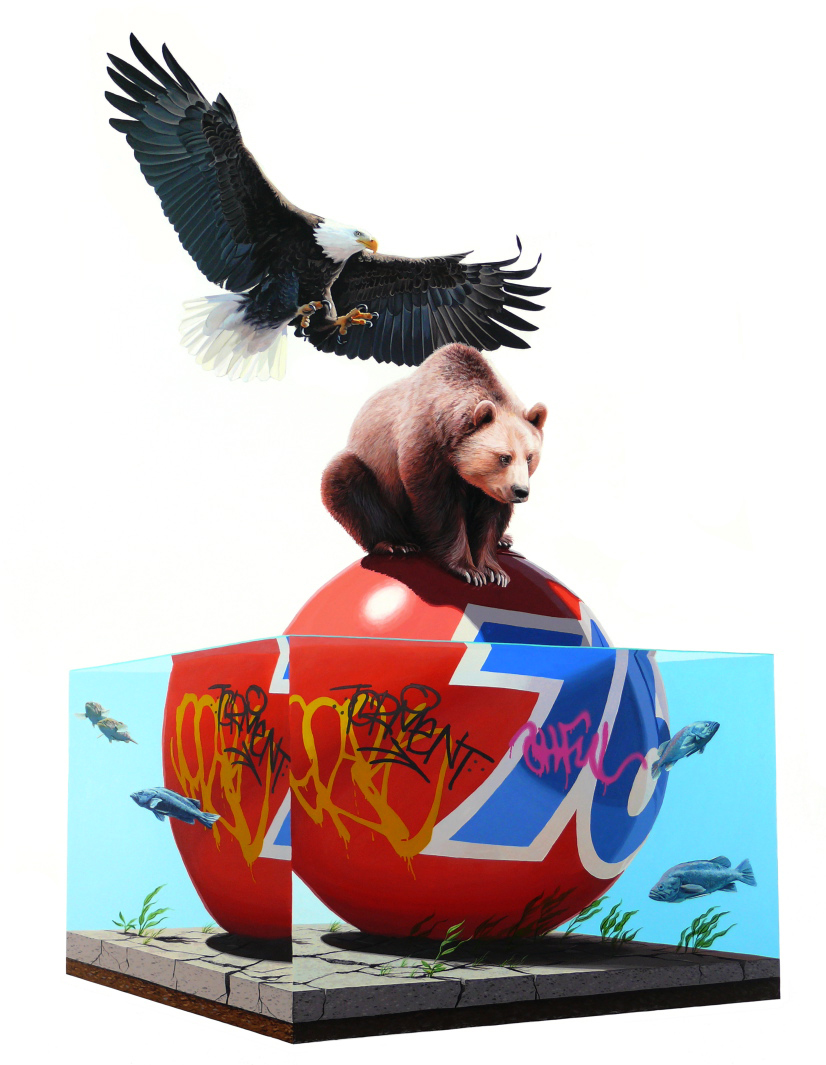
Josh Keyes (b. 1969) is an American contemporary artist who works with painting, drawing, and installation art. He currently works out of Portland, Oregon. His work has been described as ‘a satirical look at the impact urban sprawl has on the environment and surmises, with the aid of scientific slices and core samples, what could happen if we continue to infiltrate and encroach on our rural surroundings.’
Josh’s work brings to mind the detail and complexity of natural history dioramas, and the color and diagrammatic complexity one might find in cross section illustrations from a vintage science textbook. His work has developed over the past years into a complex personal vocabulary of imagery that creates a mysterious and sometimes unsettling juxtaposition between the natural world and the man made landscape.
read more »
Posted in Art, Politics, Technology |
Leave a Comment »