July 26, 2011

A dubplate is an acetate disc — usually 12, 10, or 7 inches in diameter — used in mastering studios for quality control and test recordings before proceeding with the final master, and subsequent pressing of the record to be mass-produced on vinyl. The ‘dub’ in dubplate is an allusion to the plate’s use in ‘dubbing’ or ‘doubling’ the original version of a track. In music, dubbing is copying of audio recordings from one medium to another.
The name dubplate also refers to an exclusive, ‘one-off’ disc recording pioneered by reggae sound systems but also used by drum and bass and other dance music artists, DJs and sound systems. These dubplates will often be unreleased recordings (which may or may not end up being made available to the general public). They are often used as a market research tool to assess the probable sales of a song once it’s released, as they are far cheaper to produce than a pressed vinyl record. However, because they have a limited life-span they can only be used about fifty times.
Posted in Art, Language, Technology |
Leave a Comment »
July 26, 2011

Biophilia is the musical project and forthcoming eighth full-length studio album from Icelandic singer Björk. The album is ‘partly recorded’ on an iPad and will be released in the form of a series of apps. Biophilia will be the world’s ‘first app album’ in collaboration with Apple. Björk has described the project as a multimedia collection ‘encompassing music, apps, internet, installations, and live shows.’ Scott Snibbe, an interactive artist was commissioned by Björk in the summer of 2010 to produce the app, as well as the images for the live shows (which will combine his visuals with National Geographic imagery, mixed live from iPads on the stage).
For the song, ‘Virus,’ the app will feature a close-up study of cells being attacked by a virus to represent what Snibbe calls: ‘A kind of a love story between a virus and a cell. And of course the virus loves the cell so much that it destroys it.’ The interactive game challenges the user to halt the attack of the virus, although the result is that the song will stop if the player succeeds. In order to hear the rest of the song, the players will have to let the virus take its course. Using some artistic license, the cells will also mouth along to the chorus. Björk is determined to fuse different elements together, be it juxtaposing a female choir from Greenland with the bleeps and glitches of electronic music pioneers Matmos during the Vespertine tour, or meshing soaring strings and jagged beats on ‘Homogenic,’ that ‘helps explain the power and success of Björk’s collaborations.’
Posted in Art, Games, Technology |
Leave a Comment »
July 25, 2011

Wave Twisters (2001) is an animated film, also known as the first turntablism-based musical. It is based on DJ Q-Bert’s album of the same name. The film is entirely scripted to match the DJ Q-Bert recording. As such, it can seem a little disjointed at times. It was produced digitally using Adobe After Effects and a relatively small team of animators. Buckethead makes a short appearance in the film as well, near the beginning.
A crew of heroes is determined to save the lost arts of Hip Hop. Break Dancing, Graffiti, MCing, and DJing from total extinction. The lost arts are being oppressed throughout inner-space by lord Ook and his evil minions the Chinheads. The dental commander Dr. Julio Azul DDS, assumed to be secretary Honey Drips, Dental Hygienist/Robot Rubbish, and Grandpa have a series of adventures, synced to the music. Armed with the ancient relic known as the Wave Twister (a small turntable/wristwatch, the only weapon powerful enough to defeat their enemies), they travel to the far ends of inner-space for a final confrontation with the sinister army of oppressors. The film ends with the team teaching the liberated the lost fundamentals of hip hop.
Posted in Art, Humor, Technology |
Leave a Comment »
July 25, 2011
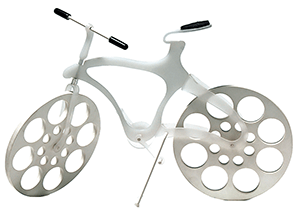
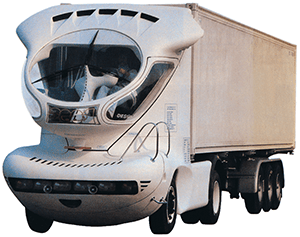
Luigi Colani (b. 1928) is a German industrial designer. The prime characteristic of his designs are the rounded, organic forms, which he terms ‘biodynamic’ and claims are ergonomically superior to traditional designs. His ‘kitchen satellite’ from 1969 is the most prominent example of this school of thought. Many of his designs for small appliances are being mass-produced and marketed, but his larger designs have not been built, ‘a whole host of futuristic concepts that will have us living in pods and driving cars so flat that leg amputation is the only option.’
Colani responding to his critics said, ‘The earth is round, all the heavenly bodies are round; they all move on round or elliptical orbits. This same image of circular globe-shaped mini worlds orbiting around each other follows us right down to the microcosmos. We are even aroused by round forms in species propagation related eroticism. Why should I join the straying mass who want to make everything angular? I am going to pursue Galileo Galilei’s philosophy: my world is also round.’
Posted in Art, Money, Technology |
Leave a Comment »
July 25, 2011

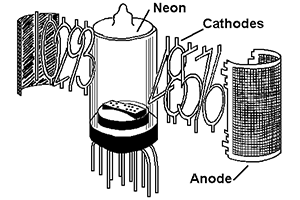
A nixie tube, or cold cathode display, is an electronic device for displaying numerals or other information using glow discharge. The glass tube contains a wire-mesh anode and multiple cathodes, shaped like numerals or other symbols. Applying power to one cathode surrounds it with an orange glow discharge. The tube is filled with a gas at low pressure, usually mostly neon and often a little mercury or argon.
Although it resembles a vacuum tube in appearance, its operation does not depend on thermionic emission of electrons from a heated cathode. It is therefore called a cold-cathode tube (a form of gas-filled tube), or a variant of neon lamp. Such tubes rarely exceed 40 °C (104 °F) even under the most severe of operating conditions in a room at ambient temperature. Vacuum fluorescent displays from the same era use completely different technology – they have a heated cathode together with a control grid and shaped phosphor anodes; Nixies have no heater or control grid, typically a single anode, and shaped bare metal cathodes.
read more »
Posted in Money, Technology |
Leave a Comment »
July 25, 2011

Airstream is a brand of luxury recreational vehicle manufactured in Jackson Center, Ohio. It is currently a division of Thor Industries. The company, which now employs fewer than 400, is the oldest in the industry. Airstream trailers are easily recognized for their distinctive rounded aluminum bodies, which originated in the 1930s from designs created by Hawley Bowlus. Bowlus was the chief designer of Charles Lindbergh’s aircraft, the Spirit of St. Louis.
The company was founded by Wally Byam, who began building trailers out of Masonite in his backyard in Los Angeles during the late 1920s. A lawyer by training, Byam published a magazine selling ‘how-to’ kits to customers wishing to build their own trailers. He then acquired the struggling Bowlus Company. In 1936 Byam introduced the ‘Airstream Clipper,’ which was essentially a rebadged 1935 Bowlus, with the door relocated from the front to the side. The design cut down on wind resistance and thus improved fuel efficiency. It was the first of the now familiar sausage-shaped, silver aluminum Airstream trailers.
read more »
Posted in Games, Money, Technology |
Leave a Comment »
July 24, 2011

God Helmet refers to an experimental apparatus used in neuroscience, primarily in the field of neurotheology (the study of correlations of neural phenomena with subjective experiences of spirituality). Originally called the ‘Koren helmet’ after its inventor Stanley Koren, it was conceived to study creativity and the effects of subtle stimulation of the temporal lobes. Reports by participants of a ‘sensed presence’ brought public attention to the device. The apparatus, placed on the head of an experimental subject, generates weak fluctuating (i.e. ‘complex’) magnetic fields. These fields are approximately as strong as those generated by a land line telephone handset or an ordinary hair dryer, but far weaker than that of an ordinary fridge magnet.
Michael Persinger, a Canadian neuroscientist, has published extensively about the effects on the human brain of the ‘complex’ magnetic fields generated by the God helmet and similar devices. Many subjects have reported ‘mystical experiences and altered states’ while wearing the God Helmet.
read more »
Posted in Health, Philosophy, Technology |
1 Comment »
July 24, 2011
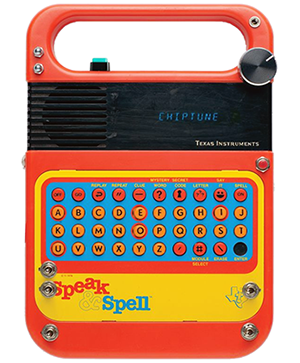
Circuit bending is the creative customization of the circuits within electronic devices such as low voltage, battery-powered guitar effects, children’s toys, and small digital synthesizers to create new musical or visual instruments and sound generators.
Emphasizing spontaneity and randomness, the techniques of circuit bending have been commonly associated with noise music, though many more conventional contemporary musicians and musical groups have been known to experiment with ‘bent’ instruments. Circuit bending usually involves dismantling the machine and adding components such as switches and potentiometers (control knobs) that alter the circuit.
read more »
Posted in Art, Games, Technology |
Leave a Comment »
July 24, 2011

Promession is an ecologically-conscious method for disposing of human remains by freeze drying. It was invented and patented in 1999 by Swedish biologist Susanne Wiigh-Mäsak. The method begins by reducing the body of the deceased to a fine powder, thereby allowing subsequent decomposition to be aerobic. This is achieved by submerging the body in liquid nitrogen, making the remains so brittle that they shatter into a powder as the result of slight vibrations. The powder is then dried, reducing the deceased remains to around 30% of their original body weight. Next, an electromagnet pulls out metals within the powdered remains (including mercury, which is only magnetic at cryogenic temperature, which are recycled. Finally, the powder is buried shallowly in a biodegradable cornstarch box. Seeds planted in the soil draw nutrients from the remains. Below two feet, at the depth which coffins are traditionally buried, there is no oxygen, which is one of the prerequisites for composting or aerobic decomposition to take place. But despite this, the dead are buried at a depth where the oxygen is missing; therefore the deceased are exposed to a negative putrefaction process or anaerobic decomposition.
It is the lack of oxygen combined with the amount of remains that causes the body to not decompose, but effectively putrify in an ordinary burial, With such large bodies, humans always start to rot if not first broken down into smaller parts so that oxygen can reach all body parts. In the past this would have been done by wild animals. It is important to remember that even the powder produced by Promession would not compost at 2 meters below ground, due to the lack of oxygen. The same applies to a body that is above ground or in the upper soil layers with high availability of oxygen. Despite the high oxygen content, the body still putrefies because the body is intact and whole and anaerobic conditions are already present in the gut . It is not enough for one or the other. Proper composting or aerobic decomposition of a corpse requires a combination of fragmentation of the body, oxygen-rich soil and micro-and macro-organisms. Therefore Promession is a modern and ethical manner to transform the body into smaller parts to get it to compost correctly and return to soil without the negative side effects associated with putrefaction.
Posted in Death, Technology |
Leave a Comment »
July 23, 2011

Kid Carpet, real name Ed Patrick, is a musician from Bristol, England. His music has been described as ‘kiddy disco punk’ and ‘shit-hop,’ as it is recorded in his home studio using instruments such as samplers, Casio keyboards, and various children’s toys including plastic Fisher-Price guitars and Tamagotchi innards.
Posted in Art, Humor, Technology |
Leave a Comment »
July 23, 2011
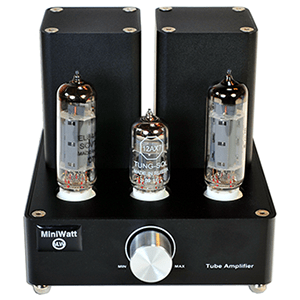
Retrotronics is the making of electric circuits or appliances using older electric components, such as vacuum tubes, Nixie displays, relays, uniselectors, analog meters, etc. These are usually chosen for their aesthetic qualities, rather than their utility. Retrotronics is a popular strand within the steampunk movement. At the Oxford exhibition of Steampunk art, many of the works had a strong retrotronic influence, from light fittings of period components to computer keyboards and webcams of burnished copper and brass. Outside steampunk, similar influences are found amongst the retro-futurist scene.
A recent musical trend has sought to recapture early 1980s 8-bit game and synthesizer sounds, often referred to as Chiptune. Artists such as Kid Carpet perform entire sets on children’s toys or pocket synths of the period. Other artists, such as Nullsleep, perform using only period video game hardware. DJs offer dance music events built from samples of period games or gadgets.
read more »
Posted in Art, Money, Technology |
Leave a Comment »
July 23, 2011

Dieselpunk is a sub-genre of the pop surrealist art movement, as well as a budding subculture, that combines the aesthetics of the interbellum period through the early 1950s with postmodern technology and sensibilities. First coined in 2001 as a marketing term by game designer Lewis Pollak to describe his role-playing game ‘Children of the Sun,’ dieselpunk has grown to describe a distinct style.
The name ‘dieselpunk’ is a derivative of the 1980s science fiction genre cyberpunk, and is used to represent the time period – or ‘era’- when diesel-based locomotion was the main technological focus of Western culture. The ‘-punk’ suffix attached to the name is representative of the counterculture nature of the genre with regards to its opposition of contemporary aesthetics. The term also refers to the tongue-in-cheek name given to a similar cyberpunk derivative, ‘steampunk,’ which focuses on science fiction set within the Victorian era.
read more »
Posted in Art, Language, Technology |
2 Comments »