July 22, 2011

Steampunk is a sub-genre of science fiction, alternate history, and speculative fiction that came into prominence during the 1980s and early 1990s. It involves a setting where steam power is still widely used—usually the Victorian era Britain—that incorporates elements of either science fiction or fantasy.
Works of steampunk often feature anachronistic technology or futuristic innovations as Victorians may have envisioned them; based on a Victorian perspective on fashion, culture, architectural style, art, etc. This technology may include such fictional machines as those found in the works of H. G. Wells and Jules Verne.
read more »
Posted in Art, Language, Technology |
Leave a Comment »
July 22, 2011
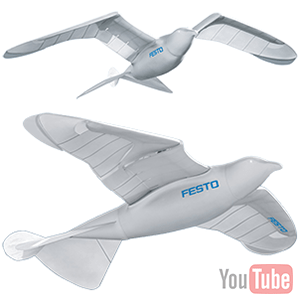
SmartBird is an autonomous unmanned aerial vehicle created by Festo’s Bionic Learning Network. It is an ornithopter modeled on the herring gull. It has a mass of 450 grams and a wingspan of 1.96 meters. Smartbird is constructed of polyurethane foam and carbon fiber and is powered by a 135 brushless motor running at 23 watts.
Flight occurs in a manner very similar to that of real birds. The vertical motion of the wings is provided by an electric motor in the body of the bird. It is connected to two wheels that attach to rods in the wings in a manner similar to steam locomotives. Inside the wings are torsional motors that adjust the wings’ angle of attack to provide forward motion. Directional control is provided by moving the tail.
Posted in Technology |
Leave a Comment »
July 20, 2011

Dippin’ Dots is an ice cream snack, invented by Curt Jones in 1987. The confection is created by flash freezing ice cream mix in liquid nitrogen; consequently, Dippin’ Dots contain less air than conventional ice cream. The resulting small spheres of ice cream are stored at temperatures ranging from -70 to -20 °F (from -57 °C to -29 °C). The marketing slogan is ‘Ice Cream of the Future.’ The company, headquartered in Paducah, Kentucky, United recently began selling its product in supermarkets in the United States. Dippin’ Dots are sold in individual servings at franchised outlets, many in theme parks, stadiums, shopping malls, and in vending machines.
Several competing beaded ice-cream lines have been introduced in recent years. Some of these competing brands are similar to Dippin’ Dots in shape or size, yet differ in that they use dairy stabilizers and artificial sweeteners, in an effort to keep the beads from adhering to one another. Dippin’ Dots, made from conventional ice cream ingredients, are held at sub-zero temperatures to keep the beads separate and free-flowing.
Posted in Food, Money, Technology |
1 Comment »
July 20, 2011

El Bulli is a molecular gastronomy restaurant near the town of Roses, Spain (near the French border), run by chef Ferran Adrià. In early 2011, management announced that the restaurant would close that summer to reopen as a creativity center in 2014. Its main objective is to be a think-tank for creative cuisine and gastronomy and will managed by a private foundation. The former restaurant accommodated only 8,000 diners a season, but received more than two million requests. The average cost of a meal was €250. The restaurant itself operated at a loss since 2000, with operating profit coming from El Bulli-related books and lectures by Adrià. The location was selected in 1961 by Dr Hans Schilling, a German, and his Czech wife Marketta, who wanted a restaurant for a piece of land he had purchased. The name ‘El Bulli’ came from the French bulldogs the Schillings owned.
The first restaurant was opened in 1964. Ferran Adrià joined the staff in 1984, and was put in sole charge of the kitchen in 1987. In 1990 the restaurant gained its second Michelin star, and in 1997 its third. Menu items have included melon with ham, pine nut marshmallows, steamed brioche with rose-scented mozzarella, rock mussels with seaweed and fresh herbs, and passion fruit trees. Texturas is a range of products by Adrià and his brother Albert. Texturas include products such as Xanthan and Algin. Xanthan gum allows the user to use a very small amount to thicken soups, sauces and creams without changing the flavor. Algin is a key component of the ‘Spherification Kit’ and is essential for every spherical preparation: caviar, raviolis, balloons, gnocchi, pellets, and mini-spheres.
Posted in Food, Money, Technology |
Leave a Comment »
July 20, 2011

Spherification is the culinary process of shaping a liquid into spheres which visually and texturally resemble caviar. The technique was originally developed by the creative team at the Spanish restaurant, elBulli under the direction of executive chef Ferran Adrià. There are two main methods for creating such spheres, which differ based on the calcium content in the product to be spherified.
For substances containing no calcium, the liquid is mixed with sodium alginate, and dripped into a cold solution of calcium chloride or calcium carbonate. ‘Reverse’ spherification, for use with substances which contain calcium, requires dripping the substance into an alginate bath. Both methods give the same result: a sphere of liquid held by a thin gel membrane, texturally similar to caviar.
Posted in Food, Technology |
Leave a Comment »
July 20, 2011
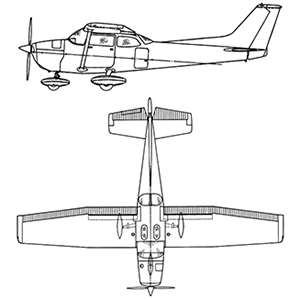
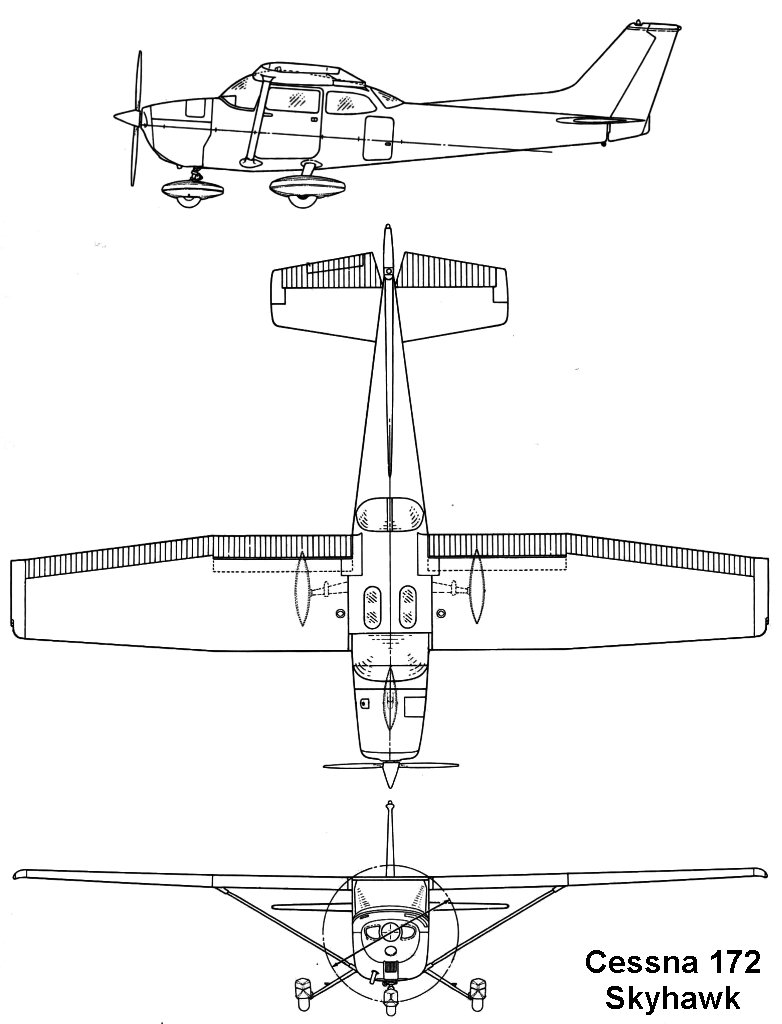
The Cessna 172 Skyhawk is a four-seat, single-engine, high-wing, fixed-wing aircraft. First flown in 1955 and still in production, more Cessna 172s have been built than any other aircraft.
Measured by its longevity and popularity, the Cessna 172 is the most successful mass produced light aircraft in history. The first production models were delivered in 1956 and they are still in production. As of 2008, more than 43,000 had been built.
Posted in Money, Technology |
Leave a Comment »
July 19, 2011
Kid A is the fourth studio album by the English rock band Radiohead, released in 2000. Despite the lack of an official single or music video as publicity, ‘Kid A’ became the first Radiohead release to debut at number one in the US. This success was credited variously to a unique marketing campaign, the early Internet leak of the album, and anticipation after the band’s 1997 album, ‘OK Computer.’
‘Kid A’ was recorded in Paris, Copenhagen, Gloucestershire and Oxford with producer Nigel Godrich. The album’s songwriting and recording were experimental for Radiohead, as the band replaced their earlier ‘anthemic’ rock style with a more electronic sound. Influenced by Krautrock, jazz, and 20th century classical music, Radiohead abandoned their three-guitar line-up for a wider range of instruments on ‘Kid A,’ using keyboards, the Ondes martenot (an early electronic musical instrument), and, on certain compositions, strings and brass. Kid A also contains more minimal and abstract lyrics than the band’s previous work.
read more »
Posted in Art, Technology |
Leave a Comment »
July 19, 2011
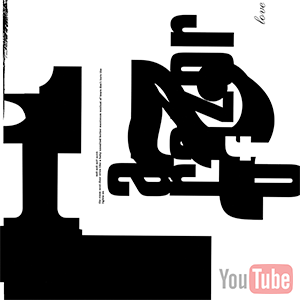
Dubnobasswithmyheadman is the third album by Underworld, released in 1994 after the band made the transition from synth pop to progressive house. It is also the first album to feature Darren Emerson, ushering in the ‘MK2’ phase of the band, which continued until Emerson’s departure in 2001.
Tomato, the art design collective that includes Underworld’s Rick Smith and Karl Hyde, designed the artwork for Dubnobasswithmyheadman. It features black and white type that has been ‘multiplied, smeared, and overlaid’ so much that it is nearly unreadable, alongside a ‘bold symbol consisting of a fractured handprint inside a broken circle.’ The artwork was originally intended for Tomato’s book ‘Mmm…Skyscraper I Love You: A Typographic Journal of New York,’ published in 1994.
Posted in Art, Technology |
Leave a Comment »
July 19, 2011

Blue Lines is the debut album by British electronica group Massive Attack, released in 1991. It is generally considered the first trip hop album, although the term was not coined until years later.
A fusion of electronic music, hip hop, dub, ’70s soul and reggae, the album established Massive Attack as one of the most innovative British bands of the 1990s and the founder of trip hop’s Bristol Sound. The album also marked a change in electronic/dance music, ‘a shift toward a more interior, meditational sound.
read more »
Posted in Art, Technology, World |
Leave a Comment »
July 18, 2011
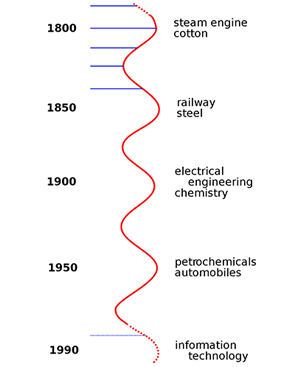
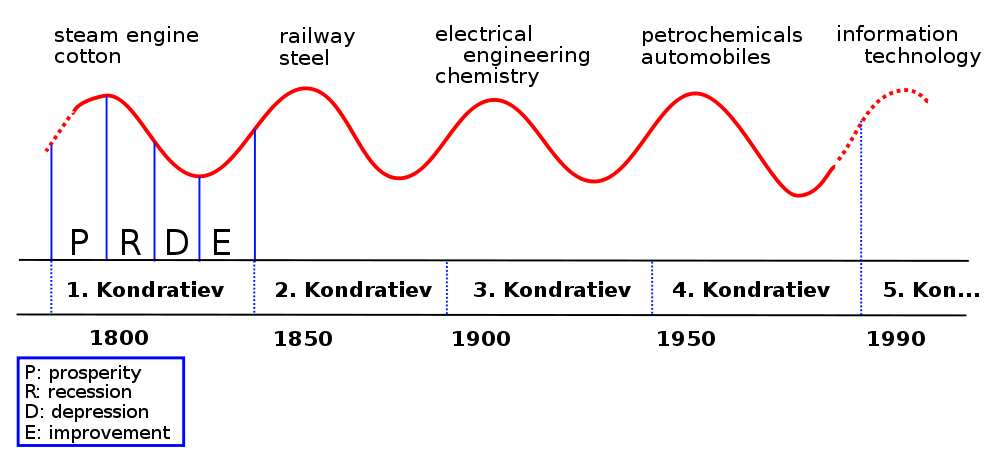
Kondratiev waves (also called supercycles, great surges, or long waves) are described as sinusoidal-like cycles in the modern capitalist world economy. Averaging fifty and ranging from approximately forty to sixty years in length, the cycles consist of alternating periods between high sectoral growth and periods of relatively slow growth. Unlike the short-term business cycle, the long wave of this theory is not accepted by current mainstream economics.
Russian economist Nikolai Kondratiev (1892 – 1938) was the first to bring these observations to international attention in his book ‘The Major Economic Cycles’ (1925). Kondratiev was a Russian economist, but his economic conclusions were disliked by the Soviet leadership and upon their release he was quickly dismissed from his post as director of the Institute for the Study of Business Activity in the Soviet Union in 1928. His conclusions were seen as a criticism of Joseph Stalin’s intentions for the Soviet economy. As a result he was sentenced to the Soviet Gulag and later received the death penalty in 1938.
read more »
Posted in Money, Technology, World |
Leave a Comment »
July 18, 2011
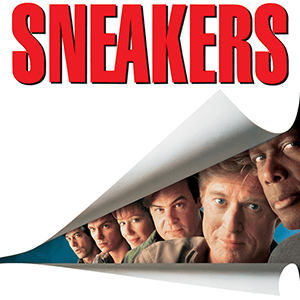
A tiger team is a group of experts assigned to investigate and/or solve technical or systemic problems. The term may have originated in aerospace design but is also used in other settings, including information technology and emergency management. It has been described as ‘a team of undomesticated and uninhibited technical specialists, selected for their experience, energy, and imagination, and assigned to track down relentlessly every possible source of failure in a spacecraft subsystem.’ In security work, a tiger team is a specialized group that tests an organization’s ability to protect its assets by attempting to circumvent, defeat, or otherwise thwart that organization’s internal and external security. The term originated within the military to describe a team whose purpose is to penetrate security of ‘friendly’ installations to test security measures. It now more generally refers to any team that attacks a problem aggressively.
Many tiger teams are informally constituted through managerial edicts. One of these was set up in NASA circa 1966 to solve the ‘Apollo Navigation Problem. Technology at the time was unable to navigate Apollo at the level of precision mandated by the mission planners. Tests using radio tracking data were revealing errors of 2000 meters instead of the 200 that the mission required to safely land Apollo when descending from its lunar orbit. Five tiger teams were set up to find and correct the problem, one at each NASA center, from CalTech JPL in the west to Goddard SFC in the east. The Russians via Luna 10 were also well aware of this problem. The JPL found a solution in 1968; the problem was caused by the unexpectedly large local gravity anomalies on the moon arising from large ringed maria, mountain ranges and craters on the moon. This also led to the construction of the first detailed gravimetric map of a body other than the earth and the discovery of the lunar mass concentrations.
Posted in Language, Politics, Technology |
Leave a Comment »
July 18, 2011
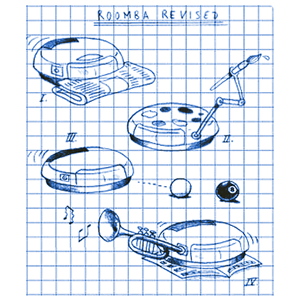
Hack value is the notion among hackers that something is worth doing or is interesting. This is something that hackers often feel intuitively about a problem or solution; the feeling approaches the spiritual for some. An aspect of hack value is performing feats for the sake of showing that they can be done, even if others think it is difficult. Using things in a unique way outside their intended purpose is often perceived as having hack value. Examples are using a matrix printer to produce musical notes, using a flatbed scanner to take ultra-high-resolution photographs or using an optical mouse as barcode reader.
A solution or feat implies hack value if it is done in a way that has finesse or ingenuity. So creativity is an important part of the meaning. For example, picking a difficult lock has hack value; smashing a lock does not. By way of another example, proving Fermat’s last theorem by linking together most of modern mathematics has hack value; solving the four color map problem by exhaustively trying all possibilities does not (both of these have now in fact been proven).
Posted in Language, Technology |
1 Comment »