May 11, 2011
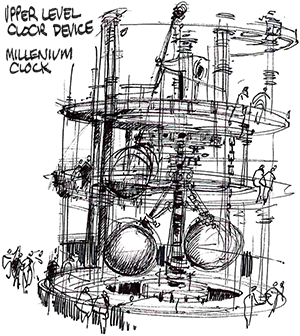

The Long Now Foundation, established in 1996, is a private organization that seeks to become the seed of a very long-term cultural institution. It aims to provide a counterpoint to what it views as today’s ‘faster/cheaper’ mindset and to promote ‘slower/better’ thinking. The Long Now Foundation hopes to ‘creatively foster responsibility’ in the framework of the next 10,000 years, and so uses 5-digit dates to address the Year 10,000 problem (e.g. by writing 02011 rather than 2011).
The Foundation has several ongoing projects, including a 10,000-year clock known as the ‘Clock of the Long Now,’ the Rosetta Project, the Long Bet Project, the open source Timeline Tool (also known as Longviewer), the Long Server and a monthly seminar series.
read more »
Posted in Philosophy, Technology |
Leave a Comment »
May 9, 2011
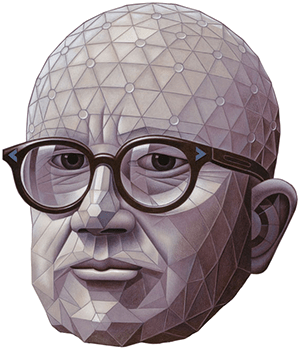
Buckminster Fuller (1895 – 1983) was an American engineer and author. He popularized terms such as ‘Spaceship Earth,’ ephemeralization, and synergetics. He also developed numerous inventions, mainly architectural designs, the best known of which is the geodesic dome. Carbon molecules known as fullerenes were later named by scientists for their resemblance to geodesic spheres.
As a child he had trouble with geometry, being unable to understand the abstraction necessary to imagine that a chalk dot on the blackboard represented a mathematical point, or that an imperfectly drawn line with an arrow on the end was meant to stretch off to infinity. He often made items from materials he brought home from the woods, and sometimes made his own tools.
read more »
Posted in Philosophy, Technology |
Leave a Comment »
May 9, 2011

Buckypaper is a thin sheet made from an aggregate of carbon nanotubes. The nanotubes are approximately 50,000 times thinner than a human hair. Originally, it was fabricated as a way to handle carbon nanotubes, but it is also being studied and developed into applications by several research groups, showing promise in vehicle and personal armor and next-generation electronics and displays. It owes its name to the buckminsterfullerene, the 60 carbon fullerene (an allotrope of carbon with similar bonding that is sometimes referred to as a Buckyball in honor of American engineer, Buckminster Fuller.
Buckypaper is one tenth the weight yet potentially 500 times stronger than steel when its sheets are stacked to form a composite. It could disperse heat like brass or steel and it could conduct electricity like copper or silicon.
Posted in Technology |
Leave a Comment »
May 9, 2011

Discovered in 1965, buckyballs (formally known as buckminsterfullerenes) are hollow spheres made of carbon atoms named after American engineer, Buckminster Fuller (1895 – 1983), who popularized geodesic dome buildings. Buckyballs and nanotubes are an allotrope (structural configuration) of carbon called fullerenes, also after Fuller.
The discovery of fullerenes greatly expanded the number of known carbon allotropes, which until recently were limited to graphite, diamond, and amorphous carbon such as soot and charcoal. Buckyballs and buckytubes have been the subject of intense research, both for their unique chemistry and for their technological applications, especially in materials science, electronics, and nanotechnology.
Posted in Science, Technology |
Leave a Comment »
May 5, 2011

Unobtrusive research is a method of data collection used primarily in the social sciences first described in 1966, which do not involve direct elicitation of data from the research subjects. Unobtrusive measures are contrasted with interviews and questionnaires, in that they try to find indirect ways to obtain the necessary data. The unobtrusive approach often seeks unusual data sources, such as garbage, graffiti and obituaries, as well as more conventional ones such as published statistics. Unobtrusive measures should not be perceived as an alternative to more reactive methods such as interviews, surveys and experiments, but rather as an additional tool in the tool chest of the social researcher. Unobtrusive measures can assist in tackling known biases such a subjective bias towards a result expected.
The proliferation of digital media opened a new era for communication researchers in search of unobtrusively obtained data sources. Online communication creates digital footprints that can allow an analysis of data that are obtained through unobtrusive methods, and are also much larger than previous studies. These footprints can now be used to analyze topics such as the content of communication events, the process of communication, and the structure of the communicative network. The surge of Internet-sourced research data rekindled the discussion of the ethical aspects of using unobtrusively obtained data. For example, can all data collected in the public domain be used for research purposes? When should we seek consent, and is it realistic to require informed consent from sources of unobtrusively collected data? These questions do not have a simple answer, and the solution is a result of a careful and ongoing dialog between researchers, and between researchers and society.
Posted in Language, Politics, Technology |
Leave a Comment »
May 3, 2011

In infrared photography, the film or image sensor used is sensitive to infrared light, which is the domain of thermal imaging. Wavelengths used for photography range from about 700 nm to about 900 nm. Usually an ‘infrared filter’ is used; this lets infrared (IR) light pass through to the camera, but blocks all or most of the visible light spectrum (the filter thus looks black or deep red).
When these filters are used together with infrared-sensitive film or sensors, very interesting ‘in-camera effects’ can be obtained; false-color or black-and-white images with a dreamlike or sometimes lurid appearance known as the ‘Wood Effect,’ an effect mainly caused by foliage (such as tree leaves and grass) strongly reflecting in the same way visible light is reflected from snow. There is a small contribution from chlorophyll fluorescence, but this is marginal and is not the real cause of the brightness seen in infrared photographs. The effect is named after the infrared photography pioneer Robert W. Wood.
Posted in Art, Science, Technology |
Leave a Comment »
May 3, 2011

Anton Stankowski (1906 – 1998) was a German graphic designer, photographer and painter. Typical Stankowski designs attempt to illustrate processes or behaviors rather than objects. Such experiments resulted in the use of fractal-like structures long before their popularization by Benoît Mandelbrot in 1975. Despite producing many unique examples of concrete art and photographics, Stankowski is best known for designing the simple trademark of the Deutsche Bank.
His work is noted for straddling the camps of fine and applied arts by synthesising information and creative impulse. He was inspired by the abstract paintings of Mondrian, van Doesburg, and Kandinsky. Stankowski advocated graphic design as a field of pictorial creation that requires collaboration with free artists and scientists.
Posted in Art, Money, Technology |
Leave a Comment »
April 27, 2011

Proun is a freeware racing game in a world of geometric objects and large colored surfaces. You avoid obstacles by rotating around a cable in order to gain as much speed as possible. There is no up or down; there is only the cable to which you are attached. The game was developed by Amsterdam-based, Joost van Dongen.
Posted in Art, Games, Technology |
Leave a Comment »
April 27, 2011

The Art of the Motorcycle was an exhibition that presented 114 motorcycles chosen for their historic importance or design excellence in a display designed by Frank Gehry in the curved rotunda of the Frank Lloyd Wright-designed Solomon R. Guggenheim Museum in New York City, running for three months in late 1998.
read more »
Posted in Art, Money, Technology |
Leave a Comment »
April 26, 2011


A location-based service (LBS) is an information or entertainment service, accessible with mobile devices through the mobile network and utilizing the ability to make use of the geographical position of the mobile device. LBS include services to identify a location of a person or object, such as discovering the nearest ATM or the whereabouts of a friend or employee.
It also include parcel tracking and vehicle tracking services, and can include mobile commerce when taking the form of coupons or advertising directed at customers based on their current location. They include personalized weather services and even location-based games. They are an example of telecommunication convergence.
Posted in Language, Money, Technology |
Leave a Comment »
April 25, 2011

The magic lantern or Laterna Magica is an early type of image projector developed in the 17th century. It has a concave mirror in front of a light source that gathers light and projects it through a slide with an image printed on it.
The lens throws an enlarged picture of the original image from the slide onto a screen. The main light sources used during the time it was invented were candles or oil lamps. These light sources were quite inefficient and produced weak projections.
read more »
Posted in Art, Technology |
Leave a Comment »
April 23, 2011
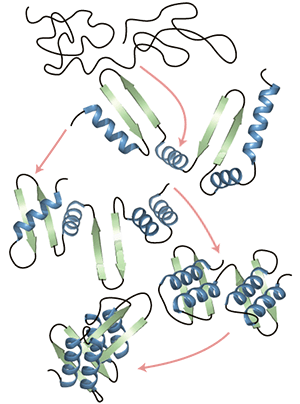
Proteomics [proh-tee-om-iks] is the large-scale study of proteins, particularly their structures and functions. Proteins are vital parts of living organisms, as they are the main components of the physiological metabolic pathways of cells. The term ‘proteomics’ was first coined in 1997 to make an analogy with genomics, the study of the genes. The word ‘proteome’ is a blend of ‘protein’ and ‘genome,’ and was coined by Australian geneticist, Marc Wilkins, in 1994. The proteome is the entire complement of proteins, including the modifications made to a particular set of proteins, produced by an organism or system. This will vary with time and distinct requirements, or stresses, that a cell or organism undergoes.
After genomics, proteomics is considered the next step in the study of biological systems. It is much more complicated than genomics mostly because while an organism’s genome is more or less constant, the proteome differs from cell to cell and from time to time. This is because distinct genes are expressed in distinct cell types. This means that even the basic set of proteins which are produced in a cell needs to be determined.
Posted in Health, Science, Technology |
Leave a Comment »





