March 31, 2011
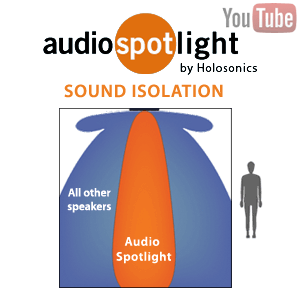
Sound from ultrasound refers to ultrasound (sound pressure with a frequency greater than the upper limit of human hearing, approx. 20 kilohertz) that has been modulated and demodulated. Ultrasound has wavelengths much smaller than audible sound and thus can be aimed in a much tighter narrow beam than any traditional audible loudspeaker system. A narrow beam of modulated ultrasound changes the speed of sound in the air that it passes through. The air within the beam extracts the signal from the ultrasound, resulting in sound that can be heard only along the path of the beam, or that appears to radiate from any surface that the beam strikes.
The practical effect of this technology is that a beam of sound can be projected over a long distance to be heard only in a small well-defined area. A listener outside the beam hears nothing. Anyone or anything that disrupts the path of the beam will interrupt the progression of the beam, like interrupting the illumination of a spotlight. For this reason, most systems are mounted overhead, like lighting. This technology was originally developed by the US Navy and Soviet Navy for underwater sonar in the mid-1960s, and was briefly investigated by Japanese researchers in the early 1980s, but these efforts were abandoned due to extremely poor sound quality (high distortion) and substantial system cost.
Posted in Money, Technology |
Leave a Comment »
March 31, 2011
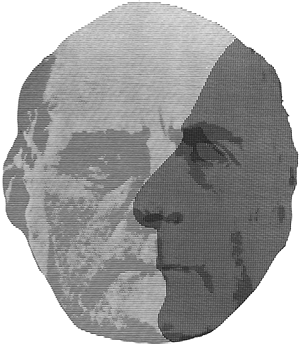
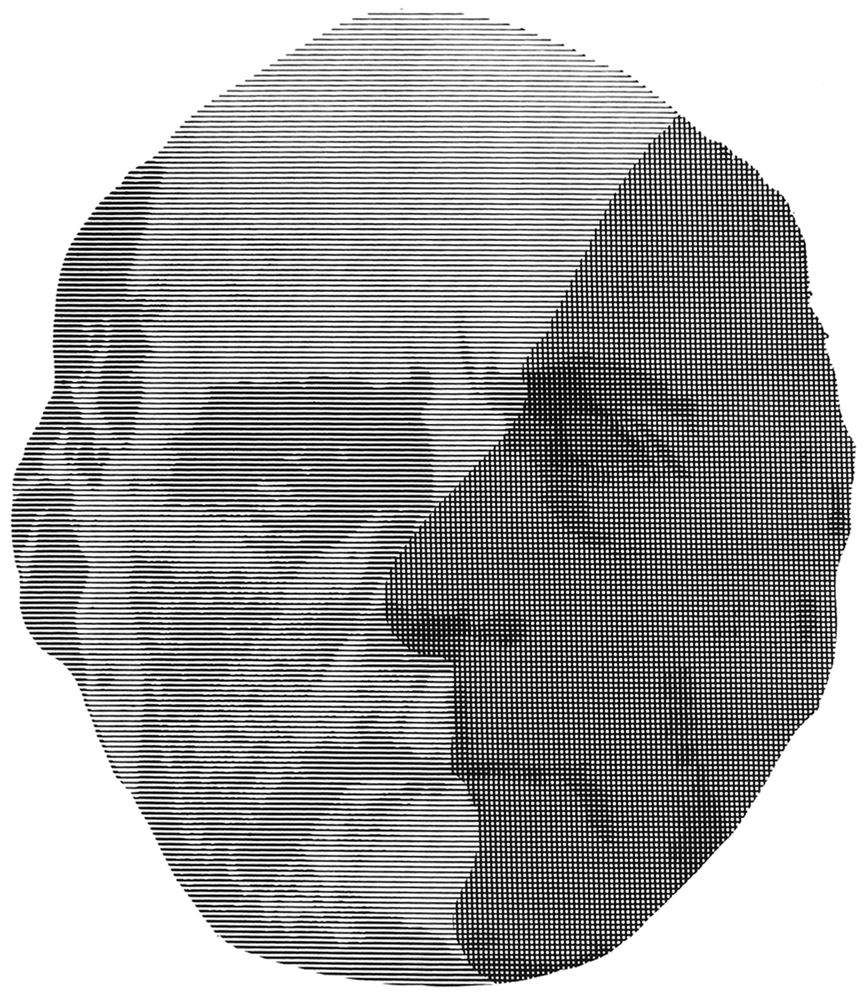
Francis Galton (1822 – 1911) was an English Victorian polymath: anthropologist, eugenicist, tropical explorer, geographer, inventor, meteorologist, and statistician. Galton had a prolific intellect, and produced over 340 papers and books throughout his lifetime. He also created the statistical concept of correlation. He was the first to apply statistical methods to the study of human differences and inheritance of intelligence, and introduced the use of questionnaires and surveys for collecting data on human communities.
He was a pioneer in eugenics, coining the term itself and the phrase ‘nature versus nurture.’ As the initiator of scientific meteorology, he devised the first weather map. He also invented the Dog Whistle for testing differential hearing ability.
Posted in Science, Technology, World |
Leave a Comment »
March 31, 2011

A dog whistle is a type of whistle used in the training of dogs and cats. It was invented by British polymath, Francis Galton. The frequency range of a dog whistle is largely out of the range of human hearing. Typically, a dog whistle is within the range of 16 to 22 kHz with only the frequencies below 20 kHz audible to the human ear.
Some dog whistles have adjustable sliders for active control of the frequency produced. Depending on the way the whistle is used, a trainer may simply gather a dog’s attention or inflict pain for the purpose of behavior modification. The name dog whistle is often used for both lung-powered whistles as well as electronic devices that emit ultrasonic sound via piezoelectric emitters. The electronic variety are sometimes coupled with bark detection circuits in an effort to curb barking behavior.
Posted in Technology |
Leave a Comment »
March 30, 2011

Velotype is the old trademark for a type of keyboard for typing text known as a syllabic chord keyboard, an invention of the Dutchmen Nico Berkelmans and Marius den Outer. The current tradename is Veyboard. Contrary to traditional QWERTY type keyboards, on which a typist usually presses one key at a time to create one character at a time, a Veyboard requires the user to press several keys simultaneously, producing syllables rather than letters.
A practiced ‘veyboarder’ can produce more text than on a traditional keyboard, as much as 200 words per minute, double the rate of a fast traditional typist. Because of this, Veyboards are often used for live applications, such as subtitling for television and for the hearing impaired. The keyboard is an orthographic chord keyboard, very different from chorded phonetic keyboards used for verbatim transcription, like the Stenotype.
Posted in Money, Technology, World |
Leave a Comment »
March 30, 2011

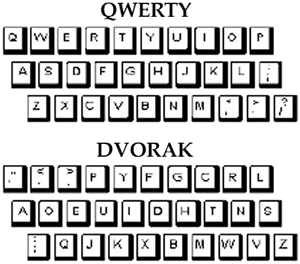
QWERTY is the most common modern-day keyboard layout. The name comes from the first six letters (keys) appearing in the top letter row of the keyboard, read left to right: Q-W-E-R-T-Y. The QWERTY design is based on a layout created by Christopher Latham Sholes in 1873 in Milwaukee, Wisconsin for the Sholes and Glidden typewriter and sold to Remington in the same year. The first model constructed by Sholes used a piano-like keyboard with two rows of characters arranged alphabetically.
The machine jammed at high typing speeds, so Sholes moved the keys he believed were most away from each other, to slow typists down. Several alternatives to QWERTY have been developed over the years, claimed by their designers and users to be more efficient, intuitive and ergonomic. Nevertheless, none has seen widespread adoption, due partly to the sheer dominance of available keyboards and training. The most widely used such alternative is the Dvorak Simplified Keyboard.
Posted in Language, Money, Technology |
Leave a Comment »
March 30, 2011

Liquid light shows or psychedelic light shows surfaced in the mid 1960s and early 1970s in America and Europe. They were an integral part of the Progressive music scene well into the seventies. Shows could be as simple as a single operator and two or three modified slide or overhead projectors and a couple of color wheels or as complex as shows with ten or more operators, 70 plus projectors (including liquid slide, liquid overhead, movie and still image models plus a vast array of highly advanced (for the time) special effects equipment).
read more »
Posted in Art, Drugs, Technology |
Leave a Comment »
March 29, 2011

AKIRA is a manga series by Katsuhiro Otomo. Set in a post-apocalyptic Neo-Tokyo, the work uses conventions of the cyberpunk genre to detail a saga of turmoil. Initially serialized in the pages of Young Magazine from 1982 until 1990, the work was collected in six volumes by Japanese publisher Kodansha. Otomo’s art on the series is considered outstanding, and the work is a breakthrough for both Otomo and the manga form.
An identically titled anime film adaptation was released in 1988, shortening the plot, but with its structure and scenes heavily informed by the manga and its serial origins. The manga takes place in a vastly larger time frame than the film and involves a far wider array of characters and subplots. Through the breadth of the work, Otomo explicates themes of social isolation, corruption and power.
read more »
Posted in Art, Technology, World |
Leave a Comment »
March 29, 2011

Akira is a 1988 Japanese animated science fiction film set in a futuristic and post-war city, Neo-Tokyo, in 2019. It was written and directed by Katsuhiro Otomo, who based it on his manga of the same name. The film explores a number of psychological and philosophical themes, such as the nature of corruption, the will to power, and the growth from childhood to maturity both in individuals and the human race itself. Elements of Buddhist and Christian symbolism are also present in the film. Other notable themes include youth culture, cyberpunk, delinquency, psychic awareness, social unrest and revolution, the world’s reaction toward a nuclear holocaust and Japan’s post-war economic revival.
The film’s plot focuses on Shotaro Kaneda, a biker gang member, as he tries to stop Tetsuo Shima from releasing Akira, the eponymous, principal subject of the story, a young boy who developed transcendent psionic, god-like abilities when serving as a test subject for secret government ESP experiments in the 1980s. He subsequently lost control of this power and the ensuing blast completely annihilated Tokyo in a horrifying explosion in 1988. After the apocalyptic event, Akira was recovered and sealed within a cryonic chamber underneath the Neo-Tokyo Olympic Stadium.
Posted in Art, Technology, World |
Leave a Comment »
March 28, 2011

Polymer banknotes were developed by the Reserve Bank of Australia, Commonwealth Scientific and Industrial Research Organization, and The University of Melbourne and were first issued as currency in Australia in 1988. These banknotes are made from the polymer biaxially-oriented polypropylene which greatly enhances durability. They also incorporate many security features not available to paper banknotes, making counterfeiting much more difficult. As of 2010, eight countries have converted fully to polymer banknotes: Australia, Bermuda, Brunei, New Zealand, Nicaragua, Papua New Guinea, Romania, and Vietnam.
An alternative polymer of polyethylene fibres marketed as Tyvek by DuPont was developed for use as currency by the American Bank Note Company in the early 1980s. Tyvek did not perform well in trials; smudging of ink and fragility were reported as problems. Only Costa Rica and Haiti issued Tyvek banknotes. Additionally, English printers Bradbury Wilkinson produced a version on Tyvek but marketed as Bradvek for the Isle of Man in 1983; however, they are no longer produced and have become collectors’ items.
Posted in Money, Technology, World |
Leave a Comment »
March 28, 2011
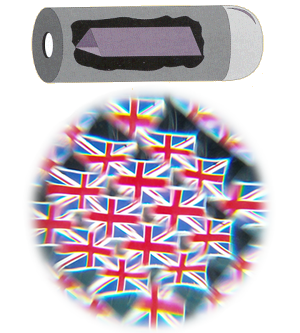
A teleidoscope [tel-ahy-duh-skohp] is a kind of kaleidoscope, with a lens and an open view, so it can be used to form kaleidoscopic patterns from objects outside the instrument, rather than from items installed as part of it. The lens at the end of the tube is not an optical requirement, but protects the internals of the teleidoscope. A spherical ball lens is often used. An advantage of using a sphere is that it will not press flat against the object being viewed, which would block all light and result in no image being seen.
The teleidoscope was invented by John Lyon Burnside III (1916 – 2008), and because he was also responsible for the rediscovery of the math behind kaleidoscope optics, for decades, every maker of optically correct kaleidoscopes sold in the US paid him royalties.
Posted in Games, Technology |
Leave a Comment »
March 28, 2011
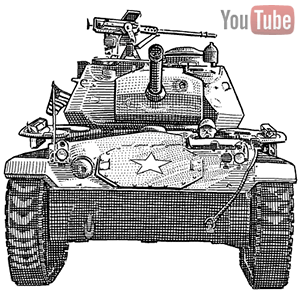
Shawn Nelson (1959 – 1995) was a U.S. Army veteran and unemployed plumber who stole an M60 Patton tank from a United States National Guard Armory in San Diego, California and went on a rampage, destroying cars, fire hydrants, and an RV before being shot dead by police. The tank’s weaponry was unloaded, but Nelson led police on a 23-minute, televised chase through the streets of San Diego. The tank had a top speed of just 30 miles per hour, but the 57-ton vehicle easily plowed through road signs, traffic lights, and crushed a van against a recreational vehicle, then plowed through the RV.
Nelson attempted to knock down a bridge by running in to the supports, but gave up after he failed to topple it with the first few hits. He eventually became caught on a concrete median of State Route 163, as he attempted to cross the median into the oncoming traffic. Four police officers climbed onto the tank and were able to open the hatch. The officers ordered Nelson to surrender, but he said nothing and began lurching the tank back and forth in attempt to free it from the median. Officer Paxton’s partner, Richard Piner, leaned in and shot Nelson. The bullet struck Nelson in the shoulder. Nelson later died in the hospital.
Posted in Technology, War |
Leave a Comment »
March 28, 2011

Marvin Heemeyer (1951 – 2004) was a welder and an automobile muffler repair shop owner. Outraged over the outcome of a zoning dispute, he armored a bulldozer with layers of steel and concrete and used it to demolish the town hall, a former judge’s home, and other buildings in Granby, Colorado.
The rampage ended when the bulldozer became stuck, and after a standoff with law enforcement agencies, Heemeyer killed himself with a handgun. He had been feuding with town officials, particularly over fines for violating city ordinances and a zoning dispute regarding a concrete factory constructed opposite to his muffler shop that caused his business to fail. Heemeyer took about a year and a half to prepare for his rampage.
read more »
Posted in Death, Technology |
Leave a Comment »