April 4, 2011
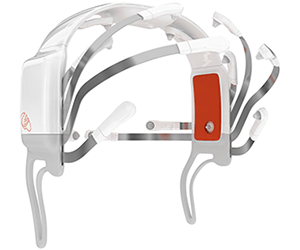
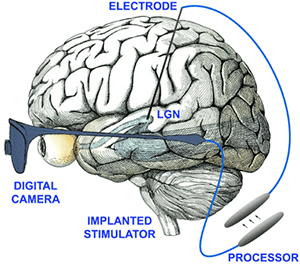
A brain–computer interface (BCI) is a direct communication pathway between the brain and an external device. BCIs are often aimed at assisting, augmenting or repairing human cognitive or sensory-motor functions. Research on BCIs began in the 1970s at UCLA under a grant from the National Science Foundation, followed by a contract from DARPA.
The field has since focused primarily on neuroprosthetics applications that aim at restoring damaged hearing, sight and movement. Thanks to the remarkable cortical plasticity of the brain, signals from implanted prostheses can, after adaptation, be handled by the brain like natural sensor or effector channels.
Posted in Health, Money, Technology |
Leave a Comment »
April 4, 2011


Deltron 3030 is an alternative hip hop supergroup composed of producer Dan the Automator, rapper Del tha Funkee Homosapien and DJ Kid Koala. Their work features many other artists as well, all taking on various futuristic pseudonyms. The group’s debut album Deltron 3030, released in 2000, is a concept album set in the year 3030 that tells of the fight by Deltron Zero (Del’s alter ego) against huge corporations that rule the universe.
The lyrics were written in less than two weeks and are characterized by extravagant allusions to futuristic outer-space themes in the tradition of Afrofuturist works by Sun Ra and George Clinton. Many samples originated with the contemporary French classical composer William Sheller. Del tha Funkee Homosapien’s lyrics veer from serious social commentary to humor to epic sci-fi battles, while producer Dan the Automator creates an eerie and dense atmosphere. Following the release of the album, all three members worked on the Gorillaz’ self-titled debut album. Deltron 3030’s second album will be titled Deltron Event II. Production began in 2006 and is still in progress.
Posted in Art, Money, Technology |
Leave a Comment »
April 4, 2011

Deltron 3030 is the debut album by hip hop supergroup Deltron 3030. Released in 2000, it is a rap opera concept album set in a dystopian year 3030.
The album follows Deltron Zero’s fight against an oppressive government and powerful corporations, while also battling to be the Galactic Rhyme Federation Champion. Del tha Funkee Homosapien’s lyrics veer from serious social commentary to humor to epic sci-fi battles, while producer Dan the Automator creates an eerie and dense atmosphere.
Posted in Art, Money, Technology |
Leave a Comment »
April 3, 2011

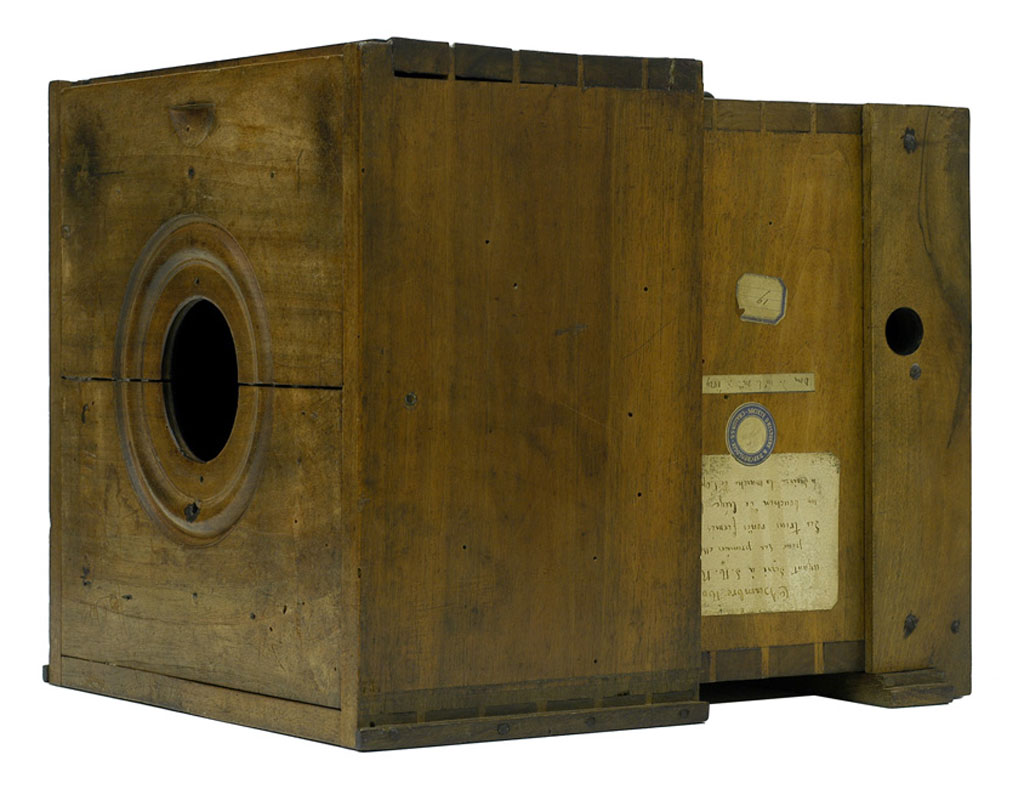
Photogravure [foh-tuh-gruh-vyoor] is a photo-mechanical process whereby a copper plate is coated with a light-sensitive gelatin tissue which had been exposed to a film positive, and then etched, resulting in a high quality intaglio print that can reproduce the detail and continuous tones of a photograph. The earliest forms of photogravure were developed in the 1830s by the original pioneers of photography itself, Henry Fox Talbot in England and Nicéphore Niépce in France.
They were seeking a means to make prints that would not fade, by creating photographic images on plates that could then be etched. The etched plates could then be printed using a traditional printing press. These early images were among the first photographs, pre-dating daguerreotypes and the later wet-collodion photographic processes. Photogravure in its mature form was developed in 1878 by Czech painter Karel Klíč, who built on Talbot’s research. This process, the one still in use today, is called the Talbot-Klič process.
Posted in Art, Money, Technology |
Leave a Comment »
April 3, 2011
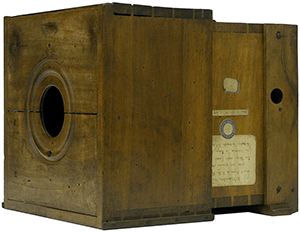

Nicéphore Niépce (1765 – 1833) was a French inventor, most noted as one of the inventors of photography and a pioneer in the field. He is credited with taking the world’s first known photograph in 1825.
Among Niépce’s other inventions was the Pyréolophore, the world’s first ‘internal combustion engine’, which he conceived, created, and developed with his older brother Claude, finally receiving a patent in 1807 from the Emperor Napoleon Bonaparte, after successfully powering a boat upstream on the river Saône.
read more »
Posted in Art, Money, Technology |
Leave a Comment »
April 2, 2011

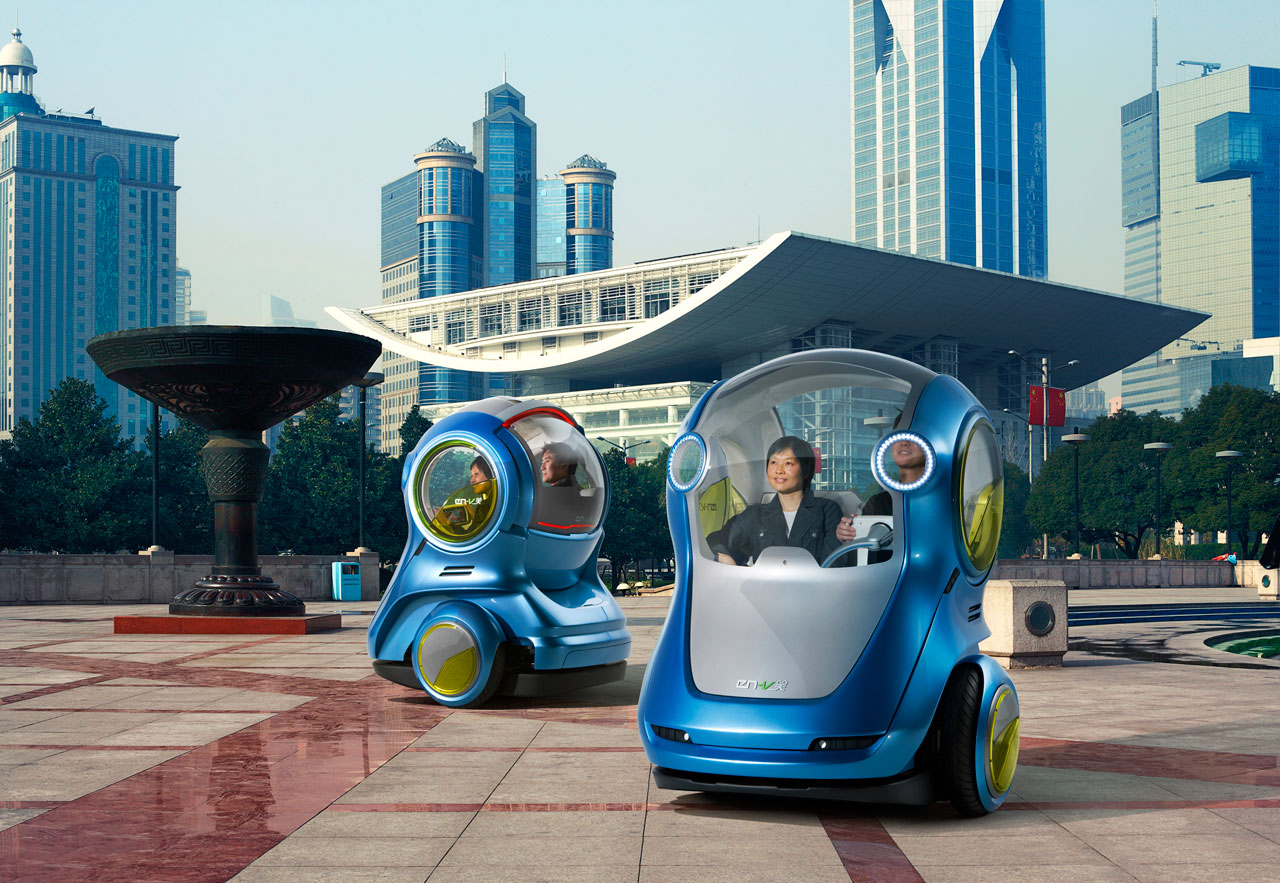
General Motors EN-V (Electric Networked-Vehicle) is a 2-seat urban electric concept car developed by GM that can be driven normally or operated autonomously. Designed for urban environments and around an extrapolation of the P.U.M.A. prototype announced in 2009 by GM and Segway, which contributed the two-wheeled balancing system. Three different vehicles are showcased, Xiao (Laugh), Jiao (Pride) and Miao (Magic). The EN-V can detect and avoid obstacles–including other vehicles–park themselves and will come when called by phone. Accomplished through a combination of GPS, vehicle-based sensors and vehicle-to-vehicle communication.
This autonomous technology is an extrapolation of that found in GM’s 2007 autonomous ‘The Boss’ Chevrolet Tahoe created for the DARPA Grand Challenge (2007). The EN-Vs can communicate with each other allowing platooning, with one or more EN-Vs tagging along automatically behind a leader. Also, if an EN-V detects another in close proximity, it can check what that other is intending to do and agree on how to pass it safely. Powered by two electric motors, one on each wheel, and a lithium-ion phosphate battery, the EN-V has a top speed of 40 kilometers per hour (25 mph) and a maximum all-electric range of 40 kilometers (25 mi).
Posted in Money, Technology |
Leave a Comment »
April 2, 2011

The Google Driverless Car project is currently being led by engineer Sebastian Thrun, director of the Stanford Artificial Intelligence Laboratory and co-inventor of Google Street View, whose team at Stanford created the robotic vehicle Stanley which won the 2005 DARPA Grand Challenge (the second driverless car competition by the Defense Advanced Research Projects Agency) and its $2 million prize from the United States Department of Defense.
The system combines information gathered for Google Street View with input from video cameras inside the car, a LIDAR sensor on top of the vehicle, radar sensors on the front of the vehicle, and a position sensor attached to one of the rear wheels that helps locate the car’s position on the map.
read more »
Posted in Money, Technology |
Leave a Comment »
April 1, 2011

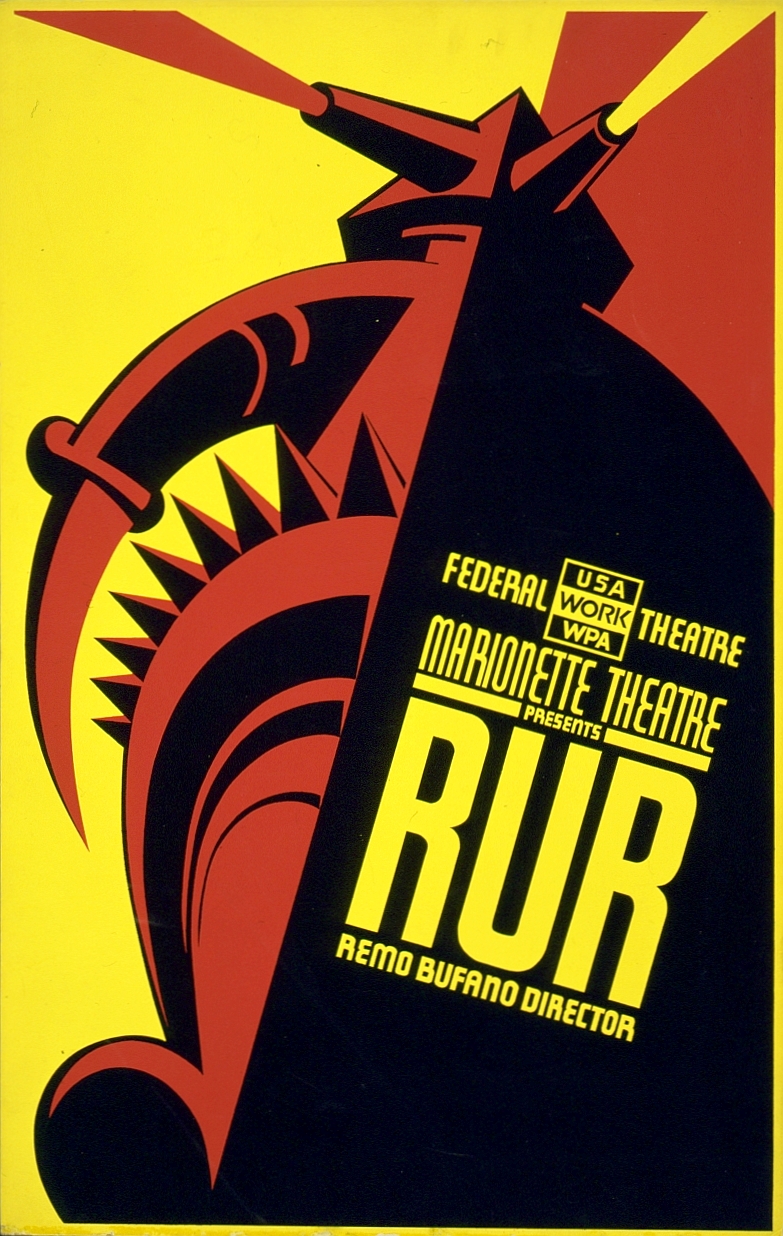
R.U.R. is a 1921 science fiction play in the Czech language by Karel Čapek. R.U.R. stands for Rossum’s Universal Robots, an English phrase used as the subtitle in the Czech original. The play begins in a factory that makes artificial people called ‘robots.’ Unlike the modern usage of the term, these creatures are closer to the modern idea of androids or even clones, as they can be mistaken for humans and can think for themselves.
They seem happy to work for humans, although that changes and a hostile robot rebellion leads to the extinction of the human race. After finishing the manuscript, Čapek realized that he had created a modern version of the Jewish Golem legend. The play introduced the word ‘Robot’ which displaced older words such as ‘automaton’ or ‘android’ in languages around the world. In its original Czech, ‘robota’ means forced labor of the kind that serfs had to perform on their masters’ lands, and is derived from rab, meaning ‘slave.’
Posted in Art, Language, Technology |
Leave a Comment »
April 1, 2011
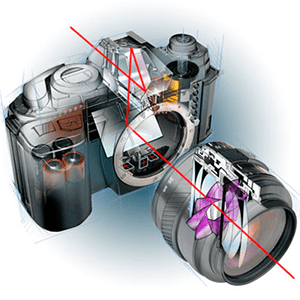
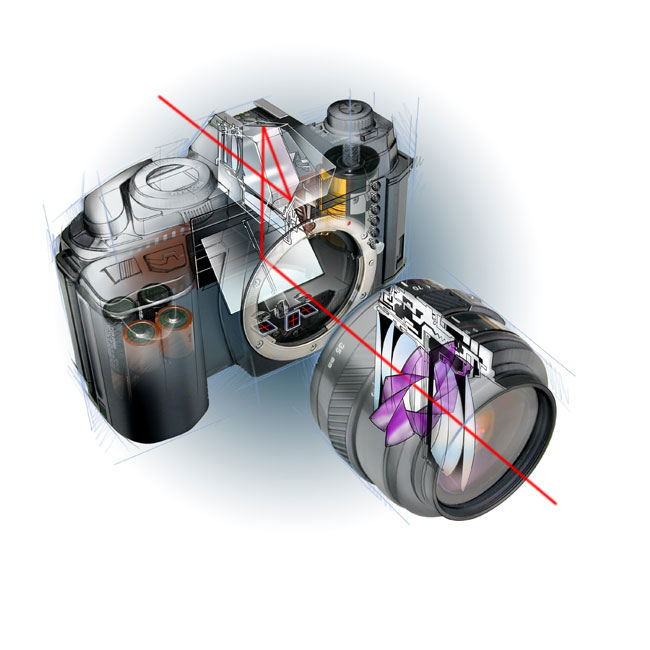
Digital single-lens reflex cameras (DSLR) are cameras that use a mechanical mirror system and pentaprism to direct light from the lens to an optical viewfinder on the back of the camera. The basic operation of a DSLR is as follows: for viewing purposes, the mirror reflects the light coming through the attached lens upwards at a 90 degree angle. It is then reflected three times by the roof pentaprism, rectifying it for the photographer’s eye.
During exposure, the mirror assembly swings upward, the aperture narrows (if stopped down, or set smaller than wide open), and a shutter opens, allowing the lens to project light onto the image sensor. A second shutter then covers the sensor, ending the exposure, and the mirror lowers while the shutter resets. All of this happens automatically over a period of milliseconds, with cameras designed to do this 3–10 times per second.
Posted in Money, Technology |
Leave a Comment »
April 1, 2011
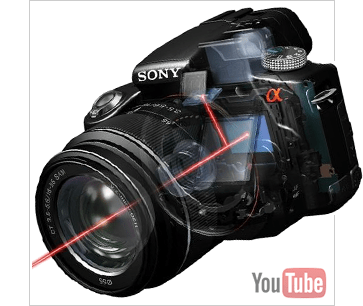
A Single-Lens Translucent (SLT) camera is similar to a Digital Single-Lens Relex (DSLR) but uses a beam splitter instead of a solid mirror. Unlike DSLRs SLT cameras do not have an optical viewfinder, instead they rely on an electronic viewfinder, using the image collected by the sensor. A DSLR mirror allows the user to directly view the image that is passing through the lens; in a SLT the mirror is only used for focusing.
A semi-translucent mirror allows the majority of the light to pass through to the sensor while reflecting a portion of the light onto a phase-detection autofocus sensor in the top of the camera, allowing the camera to take photos without any mirror movement (and associated vibrations), as well as full time auto focus. Since the autofocus array is constantly receiving light, SLT cameras are able to use phase-detection autofocus during video recording, while DSLR’s and other interchangeable lens cameras have to use slower contrast detect autofocus for video and live view.
Posted in Money, Technology |
Leave a Comment »
April 1, 2011


A mirrorless interchangeable lens camera is an emerging class of digital system cameras, intermediate between compact digital cameras and digital single-lens reflex cameras (DSLRs).
They are characterized by large sensors (the same size as entry-level DSLRs), no mirror, and interchangeable lenses, as the name suggests, and provide DSLR-quality pictures in a significantly smaller camera.
Posted in Money, Technology |
Leave a Comment »
April 1, 2011

A molten salt reactor (MSR) is a type of nuclear fission reactor in which the primary coolant is a molten salt mixture, which can run at high temperatures (for higher thermodynamic efficiency) while staying at low vapor pressure for reduced mechanical stress and increased safety, and is less reactive than molten sodium coolant.
The nuclear fuel may be solid fuel rods, or dissolved in the coolant itself, which eliminates fuel fabrication, simplifies reactor structure, equalizes burnup, and allows online reprocessing. One kind of proposed MSR is a liquid fluoride thorium reactor (LFTR). Thorium is a naturally occurring radioactive chemical element estimated to be about three to four times more abundant than uranium in the Earth’s crust.
Posted in Money, Technology |
Leave a Comment »