April 17, 2013

Mark Ryden (b. 1963) is an American painter. Ryden is one of the most well known artists of the Pop Surrealist movement, an underground, pop-culture-infused art scene with its origins in 1970s Southern California. He was dubbed ‘the god-father of pop surrealism’ by ‘Interview Magazine.’ Ryden’s aesthetic is developed from subtle amalgams of many sources: from Ingres, David and other French classicists to ‘Little Golden Books.’
Ryden also draws his inspiration from anything that will evoke mystery; old toys, anatomical models, stuffed animals, skeletons and religious ephemera found in flea markets. According to ‘The New York Times,’ ‘Ryden’s pictures hint at the psychic stuff that pullulates beneath the sentimental, nostalgic and naïve surface of modern kitsch.’
Continue reading →
Posted in Art |
Leave a Comment »
April 17, 2013

The Korova Milk Bar (‘korova’ is Russian for ‘cow’) appears in the novel and film ‘A Clockwork Orange’ by Anthony Burgess. It is a twisted version of a milk bar (general store) that serves milk laced with drugs. The novel begins with the droogs (friends) sitting in their favorite hangout, drinking milk-drug cocktails, called ‘milk-plus,’ to hype themselves for the night’s mayhem.
The protagonist and narrator Alex lists some of the (fictitious) ingredients one can request: vellocet (opiate), synthemesc (synthetic mescalines), drencrom (adrenochrome). For another ingredient he advises to, ‘(drink the milk) ‘with knives in it,’ as it ‘would sharpen you up.” By serving milk (instead of alcohol), the bar is able to serve minors. In the film, the bar has furniture in the shape of naked women and the milk is served from their nipples.
Posted in Drugs, Food |
Leave a Comment »
April 17, 2013

Jen Stark (b. 1983) is a contemporary artist who creates paper sculptures. She also works with drawing and animation. She draws inspiration from microscopic patterns in nature, wormholes, and sliced anatomy. She studied at the Maryland Institute College of Art (MICA), graduating Magna Cum Laude with a BFA majoring in Fibers with a minor in Animation.
Stark’s ideas are based on replication and infinity, echoing patterns found in nature. Since expanding her medium from paper to include wood and even mirrors, Stark’s oeuvre of optically and methodologically baffling sculptures and drawings has enjoyed a renaissance of context. Her signature creations combine a variety of materials in hypnotic mandala-like configurations. Stark lives and works in Miami, Fl.
Posted in Art |
Leave a Comment »
April 17, 2013

A white elephant is an idiom for a valuable but burdensome possession of which its owner cannot dispose and whose cost (particularly cost of upkeep) is out of proportion to its usefulness or worth. The term derives from the story that the kings of Siam (now Thailand) were accustomed to make a present of one of these animals to courtiers who had rendered themselves obnoxious, in order to ruin the recipient by the cost of its maintenance. In modern usage, it is an object, scheme, business venture, facility, etc., considered to be without use or value.
The term derives from the sacred white elephants kept by Southeast Asian monarchs in Burma, Thailand, Laos, and Cambodia. To possess a white elephant was regarded (and is still regarded in Thailand and Burma) as a sign that the monarch reigned with justice and power, and that the kingdom was blessed with peace and prosperity. Continue reading →
Posted in Language, Philosophy |
Leave a Comment »
April 17, 2013
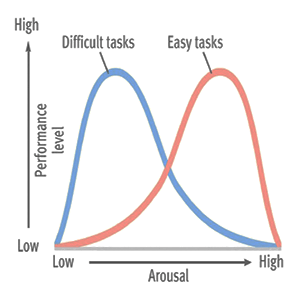
The Yerkes–Dodson law is an empirical relationship between arousal and performance, originally developed by psychologists Robert M. Yerkes and John Dillingham Dodson in 1908. The law dictates that performance increases with physiological or mental arousal, but only up to a point. When levels of arousal become too high, performance decreases. The process is often illustrated graphically as a curvilinear, inverted U-shaped curve which increases and then decreases with higher levels of arousal.
Research has found that different tasks require different levels of arousal for optimal performance. For example, difficult or intellectually demanding tasks may require a lower level of arousal (to facilitate concentration), whereas tasks demanding stamina or persistence may be performed better with higher levels of arousal (to increase motivation). Continue reading →
Posted in Health, Science |
4 Comments »
April 16, 2013
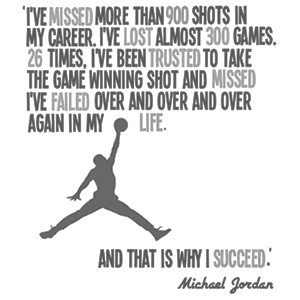
Failure is the state or condition of not meeting a desirable or intended objective, and may be viewed as the opposite of success. Product failure ranges from failure to sell the product to fracture of the product, in the worst cases leading to personal injury, the province of forensic engineering. Former IBM CEO Thomas J. Watson is attributed with saying ‘If you want to succeed, double your failure rate.’ ‘
Wired Magazine’ editor Kevin Kelly likewise explains that a great deal can be learned from things going unexpectedly, and that part of science’s success comes from keeping blunders ‘small, manageable, constant, and trackable.’ He uses the example of engineers and programmers who push systems to their limits, breaking them to learn about them. Kelly also warns against creating a culture (e.g. school system) that punishes failure harshly, because this inhibits a creative process, and risks teaching people not to communicate important failures with others (e.g. Null results).
Continue reading →
Posted in Language, Money, Science |
Leave a Comment »
April 16, 2013
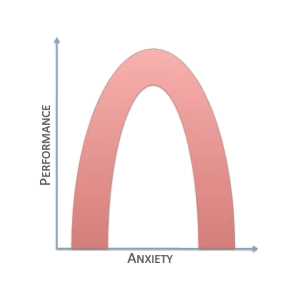
Atychiphobia [at-i-kuh-foh-bee-uh] (‘atyches’ meaning ‘unfortunate’) is the abnormal, unwarranted, and persistent fear of failure. As with many phobias, atychiphobia often leads to a constricted lifestyle, and is particularly devastating for its effects on a person’s willingness to attempt certain activities. A person afflicted with atychiphobia considers the possibility of failure so intense that they choose not to take the risk.
Oftentimes this person will subconsciously undermine their own efforts so that they no longer have to continue to try. Because effort is proportionate to the achievement of personal goals and fulfillment, this unwillingness to try, which arises from the perceived inequality between the possibilities of success and failure, holds the atychiphobic back from a life of meaning and the realization of potential. Continue reading →
Posted in Health |
Leave a Comment »
April 16, 2013

The biophilia [bahy-oh-fil-ee-uh] hypothesis suggests that there is an instinctive bond between human beings and other living systems. American biologist Edward O. Wilson introduced and popularized the hypothesis in his book, ‘Biophilia’ (1984). He defines ‘biophilia’ as ‘the urge to affiliate with other forms of life.’
The term literally means ‘love of life or living systems.’ It was first used by German sociologist Erich Fromm to describe a psychological orientation of being attracted to all that is alive and vital. Wilson uses the term in the same sense when he suggests that biophilia describes ‘the connections that human beings subconsciously seek with the rest of life.’ He proposed the possibility that the deep affiliations humans have with nature are rooted in our biology. Unlike phobias, which are the aversions and fears that people have of things in the natural world, philias are the attractions and positive feelings that people have toward certain habitats, activities, and objects in their natural surroundings.
Continue reading →
Posted in Health, Science |
Leave a Comment »
April 16, 2013
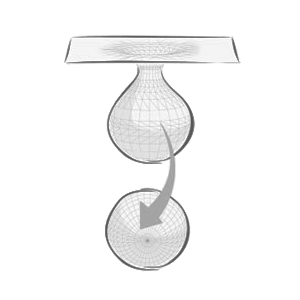
Fecund [fee-kuhnd] universes is a multiverse theory by American theoretical physicist Lee Smolin, also called cosmological natural selection theory, suggesting that a process analogous to biological natural selection applies at the grandest scales. Smolin summarized the idea in a book aimed at a lay audience called ‘The Life of the Cosmos.’ The theory surmises that a collapsing black hole causes the emergence of a new universe on the ‘other side,’ whose fundamental constant parameters (speed of light, Planck length, and so forth) may differ slightly from those of the universe where the black hole collapsed. Each universe therefore gives rise to as many new universes as it has black holes.
Thus the theory contains the evolutionary ideas of ‘reproduction’ and ‘mutation’ of universes, but has no direct analogue of natural selection. However, given any universe that can produce black holes that successfully spawn new universes, it is possible that some number of those universes will reach heat death with unsuccessful parameters. So, in a sense, fecundity cosmological natural selection is one where universes could die off before successfully reproducing, just as any biological being can die without having offspring.
Continue reading →
Posted in Philosophy, Science |
2 Comments »
April 16, 2013

The evil twin is an antagonist found in many different fictional genres. They are physical copies of protagonists, but with radically inverted moralities. In filmed entertainment, they can have obvious physical differences with the protagonist—such as facial hair (often a goatee), eyepatches, scars or distinctive clothing—that make it easy for the audience to visually identify the two characters. Sometimes, however, the physical differences between the characters will be minimized, so as to confuse the audience. Both roles are almost always played by either the same actor or the actor’s actual twin (if the actor has one).
Though there may be moral disparity between actual biological twins, the term is more often a misnomer. In many cases, the two look-alikes are not actually twins, but rather physical duplicates produced by other phenomena (e.g. alternate universes). In others, the so-called ‘evil’ twin is more precisely a dual opposite to their ‘good’ counterpart, possessing at least some commonality with the value system of the protagonist.
Continue reading →
Posted in Humor, Language, Philosophy |
Leave a Comment »
April 16, 2013
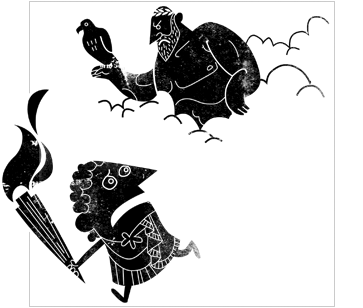
A culture hero is a mythological hero specific to some group (cultural, ethnic, religious, etc.) who changes the world through invention or discovery. A typical culture hero might be credited as the discoverer of fire, or agriculture, songs, tradition, law or religion, and is usually the most important legendary figure of a people, sometimes as the founder of its ruling dynasty. In some cultures, there are dualistic myths, featuring two culture heroes arranging the world in a complementary manner. Dualistic cosmologies are present in all inhabited continents and show great diversity: they may feature culture heroes, but also demiurges (artisan-like figures responsible for the fashioning and maintenance of the physical universe), or other beings; the two heroes may compete or collaborate; they may be conceived as neutral or contrasted as good versus evil; be of the same importance or distinguished as powerful versus weak; be brothers (even twins) or be not relatives at all.
In many cultures, the mythical figure of the trickster and the culture hero are combined. To illustrate, Prometheus, in Greek mythology, stole fire from the gods to give it to humans. In many Native American mythologies and beliefs, the coyote spirit stole fire from the gods (or stars or sun) and is more of a trickster than a culture hero. Natives from the Southeastern US typically saw a rabbit trickster/culture hero, and Pacific Northwest native stories often feature a raven in this role: in some stories, Raven steals fire from his uncle Beaver and eventually gives it to humans. The Western African trickster spider Ananse is also widely disseminated.
Posted in Philosophy, World |
Leave a Comment »
April 16, 2013
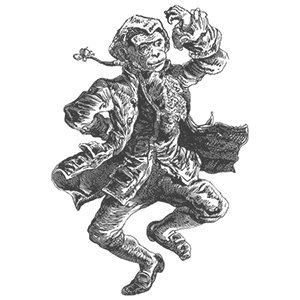
Signifyin’ (vernacular) is a practice in African-American culture, involving a verbal strategy of indirection that exploits the gap between the denotative and figurative meanings of words. According to African-American literary scholar Henry Louis Gates Jr., the practice derived from the Trickster archetype found in much African mythology, folklore, and religion: a god, goddess, spirit, man, woman, or anthropomorphic animal who plays tricks or otherwise disobeys normal rules and societal norms. In practice, signifyin’ often takes the form of quoting from subcultural vernacular, while extending the meaning at the same time through a rhetorical figure.
The expression itself derives from the numerous tales about the Signifying Monkey, a folk trickster figure said to have originated during slavery in the United States. In most of these narratives, the Monkey manages to dupe the powerful Lion by signifying. Signifyin(g) directs attention to the connotative, context-bound significance of words, which is accessible only to those who share the unique cultural values of a given speech community.
Continue reading →
Posted in Humor, Language, Politics |
Leave a Comment »



