January 28, 2013

Charles Wheelan is the author of ‘Naked Economics: Undressing the Dismal Science,’ a 2002 book that attempts to translate basic economic issues into a format that can be easily read by people with little or no previous knowledge of economics. In 2013, he published a follow-up called ‘Naked Statistics: Stripping the Dread from the Data.’
In 2009, he was an unsuccessful Democratic candidate in the special election for Illinois’s 5th congressional district, the seat vacated by Rahm Emanuel. Wheelan graduated from Dartmouth College, where he was a member of Alpha Delta fraternity. From 1997 to 2002, he was the Midwest correspondent for ‘The Economist.’ Wheelan is a regular contributor to the ‘Motley Fool Radio Show’ on National Public Radio and to the ‘Eight Forty-Eight’ program on WBEZ, Chicago Public Radio.
Posted in Education, Language, Money |
Leave a Comment »
January 28, 2013

The Centre for the Study of Existential Risk (CSER) is a proposed research centre at the University of Cambridge, intended to study possible catastrophic threats posed by present or future technology. The co-founders of the project to establish the center are Huw Price (a philosophy professor at Cambridge), Martin Rees (cosmology and astrophysics professor and former President of the Royal Society) and Jaan Tallinn (a computer programmer and co-founder of Skype).
Among the risks to be studied by the proposed center are those that might arise from developments in artificial intelligence, a risk likened in some press coverage to that of a robot uprising à la ‘The Terminator.’ Speaking about this case, Professor Price said, ‘It seems a reasonable prediction that some time in this or the next century intelligence will escape from the constraints of biology.’ He added that when this happens ‘we’re no longer the smartest things around,’ and will risk being at the mercy of ‘machines that are not malicious, but machines whose interests don’t include us.’
Posted in Death, Education, Technology |
2 Comments »
January 28, 2013

Buildering (also known as urban climbing, structuring, or stegophily) is the act of climbing on (usually) the outside of buildings and other artificial structures.
The word is a portmanteau, combining the word ‘building’ with the climbing term ‘bouldering’. If done without ropes or protection far off the ground, buildering may be dangerous. It is often practiced outside legal bounds, and is thus mostly undertaken at night-time.
Continue reading →
Posted in Games, Humor |
Leave a Comment »
January 28, 2013

Security through obscurity is a pejorative referring to a principle in security engineering, which attempts to use secrecy of design or implementation to provide security. A system relying on security through obscurity may have theoretical or actual security vulnerabilities, but its owners or designers believe that if the flaws are not known, then attackers will be unlikely to find them. The technique stands in contrast with security by design and open security, although many real-world projects include elements of several strategies.
Security through obscurity has never achieved engineering acceptance as an approach to securing a system, as it contradicts the principle of ‘keeping it simple.’ The United States National Institute of Standards and Technology (NIST) specifically recommends against security through obscurity in more than one document. Quoting from one, ‘System security should not depend on the secrecy of the implementation or its components.’ Continue reading →
Posted in Politics, Technology, War |
Leave a Comment »
January 28, 2013

‘The little boy’s mother was off to market. She worried about her boy, who was always up to some mischief. She sternly admonished him, ‘Be good. Don’t get into trouble. Don’t eat all the cabbage. Don’t spill all the milk. Don’t throw stones at the cow. Don’t fall down the well.’ The boy had done all of these things on other market days. Hoping to head off new trouble, she added, ‘And don’t stuff beans up your nose!’
This was a new idea for the boy, who promptly tried it out.’ In our zeal to head off others’ unwise action, we may put forth ideas they have not entertained before. It may be wise not to caution against such possibilities. Prophylactic admonition may trigger novel mischief. As the popular saying goes, ‘don’t give ’em any ideas.’
Posted in Education, Humor |
Leave a Comment »
January 28, 2013

The First law of holes is a proverb attributed to British politician Denis Healey. It states, ‘If you find yourself in a hole, stop digging.’
The meaning behind this proverb is that if you find yourself in an undesirable situation (‘the hole’), such as an argument with others, you should not ignore the situation or attempt to continue what you were doing (the ‘digging’), as it can make the situation worse. It has been cited numerous times by other politicians and in books.
Posted in Humor, Language, Politics |
Leave a Comment »
January 25, 2013


Torture has been used throughout history to force individuals to divulge vital information. It’s effectiveness is highly controversial, and some who oppose its use argue that it is violent, horrific, and useless.
On the subject, Ali Soufan, a former FBI agent and an expert on al-Qaeda operation says the following ‘Time and time again, people with actual experience with interrogating terror suspects and actual experience and knowledge about the effectiveness of torture techniques have come out to explain that they are ineffective and that their use threatens national security more than it helps.’ Whilst Prof. Dershowitz, a person morally opposed to torture, says that he believes law enforcement officials will employ torture in ‘ticking bomb’ cases, an article by Dr. Marvin Zalman says that ‘the problem is that the ‘ticking bomb’ scenario is a myth.’ Continue reading →
Posted in Politics, War |
Leave a Comment »
January 24, 2013

Animutation is a form of web-based computer animation, typically created in Adobe Flash and characterized by unpredictable montages of pop-culture images set to music, often in a language foreign to the intended viewers. It is not to be confused with manual collage animation (e.g., the work of Stan Vanderbeek and Terry Gilliam) which predates the Internet.
Animutation was ‘invented’ by American comedian Neil Cicierega. Cicierega claims to have been inspired by several sources, notably bizarre Japanese commercials (parodied, for example, by the Simpsons’ Mr. Sparkle), and Martin Holmström’s ‘Hatten är din’ Soramimi video (interpreting lyrics in one language as similar-sounding lyrics in another language) made for the ‘Habbeetik’ song by Azar Habib. Continue reading →
Posted in Humor, Language, World |
Leave a Comment »
January 23, 2013

Soramimi (‘mishearing’; [feigned] ‘deafness’) and Soramimi kashi (‘misheard lyrics’) are Japanese terms for homophonic translation of song lyrics, that is, interpreting lyrics in one language as similar-sounding lyrics in another language. A bilingual soramimi word play contrasts with a monolingual mondegreen (mishearing a phrase as a result of near-homophony, in a way that gives it a new meaning).
And example of Soramimi kashi is the Moldovan band O-Zone’s song ‘Dragostea din tei’ (named from the words in the opening of the song), known on the web as the ‘Numa Numa’ song. The refrain of the original song (in Romanian) is: ‘Vrei să pleci dar nu mă, nu mă iei…’ (‘You want to leave but you don’t want, don’t want to take me…’) A soramimi version, from the Japanese flash animation ‘Maiyahi,’ translates these words as: ‘Bei sa, beishu ka, nomanoma-yei!’ (‘Rice, is it, rice wine, drink it drink it yeah!’) Continue reading →
Posted in Humor, Language, World |
Leave a Comment »
January 23, 2013

A mondegreen [mon-di-green] is the mishearing or misinterpretation of a phrase as a result of near-homophony, in a way that gives it a new meaning. It most commonly is applied to a line in a poem or a lyric in a song. American writer Sylvia Wright coined the term in her essay ‘The Death of Lady Mondegreen,’ published in ‘Harper’s Magazine’ in 1954. The phenomenon is not limited to English, with examples cited by Fyodor Dostoyevsky, in the Hebrew song ‘Háva Nagíla’ (‘Let’s Be Happy’), and in Bollywood movies.
A closely related category is ‘soramimi’—songs that produce unintended meanings when homophonically translated to another language. The unintentionally incorrect use of similar-sounding words or phrases in speaking is a malapropism. If there is a connection in meaning, it can be called an ‘eggcorn.’ If a person stubbornly sticks to a mispronunciation after being corrected, that can be described as ‘mumpsimus.’ Continue reading →
Posted in Humor, Language |
Leave a Comment »
January 23, 2013

Second Variety is an influential short story by Philip K. Dick first published in ‘Space Science Fiction’ magazine in 1953. A nuclear war between the Soviet Union and the West has reduced much of the world to a barren wasteland.
The war continues however among the scattered remains of humanity. The Western forces have recently developed ‘claws,’ which are autonomous self-replicating robots to fight on their side. It is one of Dick’s many stories in which nuclear war has rendered the Earth’s surface uninhabitable. The story was adapted to the movie ‘Screamers’ in 1995.
Posted in Art, Language, Technology |
Leave a Comment »
January 23, 2013
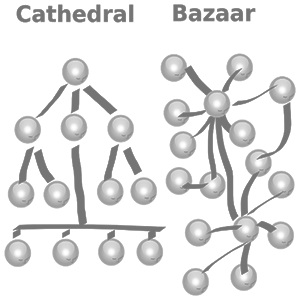
‘The Cathedral and the Bazaar: Musings on Linux and Open Source by an Accidental Revolutionary’ is an essay by Eric S. Raymond on software engineering methods, based on his observations of the Linux kernel development process and his experiences managing an open source project, fetchmail. It examines the struggle between top-down and bottom-up design. It was first presented by the author at the Linux Kongress in 1997 in Germany and was published as part of a book of the same name in 1999.
The essay contrasts two different free software development models: the Cathedral model, in which source code is available with each software release, but code developed between releases is restricted to an exclusive group of software developers. And, the Bazaar model, in which the code is developed over the Internet in view of the public. Raymond credits Linus Torvalds, leader of the Linux kernel project, as the inventor of this process. Raymond also provides anecdotal accounts of his own implementation of this model for the Fetchmail project. Continue reading →
Posted in Language, Technology |
Leave a Comment »


 The Daily Omnivore