November 5, 2012

Chemophobia literally means ‘fear of chemicals.’ It is most often used to describe the assumption that ‘chemicals’ (i.e., man-made products or artificially concentrated but naturally occurring chemicals) are bad and harmful, while ‘natural’ things (i.e., chemical compounds that occur naturally or that are obtained using traditional techniques) are good and healthy.
General chemophobia derives from incomplete knowledge of science, or a misunderstanding of science, and is a form of technophobia and fear of the unknown. In terms of chemical safety, ‘industrial,’ ‘synthetic’ ‘artificial,’ and ‘man-made’ do not necessarily mean damaging, and ‘natural’ does not necessarily mean better.
Continue reading →
Posted in Health, Science |
Leave a Comment »
November 5, 2012

The fine-tuned Universe is the proposition that the conditions that allow life in the Universe can only occur when certain universal fundamental physical constants lie within a very narrow range, so that if any of several fundamental constants were only slightly different, the Universe would be unlikely to be conducive to the establishment and development of matter, astronomical structures, elemental diversity, or life as it is presently understood.
The existence and extent of fine-tuning in the Universe is a matter of dispute in the scientific community.
Continue reading →
Posted in Philosophy, Science |
2 Comments »
November 4, 2012
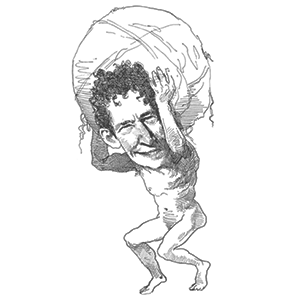
In astrophysics and cosmology, the anthropic [an-throp-ik] principle is the philosophical consideration that observations of the physical Universe must be compatible with the conscious life that observes it. Some proponents of the anthropic principle reason that it explains why the Universe has the age and the fundamental physical constants necessary to accommodate conscious life. As a result, they believe it is unremarkable the universe’s fundamental constants happen to fall within the narrow range thought to be compatible with life.
The strong anthropic principle (SAP) as explained by Barrow and Tipler states that this is all the case because the Universe is compelled, in some sense, for conscious life to eventually emerge. English writer Douglas Adams, who wrote ‘The Hitchhiker’s Guide to the Galaxy,’ used the metaphor of a living puddle examining its own shape, since, to those living creatures, the universe may appear to fit them perfectly (while in fact, they simply fit the universe perfectly). Continue reading →
Posted in Philosophy, Science |
2 Comments »
November 4, 2012

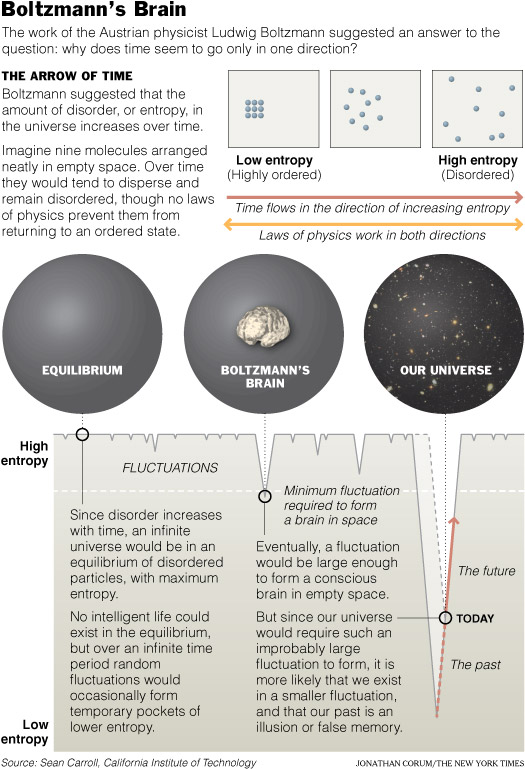
A Boltzmann brain is a hypothesized self-aware entity which arises due to random fluctuations out of a state of chaos. The idea is named for the physicist Ludwig Boltzmann (1844–1906), who advanced an idea that the known universe arose as a random fluctuation, similar to a process through which Boltzmann brains might arise. Boltzmann brains are often referred to in the context of the ‘Boltzmann brain paradox.’
They have also been referred to as ‘Boltzmann babies.’ The concept arises from the need to explain why we observe such a large degree of organization in the universe. The second law of thermodynamics states that the total entropy in a closed universe will never decrease. We may think of the most likely state of the universe as one of high entropy, closer to uniform and without order. So why is the observed entropy so low?
Continue reading →
Posted in Philosophy, Science |
Leave a Comment »
November 4, 2012

Night Thoughts of a Classical Physicist is a 1918 novel by historian of science Russell McCormmach, which explores the world of physics in the early 20th century—including the advent of modern physics and the role of physicists in World War I—through the recollections of the fictional Viktor Jakob.
Jakob is an old German physicist who spent most of his career during the period of classical physics, a paradigm being confronted by the rapid and radical developments of relativistic physics of Albert Einstein in 1900s and 1910s. This conflict allows for extensive examination of the various tensions placed on Jakob by the academic environment, the German academic system and the changing academic culture of the early 20th century.
Continue reading →
Posted in Language, Science |
Leave a Comment »
November 3, 2012


A paradigm [par-uh-dahym] shift (or revolutionary science) is, according to American physicist Thomas Kuhn, in his influential book ‘The Structure of Scientific Revolutions’ (1962), a change in the basic assumptions, or paradigms, within the ruling theory of science.
It is in contrast to his idea of ‘normal science’ (everyday problem solving within an existing paradigm). According to Kuhn, ‘A paradigm is what members of a scientific community, and they alone, share.’ Unlike a normal scientist, Kuhn held, ‘a student in the humanities has constantly before him a number of competing and incommensurable solutions to these problems, solutions that he must ultimately examine for himself.’ Continue reading →
Posted in Language, Science |
Leave a Comment »
November 2, 2012

The Structure of Scientific Revolutions by Thomas S. Kuhn, is an analysis of the history of science, published in 1962. Its publication was a landmark event in the history, philosophy, and sociology of scientific knowledge and it triggered an ongoing worldwide assessment and reaction in—and beyond—those scholarly communities. In this work, Kuhn challenged the then prevailing view of progress in ‘normal science’ (the routine work of scientists experimenting within a paradigm).
Scientific progress had been seen primarily as ‘development-by-accumulation’ of accepted facts and theories. Kuhn argued for an episodic model in which periods of such conceptual continuity in normal science were interrupted by periods of revolutionary science. During revolutions in science the discovery of anomalies leads to a whole new paradigm that changes the rules of the game and the ‘map’ directing new research, asks new questions of old data, and moves beyond the puzzle-solving of normal science.
Continue reading →
Posted in Language, Philosophy, Science |
1 Comment »
November 1, 2012
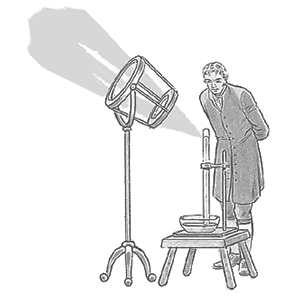
In the philosophy of science, the pessimistic induction is an argument which seeks to rebut scientific realism, the belief that we have good reasons to believe that our presently successful scientific theories are true or approximately true, where approximate truth means a theory is able to make novel predictions.
Pessimistic induction undermines the realist’s warrant for his epistemic optimism via historical counterexample. Using meta-induction, philosopher of science Larry Laudan argues that if past scientific theories which were successful were found to be false, we have no reason to believe the realist’s claim that our currently successful theories are approximately true. The argument was first fully postulated by Laudan in 1981. Continue reading →
Posted in Science |
Leave a Comment »
November 1, 2012
Factual relativism or epistemic relativism is a mode of reasoning which extends relativism and subjectivism to factual matter and reason. In factual relativism the facts used to establish the truth or falsehood of any statement are understood to be relative to the perspective of those proving or falsifying the proposition. Factual relativism is contested by factual universalism.
One school of thought compares scientific knowledge to the mythology of other cultures, arguing that it is merely our society’s set of myths based on our society’s assumptions. For support, Austrian-American philosopher of science Paul Feyerabend’s comments in ‘Against Method’ that, The similarities between science and myth are indeed astonishing’ and ‘First-world science is one science among many’ are sometimes cited, although it is not clear if Feyerabend meant them entirely seriously.
Continue reading →
Posted in Philosophy, Science |
Leave a Comment »
November 1, 2012

Pathological science is the process by which ‘people are tricked into false results … by subjective effects, wishful thinking or threshold interactions.’ The term was first used by Irving Langmuir, Nobel Prize-winning chemist, during a 1953 colloquium at the Knolls Research Laboratory. Langmuir said a pathological science is an area of research that simply will not ‘go away’—long after it was given up on as ‘false’ by the majority of scientists in the field. He called pathological science ‘the science of things that aren’t so.’
Sociologist Bart Simon lists it among practices pretending to be science: ‘categories [.. such as ..] pseudoscience, amateur science, deviant or fraudulent science, bad science, junk science, and popular science [..] pathological science, cargo-cult science, and voodoo science ..’ Examples of pathological science may include homeopathy, Martian canals, N-rays, polywater, water memory (homeopathy), perpetual motion, and cold fusion. The theories and conclusions behind all of these examples are currently rejected or disregarded by the majority of scientists. Continue reading →
Posted in Science |
Leave a Comment »
November 1, 2012

Cargo cult science refers to practices that have the semblance of being scientific, but do not in fact follow the scientific method. The term was first used by the physicist Richard Feynman during his commencement address at the California Institute of Technology in 1974. The speech is reproduced in the book ‘Surely You’re Joking, Mr. Feynman!’ He based the phrase on a concept in anthropology, the cargo cult, which describes how some pre-scientific cultures interpreted technologically advanced visitors as religious or supernatural figures who brought boons of cargo.
Later, in an effort to call for a second visit the natives would develop and engage in complex religious rituals, mirroring the previously observed behavior of the visitors manipulating mock machines but without understanding the true nature of those tasks. Just as cargo cultists create mock airports that fail to produce airplanes, cargo cult scientists conduct flawed research that superficially resembles the scientific method, but which fails to produce scientifically useful results. Continue reading →
Posted in Philosophy, Science |
Leave a Comment »
November 1, 2012

Social Darwinism is an ideology of society that seeks to apply biological concepts of Darwinism or of evolutionary theory to sociology and politics, often with the assumption that conflict between groups in society leads to social progress as superior groups outcompete inferior ones.
It is a modern name given to the various theories of society that emerged in England and the United States in the 1870s, which, it is alleged, sought to apply biological concepts to sociology and politics. The term social Darwinism gained widespread currency when used in 1944 to oppose these earlier concepts. Continue reading →
Posted in Philosophy, Politics, Science |
1 Comment »