October 29, 2012

Finite and Infinite Games is a book by religious scholar James P. Carse. With this philosophy text, Carse demonstrates a way of looking at actions in life as being a part of at least two types of what he describes as ‘games,’ finite and infinite. Both games are played within rules, as agreed upon by the participants; however, the meaning of the rules are different between the two types of games.
The book stresses a non-serious (or ‘playful’) view of life on the part of ‘players,’ referring to their choices as ‘moves,’ and societal constructs and mores as ‘rules’ and ‘boundaries.’ He regularly employs familiar terms in specialized ways, but casts them as associated with finite or infinite play & players. Boundaries are ‘rules’ that one must stay within when playing a finite game, in contrast with horizons, which move with the player, and are constantly changing as he or she ‘plays.’ In short, a finite game is played with the purpose of winning (thus ending the game), while an infinite game is played with the purpose of continuing the play.
Continue reading →
Posted in Games, Philosophy |
1 Comment »
October 29, 2012

Gamification is the use of game mechanics and game design techniques in non-game contexts. Typically gamification applies to non-game applications and processes, in order to encourage people to adopt them, or to influence how they are used.
Gamification’s proponents argue that it works by making technology more engaging, by encouraging users to engage in desired behaviors, by showing a path to mastery and autonomy, by helping to solve problems and being more engaging, and by taking advantage of humans’ psychological predisposition to engage in gaming. Available data from gamified websites, applications, and processes indicate potential improvements in areas such as user engagement, ROI, data quality, timeliness, and learning. Continue reading →
Posted in Education, Games, Money |
Leave a Comment »
October 29, 2012
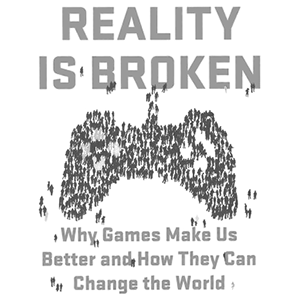
Game studies or ‘gaming theory’ is an academic discipline that deals with the critical study of games. More specifically, it focuses on game design, players, and their role in society and culture.
Game studies is an interdisciplinary field with researchers and academics from a multitude of other areas such as computer science, psychology, sociology, anthropology, philosophy, arts and literature, media studies, communication, theology, and more. Like other media disciplines, such as television studies and film studies, game studies often involves textual analysis and audience theory. Game studies tends to employ more diverse methodologies than these other branches, however, drawing from both social science and humanities approaches. Continue reading →
Posted in Education, Games, Technology |
1 Comment »
October 29, 2012
Numerous researchers have proposed potential positive effects of video games on aspects of social and cognitive development and psychological well-being. It has been shown that action video game players have better hand-eye coordination and visuo-motor skills, such as their resistance to distraction, their sensitivity to information in the peripheral vision and their ability to count briefly presented objects, than non-players.
With the development of the PlayStation Move, Kinect and Wii, video games can also help develop motor skills through full body movement. Video games also develop the individual’s intelligence, and in social games develop the social capabilities of the individual. Another way in which the usage of video games might provide a benefit is in the relief of stress. Continue reading →
Posted in Education, Games, Health |
1 Comment »
October 29, 2012
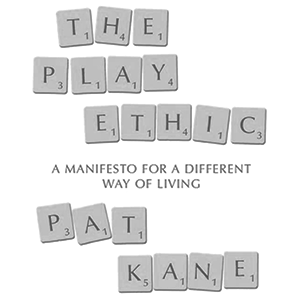
‘Everything Bad Is Good for You: How Today’s Popular Culture Is Actually Making Us Smarter’ is a non-fiction book written by American popular science author Steven Berlin Johnson.
Published in 2005, it is based upon Johnson’s theory that popular culture – in particular television shows and video games – has grown more complex and demanding over time and is improving the society within terms of intelligence and idea. The book’s claims, especially related to the proposed benefits of television, drew media attention. Continue reading →
Posted in Games, Health, Technology |
2 Comments »
October 29, 2012


Chicago-style pizza refers to a deep-dish pizza, with a crust up to three inches tall at the edge, slightly higher than the ingredients, which include large amounts of cheese and chunky tomato sauce, acting as a large bowl. Besides deep-dish, the term also refers to stuffed pizza, another Chicago style. Both styles of pizza are usually eaten with a knife and fork. There is also a style of thin-crust pizza found in Chicago and throughout the rest of the Midwest.
The crust is thin and firm enough to have a noticeable crunch, unlike a New York-style pizza. Most Chicago pizzerias offer both thin-crust and deep-dish pizzas. The Chicago-style ‘deep-dish’ pizza was invented at Pizzeria Uno, in Chicago, in 1943, reportedly by Uno’s founder Ike Sewell, a former University of Texas football star. However, a 1956 article from the ‘Chicago Daily News’ asserts that Uno’s original pizza chef Rudy Malnati developed the recipe. Another deep-dish restaurant is Uno’s companion restaurant Due, opened down the block by Sewell in 1955. Continue reading →
Posted in Food |
Leave a Comment »
October 28, 2012

‘Understanding Media: The Extensions of Man’ is a 1964 book by Marshall McLuhan. A pioneering study in media theory, it proposes that media themselves, not the content they carry, should be the focus of study. McLuhan suggests that a medium affects the society in which it plays a role not by the content delivered through it, but by the characteristics of the medium itself.
McLuhan pointed to the light bulb as an example. A light bulb does not have content in the way that a newspaper has articles or a television has programs, yet it is a medium that has a social effect; that is, a light bulb enables people to create spaces during nighttime that would otherwise be enveloped by darkness. He describes the light bulb as a medium without any content. McLuhan states that ‘a light bulb creates an environment by its mere presence.’ Continue reading →
Posted in Education, Language, Technology |
Leave a Comment »
October 28, 2012

Global Village is a term closely associated with Marshall McLuhan, popularized in his books ‘The Gutenberg Galaxy: The Making of Typographic Man’ (1962) and ‘Understanding Media’ (1964). McLuhan described how the globe has been contracted into a village by electric technology and the instantaneous movement of information from every quarter to every point at the same time. In bringing all social and political functions together in a sudden implosion, electric speed heightened human awareness of responsibility to an intense degree.
The Hindu concept of Vasudhaiva Kutumbakam (the whole world is one single family) is a similar thought, according to which: ‘Only small men discriminate saying: One is a relative; the other is a stranger. For those who live magnanimously the entire world constitutes but a family.’ The same concept is to be found in an ancient Tamil poem as, ‘every country is my own and all the people are my kinsmen.’ Continue reading →
Posted in Language, Technology, World |
Leave a Comment »
October 28, 2012

‘The Gutenberg Galaxy: The Making of Typographic Man’ is a book by Marshall McLuhan, in which he analyzes the effects of mass media, especially the printing press, on European culture and human consciousness.
It popularized the term ‘global village,’ which refers to the idea that mass communication allows a village-like mindset to apply to the entire world; and ‘Gutenberg Galaxy,’ which we may regard today to refer to the accumulated body of recorded works of human art and knowledge, especially books. McLuhan studies the emergence of what he calls ‘Gutenberg Man,’ the subject produced by the change of consciousness wrought by the advent of the printed book. Continue reading →
Posted in Language, Technology, World |
Leave a Comment »
October 28, 2012

Die Glocke (‘The Bell’) was a purported top secret Nazi scientific technological device, secret weapon, or ‘Wunderwaffe.’ First described by Polish journalist Igor Witkowski in 2000, it was later popularized by military journalist and author Nick Cook as well as by writers such as Joseph P. Farrell, who associates it with Nazi occultism and antigravity or free energy research.
According to Patrick Kiger writing in ‘National Geographic,’ Die Glocke has become a ‘popular subject of speculation’ and a following similar to science fiction fandom exists around it and other alleged Nazi ‘miracle weapons.’ Mainstream reviewers such as former aerospace scientist David Myhra express skepticism that such a device ever actually existed.
Continue reading →
Posted in Philosophy, War |
Leave a Comment »
October 28, 2012

‘Vril, the Power of the Coming Race’ is an 1871 novel by Edward Bulwer-Lytton, originally printed as ‘The Coming Race.’ Many readers believe that its account of a superior subterranean master race and the energy-form called ‘Vril’ is accurate, to the extent that some theosophists accepted the book as truth. A popular book, ‘The Morning of the Magicians’ (1960) suggested that a secret Vril Society existed in pre-Nazi Berlin.
The novel centers on a young, independently wealthy traveler (the narrator), who accidentally finds his way into a subterranean world occupied by beings who seem to resemble angels and call themselves Vril-ya. The hero soon discovers that the Vril-ya are descendants of an antediluvian civilization who live in networks of subterranean caverns linked by tunnels. Continue reading →
Posted in Philosophy, Politics, War |
Leave a Comment »
October 28, 2012
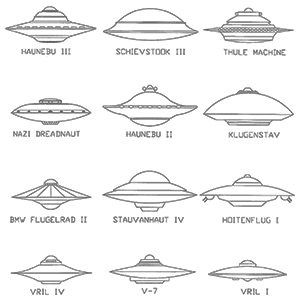
In science fiction, conspiracy theory, and underground comic books, stories or claims circulate linking UFOs to Nazi Germany.
These German UFO theories describe supposedly successful attempts to develop advanced aircraft or spacecraft prior to and during World War II, and further assert the post-war survival of these craft in secret underground bases in Antarctica, South America, or the United States, along with their creators. Continue reading →
Posted in Humor, Technology, War |
Leave a Comment »



