October 21, 2012

A hiccup is a contraction of the diaphragm that may repeat several times per minute. In medicine it is known as ‘synchronous diaphragmatic flutter’ (SDF), or ‘singultus,’ from the Latin ‘singult,’ ‘the act of catching one’s breath while sobbing.’ The hiccup is an involuntary action involving a reflex arc.
Once triggered, the reflex causes a strong contraction of the diaphragm followed about 0.25 seconds later by closure of the vocal cords, which results in the classic hic sound. At the same time, the normal peristalis of the esophagus is suppressed. A bout of hiccups, in general, resolves itself without intervention, although many home remedies are often used to attempt to shorten the duration. Medical treatment is occasionally necessary in cases of chronic hiccups.
Continue reading →
Posted in Health, Science |
1 Comment »
October 21, 2012

Sociocybernetics is an independent chapter of science in sociology based upon Systems Theory (a framework to analyze a group of objects that work in concert to produce some result) and cybernetics (the study of control and communication systems in animals and machines). It also has a basis in Organizational Development (OD) consultancy practice and in Theories of Communication, theories of psychotherapies, and computer sciences. The ‘International Sociological Association’ has a specialist research committee in the area, which publishes the (electronic) ‘Journal of Sociocybernetics.’
The study of society as a system can be traced back to the origin of sociology when the emergent idea of functional differentiation was applied for the first time to society by Auguste Comte. From his viewpoint, the principal feature of modern society was the increased process of system differentiation as a way of dealing with the complexity of the environment. This is accomplished through the creation of subsystems in an effort to copy within a system the difference between it and the environment.
Continue reading →
Posted in Politics, Science, Technology |
Leave a Comment »
October 21, 2012

‘Cognitive Surplus: Creativity and Generosity in a Connected Age’ is a 2010 non-fiction book by Clay Shirky. The book is an indirect sequel to Shirky’s ‘Here Comes Everybody,’ which covered the impact of social media. The book’s central theme is that people are now learning how to use more constructively the free time afforded to them since the 1940s for creative acts rather than consumptive ones, particularly with the advent of online tools that allow new forms of collaboration.
It goes on to catalog the means and motives behind these new forms of cultural production, as well as key examples. While Shirky acknowledges that the activities that we use our cognitive surplus for may be frivolous (such as creating ‘LOLcats’), the trend as a whole is leading to valuable and influential new forms of human expression. He also asserts that even the most inane forms of creation and sharing are preferable to the hundreds of billions of hours spent consuming television. Continue reading →
Posted in Language, Money, Technology |
Leave a Comment »
October 21, 2012

‘Here Comes Everybody: The Power of Organizing Without Organizations’ is a 2008 book by Clay Shirky, which evaluates the effect of the Internet on modern group dynamics. The author considers examples such as ‘Wikipedia’ and ‘MySpace’ in his analysis, and says his book is about ‘what happens when people are given the tools to do things together, without needing traditional organizational structure.’
The title of the work alludes to ‘HCE,’ a recurring and central figure in James Joyce’s ‘Finnegans Wake.’ In the book, Shirky recounts how social tools such as blogging software like WordPress and Twitter, file sharing platforms like Flickr, and online collaboration platforms like Wikipedia support group conversation and group action in a way that previously could only be achieved through institutions. Continue reading →
Posted in Language, Technology |
Leave a Comment »
October 21, 2012

Compared to other diseases or other cancers, breast cancer receives a disproportionate share of resources and attention. In 2001 MP Ian Gibson, chairman of the House of Commons of the United Kingdom all party group on cancer stated ‘The treatment has been skewed by the lobbying, there is no doubt about that. Breast cancer sufferers get better treatment in terms of bed spaces, facilities and doctors and nurses.’
Breast cancer also receives significantly more media coverage than other, equally prevalent cancers, with a study by Prostate Coalition showing 2.6 breast cancer stories for each one covering cancer of the prostate. Ultimately there is a concern that favoring sufferers of breast cancer with disproportionate funding and research on their behalf may well be costing lives elsewhere. Partly because of its relatively high prevalence and long-term survival rates, research is biased towards breast cancer. Some subjects, such as cancer-related fatigue, have been studied in little except women with breast cancer. Continue reading →
Posted in Health, Money, Politics |
Leave a Comment »
October 21, 2012

The Closing of the American Mind is a 1987 book by American philosopher Allan Bloom. It describes ‘how higher education has failed democracy and impoverished the souls of today’s students.’ He focuses especially upon the ‘openness’ of relativism as leading paradoxically to the great ‘closing’ referenced in the book’s title.
Bloom argues that ‘openness’ and absolute understanding undermines critical thinking and eliminates the ‘point of view’ that defines cultures. According to Bloom: ‘Education in our times must try to find whatever there is in students that might yearn for completion, and to reconstruct the learning that would enable them autonomously to seek that completion.’ Continue reading →
Posted in Education, Philosophy, Politics |
Leave a Comment »
October 20, 2012

Food microbiology is the study of the microorganisms that inhabit, create, or contaminate food. Including the study of microorganisms causing food spoilage. ‘Good’ bacteria, however, such as probiotics, are becoming increasingly important in food science. In addition, microorganisms are essential for the production of foods such as cheese, yogurt, other fermented foods, bread, beer and wine. Food safety is a major focus of food microbiology. Pathogenic bacteria, viruses, and toxins produced by microorganisms are all possible contaminants of food.
However, microorganisms and their products can also be used to combat these pathogenic microbes. Probiotic bacteria, including those that produce bacteriocins (toxins created by bacteria to kill rival bacteria), can inhibit pathogens. Alternatively, purified bacteriocins such as nisin can be added directly to food products. Finally, bacteriophages, viruses that only infect bacteria, can be used to kill bacterial pathogens. Thorough preparation of food, including proper cooking, eliminates most bacteria and viruses. However, toxins produced by contaminants may not be heat-labile, and some are not eliminated by cooking Continue reading →
Posted in Food, Health, Science |
3 Comments »
October 19, 2012

Century egg (‘pidan,’ also known as preserved egg and millennium egg) is a Chinese cuisine ingredient made by preserving fowl eggs in a mixture of clay, ash, salt, quicklime (calcium oxide), and rice hulls for several weeks to several months, depending on the method of processing. Through the process, the yolk becomes a dark green to gray color with a creamy consistency and an odor of sulfur and ammonia, while the white becomes a dark brown, translucent jelly with little flavor.
The transforming agent in the century egg is its alkaline material, which gradually raises the pH of the egg to around 9, 12, or more during the curing process. This chemical process breaks down some of the complex, flavorless proteins and fats, which produces a variety of smaller flavorful compounds. Some eggs have fungal patterns near the surface of the egg white that are likened to pine branches, and that gives rise to one of its Chinese names, the ‘pine-patterned egg.’ Continue reading →
Posted in Food, Science, World |
Leave a Comment »
October 19, 2012

Pickling, also known as ‘brining’ or ‘corning,’ is the process of preserving food with acid. Pickling began 4000 years ago using cucumbers native to India. It is called ‘achar’ in northern India. This was used as a way to preserve food for out-of-season use and for long journeys, especially by sea. Salt pork and salt beef were common staples for sailors before the days of steam engines. Although the process was invented to preserve foods, pickles are also made and eaten because people enjoy the resulting flavors.
Pickling may also improve the nutritional value of food by introducing B vitamins produced by bacteria (when pickled in a process utilizing fermentation). The term ‘pickle’ is derived from the Dutch word ‘pekel,’ meaning ‘brine’ (salt water). In the U.S. Canada, and Australia the word ‘pickle’ alone almost always refers to a pickled cucumber (other types of pickles will be described as ‘pickled onion,’ ‘pickled cauliflower,’ etc.), except when it is used figuratively. In the UK, ‘pickle’ refers to Ploughman’s pickle, a kind of chutney; a pickled cucumber is referred to as a ‘gherkin.’ Continue reading →
Posted in Food, Science, World |
2 Comments »
October 19, 2012

Fermentation [fur-men-tey-shuhn] is when a living cell uses sugar for energy without requiring oxygen. Yeast is an organism that ferments. When yeast ferments sugar, the yeast eats sugar and makes alcohol. Other organisms (such as bacteria) make vinegar (acetic acid) or lactic acid when they ferment sugar. Fermentation is used to make beer, some types of fuel, and to make bread rise. When yeast ferments, it breaks down the glucose into ethanol and carbon dioxide.
Ethanol fermentation always produces ethanol and carbon dioxide. It is important in bread-making, brewing, and winemaking. Lactic acid fermentation produces lactic acid. It happens in muscles of animals when they need lots of energy fast, and is also used to preserve foods in pickling. The word ‘fermentation’ is derived from the Latin verb ‘fervere,’ which means ‘to boil’ (same root as ‘effervescence’). It is thought to have been first used in the late fourteenth century in alchemy, but only in a broad sense. It was not used in the modern scientific sense until around 1600. Continue reading →
Posted in Food, Health, Science |
Leave a Comment »
October 18, 2012

The theory of recapitulation [ree-kuh-pich-uh-ley-shuhn] is often known as ‘ontogeny recapitulates phylogeny.’ It was an idea of French physician Étienne Serres in 1824. In 1886 German biologist Ernst Haekel proposed that the embryonic development of an individual organism (its ontogeny) followed the same path as the evolutionary history of its species (its phylogeny). It is also called the ‘biogenetic law’ or ’embryological parallelism.’
It was a theory that tied evolution (change in organisms over time) with embryology (the way organisms develop before they are born). The theory basically stated that before they are born, organisms pass through developmental stages that look like adult animals of other species, in roughly the same order that these other species split off during evolution. Although there is something to this idea, it is no longer thought to be such a useful way to look at development. Continue reading →
Posted in Science |
Leave a Comment »
October 18, 2012
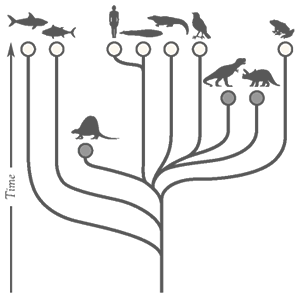
In biology, phylogeny [fahy-loj-uh-nee] refers to the evolutionary relationships among groups of organisms (e.g. species, populations). The term ‘phylogenetics’ derives from the Greek terms ‘phyle’ and ‘phylon,’ denoting ‘tribe’ and ‘race’; and the term ‘genetikos,’ denoting ‘relative to birth,’ from ‘genesis’ (‘origin’). The result of phylogenetic studies is a hypothesis about the evolutionary history of taxonomic groups. Phylogenetic analyses have become essential in researching the evolutionary tree of life. The overall goal of National Science Foundation’s Assembling the Tree of Life activity (AToL) is to resolve evolutionary relationships for large groups of organisms throughout the history of life, with the research often involving large teams working across institutions and disciplines.
Taxonomy, the classification, identification, and naming of organisms, is usually richly informed by phylogenetics, but remains methodologically and logically distinct. The degree to which taxonomy depends on phylogenies differs between schools of taxonomy: ‘numerical taxonomy’ ignored phylogeny altogether, trying to represent the similarity between organisms instead; ‘phylogenetic systematics’ tries to reproduce phylogeny in its classification without loss of information; ‘evolutionary taxonomy’ tries to find a compromise between them in order to represent stages of evolution. Continue reading →
Posted in Science |
Leave a Comment »



