October 18, 2012

Gaming etiquette refers to the norms adopted while playing multi-player video games. While specific genres and games have their own accepted rules of conduct, some of these rules are universal across almost all games. Regardless of the game, certain behaviors are universally encouraged or discouraged.
Cheating is almost never acceptable unless all players agree it should be allowed, as it causes the game to become unfair and detracts from the enjoyment of legitimate players. Continue reading →
Posted in Games |
Leave a Comment »
October 18, 2012
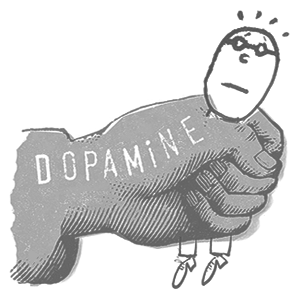
A reward is a appetitive stimulus given to a human or some other animal to alter its behavior. Rewards typically serve as a reinforcers, something that, when presented after a behavior, causes the probability of that behavior’s occurrence to increase.
Note that just because something is labelled a reward does not necessitate it as a reinforcer. A reward can only be said to be a reinforcer if its delivery has increased the probability of a behavior. Certain neural structures, called the reward system, are critically involved mediating the effects of reinforcement. Continue reading →
Posted in Drugs, Health, Money |
1 Comment »
October 17, 2012

‘A Rape in Cyberspace, or How an Evil Clown, a Haitian Trickster Spirit, Two Wizards, and a Cast of Dozens Turned a Database into a Society’ is an article written by freelance journalist Julian Dibbell and first published in ‘The Village Voice in 1993.’ The article was later included in Dibbell’s book ‘My Tiny Life’ on his experience at LambdaMOO (a text-based online virtual reality system to which multiple users are connected at the same time).
Technology advocate Lawrence Lessig has said that his chance reading of Dibbell’s article was a key influence on his interest in the field. Sociologist David Trend called it ‘one of the most frequently cited essays about cloaked identity in cyberspace.’ Continue reading →
Posted in Games, Sex, Technology |
Leave a Comment »
October 17, 2012

Virtual crime or in-game crime refers to a virtual criminal act that takes place in a massively multiplayer online game (MMOG), usually an MMORPG. The huge time and effort invested into such games can lead online ‘crime’ to spill over into real world crime, and even blur the distinctions between the two.
Some countries have introduced special police investigation units to cover such ‘virtual crimes.’ South Korea is one such country and looked into 22,000 cases in the first six months of 2003. Several interpretations of the term ‘virtual crime’ exist. Some legal scholars opt for a definition based on a report on what was the first prominent case, a ‘rape in cyberspace.’ Continue reading →
Posted in Games, Politics, Technology |
Leave a Comment »
October 17, 2012
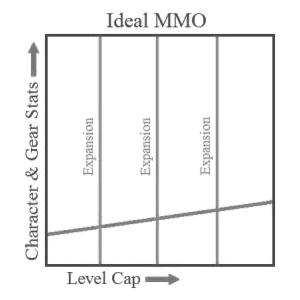
Mudflation, from MUD (multi-user dungeon) and inflation, is an economic issue that exists only in massively multiplayer online games. Mudflation occurs when future additions to (or even just continued operation of) a game causes previously acquired resources to decline in value. This can take many forms and have many causes, including new items introduced by an expansion pack, fundamental imbalances in the in-game economy, or even spread of information that allows a previously rare resource to be acquired more easily.
The term mudflation became popular during the height of the MMORPG EverQuest’s dominance, coming into common usage after the release of the ‘Ruins of Kunark’ (2000) expansion. The term originated many years prior with MUDs, the text based forerunner of MMORPGs, that also suffered from the same currency supply problems. Continue reading →
Posted in Games, Money, Technology |
1 Comment »
October 17, 2012
Gold farming is playing a massively multiplayer online game to acquire in-game currency that other players purchase in exchange for real-world money. People in China and in other developing nations have held full-time employment as gold farmers.
While most game operators expressly ban the practice of selling in-game currency for real-world cash, gold farming is lucrative because it takes advantage of economic inequality and the fact that much time is needed to earn in-game currency. Rich, developed country players, wishing to save many hours of playing time, may be willing to pay substantial sums to the developing country gold farmers. In 2009 the global market for gold farming was valued at around $3 billion annually. Continue reading →
Posted in Games, Money, Politics |
Leave a Comment »
October 17, 2012
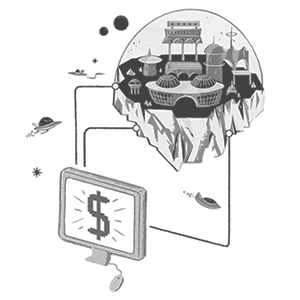
A virtual economy (or sometimes synthetic economy) is an emergent economy existing in a virtual persistent world, usually exchanging virtual goods in the context of an Internet game. People enter these virtual economies for recreation rather than necessity, which means that virtual economies lack the aspects of a real economy that are not considered to be ‘fun’ (for instance, players in a virtual economy often do not need to buy food in order to survive, and usually do not have any biological needs at all). However, some people do interact with virtual economies for ‘real’ economic benefit.
Virtual economies arise in numerous platforms. Multi-User Dungeons (MUDs) are text-based games that predate the World Wide Web. The largest virtual economies are in massively multi-player online role-playing games (MMORPGs). Virtual economies also exist in life simulation games which may have taken the most radical steps toward linking a virtual economy with the real world. For example, in ‘Second Life’ there is recognition of intellectual property rights for assets created ‘in-world’ by subscribers, and a laissez-faire policy on the buying and selling of ‘Linden Dollars’ (the world’s official currency) for real money on third party websites. Continue reading →
Posted in Games, Money, Technology |
Leave a Comment »
October 17, 2012

Virtual goods are non-physical objects purchased for use in online communities or online games. ‘Digital goods,’ on the other hand, may be a broader category including digital books, music, and movies.
Virtual goods have no intrinsic value and are intangible by definition. Including digital gifts and digital clothing for avatars, virtual goods may be classified as services instead of goods and are usually sold by companies that operate social networks, community sites, or online games. Sales of virtual goods are sometimes referred to as microtransactions, and the games that utilize this model are usually referred to as ‘freemium’ (free + premium) games. Continue reading →
Posted in Games, Money, Technology |
Leave a Comment »
October 16, 2012

Opinions differ on whether viruses are a form of life, or organic structures that interact with living organisms. They have been described as ‘organisms at the edge of life,’ since they resemble organisms in that they possess genes and evolve by natural selection, and reproduce by creating multiple copies of themselves through self-assembly. Although they have genes, they do not have a cellular structure, which is often seen as the basic unit of life.
Viruses do not have their own metabolism, and require a host cell to make new products. They therefore cannot naturally reproduce outside a host cell (although bacterial species such as chlamydia are considered living organisms despite the same limitation). Accepted forms of life use cell division to reproduce, whereas viruses spontaneously assemble within cells. They differ from autonomous growth of crystals as they inherit genetic mutations while being subject to natural selection. Virus self-assembly within host cells has implications for the study of the origin of life, as it lends further credence to the hypothesis that life could have started as self-assembling organic molecules.
Posted in Health, Philosophy, Science |
Leave a Comment »
October 16, 2012


Anti-nationalism denotes the sentiments associated with the opposition to nationalism, arguing that it is undesirable or dangerous. Some anti-nationalists are humanitarians or humanists who pursue an idealist form of world community, and self-identify as world citizens.
They reject chauvinism, jingoism, and militarism, and want humans to live in peace rather than perpetual conflict. They do not necessarily oppose the concepts of countries, nation states, national boundaries, cultural preservation or identity politics. Continue reading →
Posted in Money, Politics, World |
Leave a Comment »
October 16, 2012
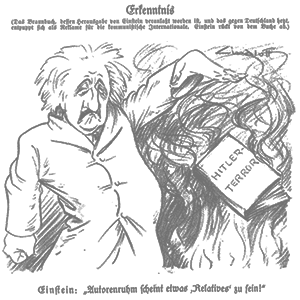
Deutsche Physik (literally: ‘German Physics’) or ‘Aryan Physics’ was a nationalist movement in the German physics community in the early 1930s against the work of Albert Einstein and other modern theoretically based physics, labeled ‘Jewish Physics’ (German: ‘Jüdische Physik’). The term was taken from the title of a 4-volume physics textbook by Philipp Lenard in the 1930s.
This movement began as an extension of a German nationalistic movement in the physics community which went back as far as World War I. In 1915, during fighting between the German army and Belgian resistance fighters after the German invasion in Belgium, the library of the Katholieke Universiteit in Leuven caught fire when German troops looted and set fire to the town. The loss of the library led to a protest note by British scientists, which was signed also by eight distinguished British scientists, namely William Bragg, William Crookes, Alexander Fleming, Horace Lamb, Oliver Lodge, William Ramsay, Baron Rayleigh, and J.J. Thomson, and in which it was assumed that the war propaganda mentioned corresponded to real behavior of German soldiers. Continue reading →
Posted in Education, Politics, Science |
Leave a Comment »
October 16, 2012

‘Uranprojekt,’ informally known as the ‘Uranverein’ (‘Uranium Club‘), was an attempted clandestine scientific effort led by Germany to develop and produce atomic weapons during World War II.
This program started in April 1939, just months after the discovery of nuclear fission in January of that year, but ended quickly, due to German invasion of Poland, where many notable physicists were drafted into the Wehrmacht (Nazi military). However, the second effort began under the administrative auspices of the Wehrmacht’s Heereswaffenamt (HWA, ‘Army Ordnance Office’) on the day WWII began (September 1, 1939). Continue reading →
Posted in Technology, War |
1 Comment »


 The Daily Omnivore