October 7, 2012

Project A119, also known as ‘A Study of Lunar Research Flights,’ was a top-secret plan developed in the late 1950s by the United States Air Force. The aim of the project was to detonate a nuclear bomb on the Moon to boost public morale in the United States after the Soviet Union took an early lead in the Space Race. The existence of the project was revealed in 2000 by a former NASA executive, Leonard Reiffel, who led the project in 1958.
A young Carl Sagan was part of the team responsible for predicting the effects of a nuclear explosion in low gravity. Project A119 was never carried out, primarily because a moon landing would be a much more acceptable achievement in the eyes of the American public. The project documents remained secret for nearly 45 years, and despite Reiffel’s revelations, the US government has never officially recognized its involvement in the study. Continue reading →
Posted in Politics, Science, War |
Leave a Comment »
October 7, 2012
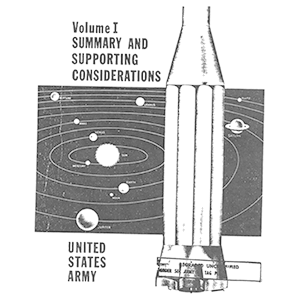
Project Horizon was a study to determine the feasibility of constructing a scientific / military base on the Moon. In 1959, a group at the Army Ballistic Missile Agency (ABMA) produced for the U.S. Department of the Army a report entitled ‘Project Horizon, A U.S. Army Study for the Establishment of a Lunar Military Outpost.’
The project proposal states the requirements as: ‘The lunar outpost is required to develop and protect potential United States interests on the moon; to develop techniques in moon-based surveillance of the earth and space, in communications relay, and in operations on the surface of the moon; to serve as a base for exploration of the moon, for further exploration into space, and for military operations on the moon if required; and to support scientific investigations on the moon.’ Continue reading →
Posted in Technology, War |
Leave a Comment »
October 7, 2012

Positive atheism (also called ‘strong atheism’ and ‘hard atheism’) is the form of atheism that asserts that no deities exist. Negative atheism (also called ‘weak atheism’ and ‘soft atheism’) is any other type of atheism, wherein a person does not believe in the existence of any deities, but does not explicitly assert there to be none.
The terms negative atheism and positive atheism were used by British philosopher Antony Flew in 1976,[1] and appeared again in Boston University philosopher Michael Martin’s writings in 1990. Because of flexibility in the term ‘god,’ it is possible that a person could be a positive/strong atheist in terms of certain conceptions of God, while remaining a negative/weak atheist in terms of others. Continue reading →
Posted in Language, Philosophy, Science |
Leave a Comment »
October 7, 2012
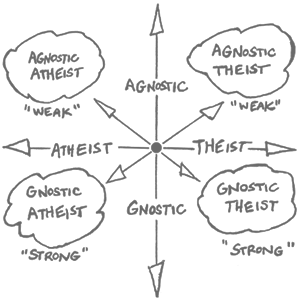
Weak agnosticism is the assertion that, at present, there is not enough information to know whether any deities exist, but that such might become knowable, or that someone may come forward with a conclusive and irrefutable proof for the existence of such deities. It is in contrast to strong agnosticism, which is the belief that the existence of any gods is completely unknowable to humanity. Neither type of agnosticism is fully irreconcilable with theism (belief in a deity or deities) nor atheism (rejecting belief in all deities).
Weak agnostics who also consider themselves theists are likely to acknowledge they have some doubt, though they are not necessarily having a crisis of faith. Weak agnosticism is compatible with weak atheism (wherein a person does not believe in the existence of any deities, but does not explicitly assert there to be none). Weak agnosticism is also referred to as ’empirical agnosticism’ and as ‘negative agnosticism.’ According to Australian philosopher Graham Oppy, weak agnosticism is ‘the view which is sustained by the thesis that it is permissible for reasonable persons to suspend judgement on the question of God’s existence.’
Continue reading →
Posted in Philosophy, Science |
Leave a Comment »
October 6, 2012

A spiritual agnostic is a subset of traditional agnosticism (the philosophical view that it is unknown -or even, unknowable- whether any deities exist or not) that is distinguished by the acceptance of the value of universal ethics yet rejection of any aspects of religions that seem divisive.
For example, love is the ideal source of motivation, and since many (if not all) religions emphasize love, a spiritual agnostic might participate in the practices of one particular religion while simultaneously rejecting some of the mainstream principles of that religion. Regardless of this possibility, spiritual agnosticism claims that innate morality and common ethics are far more important than differences in beliefs. Continue reading →
Posted in Philosophy |
1 Comment »
October 5, 2012
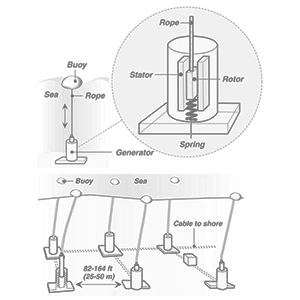
Wave power is the transport of energy by ocean surface waves, and the capture of that energy to do useful work – for example, electricity generation, water desalination, or the pumping of water (into reservoirs). Machinery able to exploit wave power is generally known as a wave energy converter (WEC). Wave power is distinct from tidal power and the steady gyre of ocean currents.
In 2008, the first experimental wave farm was opened in Portugal, at the Aguçadoura Wave Park. Waves are generated by wind passing over the surface of the sea. As long as the waves propagate slower than the wind speed just above the waves, there is an energy transfer from the wind to the waves. Both air pressure differences between the upwind and the lee side (the side sheltered from the wind) of a wave crest, as well as friction on the water surface by the wind, making the water to go into the shear stress causes the growth of the waves. Continue reading →
Posted in Money, Technology |
Leave a Comment »
October 5, 2012
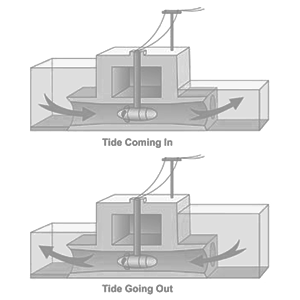
Tidal power, also called tidal energy, is a form of hydropower that converts the energy of tides into useful forms of power – mainly electricity. Although not yet widely used, tidal power has potential for future electricity generation. Tides are more predictable than wind energy and solar power. Among sources of renewable energy, tidal power has traditionally suffered from relatively high cost and limited availability of sites with sufficiently high tidal ranges or flow velocities, thus constricting its total availability.
However, many recent technological developments and improvements, both in design (e.g. dynamic tidal power, tidal lagoons) and turbine technology (e.g. new axial turbines, cross flow turbines), indicate that the total availability of tidal power may be much higher than previously assumed, and that economic and environmental costs may be brought down to competitive levels. Continue reading →
Posted in Money, Technology |
Leave a Comment »
October 4, 2012

In the United States, clean coal is any technology that may reduce emissions of carbon dioxide and other greenhouse gasses that arise from the burning of coal for electrical power. Typically, the term clean coal is used by coal companies in reference to carbon capture and storage (CCS), which pumps and stores emissions underground, and to plants using an Integrated gasification combined cycle (IGCC), which is technology that turns coal and other carbon based fuels into synthesis gas (‘syngas,’ which can be used to produce diesel, or converted into methane or other fuels).
Historically, the term has been used to refer to technologies for reducing emissions of ash, sulfur, and heavy metals from coal combustion. Carbon capture and storage technologies are being developed primarily in response to regulations by the EPA—most notably the ‘Clean Air Act’—and in anticipation of legislation that seeks to mitigate climate change. Currently, the electricity sector of the United States is responsible for about 41% of the nation’s carbon dioxide emissions, and half of the sector’s production comes from coal-fired power plants. Continue reading →
Posted in Money, Politics, Technology |
Leave a Comment »
October 4, 2012
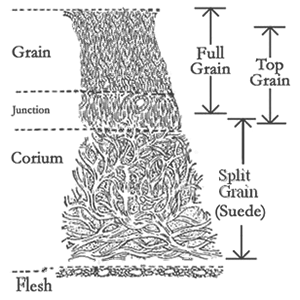
Leather is a durable and flexible material created by tanning animal rawhide and skin, often cattle hide. Traditionally, tanning used tannin, an acidic chemical compound from which the process draws its name (tannin is in turn named for an old German word for oak or fir trees, which supplied it).
Rawhide is made by removing the flesh and fat and then the hair (leather with the hair still attached is called ‘hair-on’) by use of an aqueous solution (this process is called ‘liming’ when using lime or ‘bucking’ when using lye), then scraping over a beam with a somewhat dull knife, and then drying (often while stretched). Liming or bucking also cleans the fiber network of the skin to encourage penetration of the tanning agent. Continue reading →
Posted in Art, Money, Technology |
Leave a Comment »
October 3, 2012

Feminist science fiction is a sub-genre of science fiction which tends to deal with women’s roles in society. Feminist science fiction poses questions about social issues such as how society constructs gender roles, the role reproduction plays in defining gender and the unequal political and personal power of men and women.
Some of the most notable feminist science fiction works have illustrated these themes using utopias to explore a society in which gender differences or gender power imbalances do not exist, or dystopias to explore worlds in which gender inequalities are intensified, thus asserting a need for feminist work to continue. According to professor Elyce Rae Helford: ‘Science fiction and fantasy serve as important vehicles for feminist thought, particularly as bridges between theory and practice. No other genres so actively invite representations of the ultimate goals of feminism: worlds free of sexism, worlds in which women’s contributions (to science) are recognized and valued, worlds in which the diversity of women’s desire and sexuality, and worlds that move beyond gender.’ Continue reading →
Posted in Art, Sex, Technology |
1 Comment »
October 3, 2012
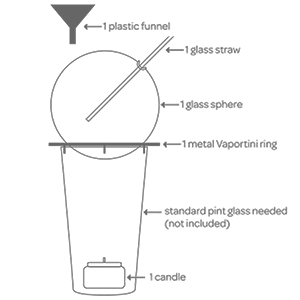
Alcohol Without Liquid is a process introduced first in Asia and Europe that allows people to take in liquor (distilled spirits) without actually consuming liquid. The machine vaporizes alcohol and mixes it with oxygen, allowing the consumer to breathe in the mixture.
The machine has been dubbed AWOL, a play on the military term AWOL (Absent Without Leave). The AWOL machine produces a very fine alcoholic mist. The continual intake of this mist over a twenty-minute period is the equivalent of taking one shot of distilled spirits. The machine was introduced to the United States in 2004. Continue reading →
Posted in Drugs, Health, Technology |
1 Comment »
October 3, 2012


In Broadcast programming, counterprogramming is the practice of offering television programs to attract an audience from another television station airing a major event. The Super Bowl is among the most-viewed programs on American television. Thus, counterprogramming focuses on the pre-game period and the halftime show.
However, it is a common gentlemen’s agreement that the broadcast networks who carry the league’s game coverage (and in turn, other cable networks owned by the broadcasters) never counterprogram the Super Bowl, yielding to the game and airing either low profile reruns of their series or a middling film in the timeslot instead. Continue reading →
Posted in Games, Money |
Leave a Comment »


 The Daily Omnivore