March 8, 2021
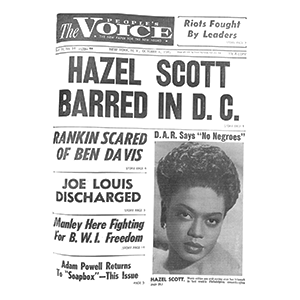
Hazel Scott (1920 – 1981) was a Trinidadian-born jazz and classical pianist, singer, and actor. She was a critically acclaimed performing artist and an outspoken critic of racial discrimination and segregation. She used her influence to improve the representation of Black Americans in film.
Born in Port of Spain, Scott moved to New York City with her mother at the age of four. Scott was a child musical prodigy, receiving scholarships to study at the Juilliard School when she was eight. In her teens, she performed in a jazz band. She also performed on the radio. Continue reading →
Posted in Art, Politics |
Leave a Comment »
March 4, 2021
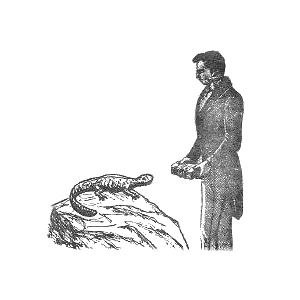
The salamander letter was a controversial document about the history of the Latter-day Saint (LDS) movement that presented a view of LDS founder Joseph Smith’s life that stood sharply at odds with the commonly accepted version of the early progression of the church Smith established.
The letter was one of hundreds of documents concerning the history of the LDS movement that surfaced in the early 1980s. Initially accepted by some document experts and collectors, the document was later demonstrated to be a forgery created by Mark Hofmann, who had been responsible for the ‘discovery’ of many other notable documents. Continue reading →
Posted in Money, Philosophy, Politics |
Leave a Comment »
March 1, 2021


A non-fungible token (NFT) is a special type of cryptographic token which represents something unique; non-fungible tokens are thus not mutually interchangeable.[1] This is in contrast to cryptocurrencies like bitcoin, and many network or utility tokens that are fungible in nature.
Non-fungible tokens are used to create verifiable digital scarcity, as well as digital ownership, and the possibility of asset interoperability across multiple platforms.[3] NFTs are used in several specific applications that require unique digital items like crypto art, digital collectibles, and online gaming. Continue reading →
Posted in Art, Technology |
Leave a Comment »
February 23, 2021
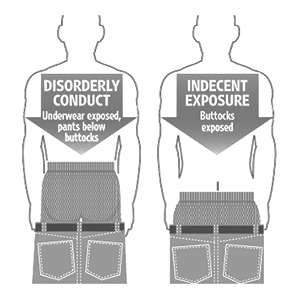
Sagging is a manner of wearing pants, jeans, or shorts that sag so that the top of the garment is significantly below the waist, sometimes revealing much of the wearer’s underpants.
Sagging is predominantly a male fashion. Women’s wearing of low-rise jeans to reveal their G-string underwear (the ‘whale tail’) is not generally described as sagging. A person wearing sagging trousers is sometimes called a ‘sagger,’ and in some countries this practice is known as ‘low-riding.’ Continue reading →
Posted in Politics |
Leave a Comment »
February 22, 2021

Free the Nipple is a topfreedom campaign created in 2012 during pre-production of a 2014 film of the same name. The campaign highlights the general convention of allowing men to appear topless in public while considering it sexual or indecent for women to do the same, and asserts that this difference is an unjust treatment of women.
The campaign argues that it should be legally and culturally acceptable for women to bare their nipples in public. There are two U.S. states where the mere showing of women’s breasts is illegal: Indiana and Tennessee. Fourteen states and many other cities have laws with ambiguous implications on how much a woman is allowed to expose her body. Continue reading →
Posted in Politics, Sex |
Leave a Comment »
February 10, 2021
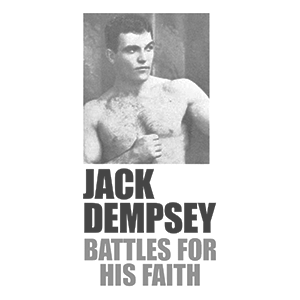
Jack Mormon is a slang term originating in nineteenth-century America originally used to describe a person who was not a baptized member of the Church of Jesus Christ of Latter Day Saints but who was friendly to church members and Mormonism, sympathized with them, and/or took an active interest in their belief system.
Sometime in the early- to mid-twentieth century, however, the term began to refer to an individual deemed by adherents of The Church of Jesus Christ of Latter-day Saints (LDS Church) to be an inactive or lapsed member of the LDS Church who, despite his personal religious viewpoint, maintained good relations with and positive feelings toward the church. Continue reading →
Posted in Drugs, Language, Philosophy |
Leave a Comment »
February 8, 2021

Neil Cicierega [sis-uh-ree-guh] (b. 1986) is an American comedian, actor, filmmaker, singer, musician, songwriter, puppeteer, artist, and animator.
He is best known as the creator of a genre of Flash animation he termed ‘Animutation,’ the ‘Harry Potter’ puppet parody series ‘Potter Puppet Pals,’ and several music albums under the name Lemon Demon. He also released a series of mashup albums under his own name that have since gained a cult following. Continue reading →
Posted in Art, Humor |
Leave a Comment »
February 5, 2021
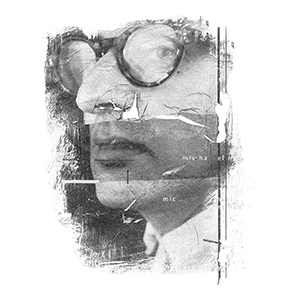
Mozart 252 is a 2008 album by composer Michael Nyman (his 58th release) with the Michael Nyman Band. Contralto vocalist Hilary Summers is Wolfgang and bass vocalist Andrew Slater is Leopold Mozart. The album celebrates the 250th anniversary of Wolfgang Amadeus Mozart’s birth.
Although ‘Revisiting the Don,’ one of only two newly written works on the album, was commissioned and performed in 2006, the album’s title is a joke on its lateness as an album, released 252 years after Mozart’s birth. Continue reading →
Posted in Art |
Leave a Comment »
January 31, 2021

Brandolini’s law, also known as the bullshit asymmetry principle, is an internet adage which emphasizes the difficulty of debunking bullshit: ‘The amount of energy needed to refute bullshit is an order of magnitude larger than to produce it.’
It was publicly formulated the first time in January 2013 by Alberto Brandolini, an Italian programmer. Brandolini stated that he was inspired by reading Daniel Kahneman’s ‘Thinking, Fast and Slow’ right before watching an Italian political talk show with journalist Marco Travaglio and former Prime Minister Silvio Berlusconi attacking each other. Continue reading →
Posted in Humor, Technology |
Leave a Comment »
January 29, 2021
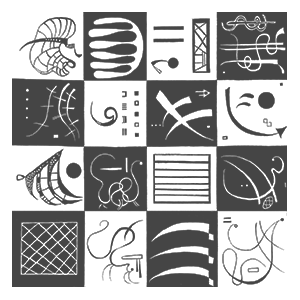
Wassily Kandinsky [kan-din-skee] (1866 – 1944) was a Russian painter, printmaker and art theorist. He was a major figure in modern art and painted some of the first modern abstract works. His art changed several times during his life. It was fauvist, abstract, expressionist and constructivist in turn.
He was interested in geometry in art and philosophy. The creative aspect of the form is expressed by a descending series of circles, triangles and squares. Kandinsky’s creation of abstract work followed a long period of development and maturation of intense thought based on his artistic experiences. He called this devotion to inner beauty, fervor of spirit, and spiritual desire inner necessity. Continue reading →
Posted in Art, Philosophy |
Leave a Comment »
January 21, 2021

White Coke is a nickname for a clear variant of Coca-Cola produced in the 1940s at the request of Marshal of the Soviet Union Georgy Zhukov. Like other clear colas, it was of the same original flavor, virtually unchanged by the absence of caramel coloring.
Zhukov was introduced to Coca-Cola during, or shortly after, World War II by his counterpart in Western Europe, Supreme Commander of Allied Forces in Western Europe, Dwight D. Eisenhower, who was also a fan of the drink. As Coca-Cola was regarded in the Soviet Union as a symbol of American imperialism, Zhukov was apparently reluctant to be photographed or reported as consuming such a product. Continue reading →
Posted in Food, Politics, World |
2 Comments »
January 18, 2021
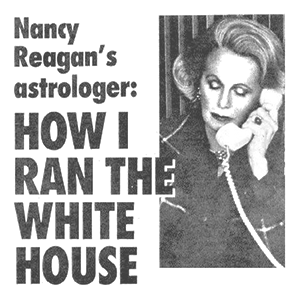
Joan Quigley (1927 – 2014), of San Francisco, was an astrologer best known for her astrological advice to the Reagan White House in the 1980s. Quigley was born in Kansas City, Missouri.
She was called on by First Lady Nancy Reagan in 1981 after John Hinckley’s attempted assassination of the president, and stayed on as the White House astrologer in secret until being outed in 1988 by ousted former chief of staff Donald Regan. Continue reading →
Posted in Philosophy, Politics |
Leave a Comment »


 The Daily Omnivore