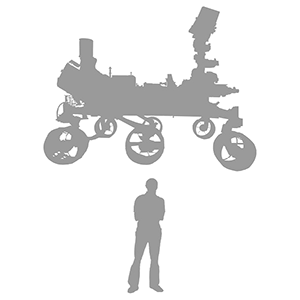
The Curiosity rover is a nuclear-powered exploration vehicle that is part of NASA’s Mars Science Laboratory (MSL) mission. The MSL spacecraft was launched in late 2011 and successfully landed on Aeolis Palus in Gale Crater in the summer of 2012. The approximately 2 billion-year-old impact crater is hypothesized to have gradually been filled in, first by water-deposited, and then by wind-deposited sediments, possibly until it was completely covered, before wind erosion scoured out the sediments, leaving an isolated 5.5 km (3.4 mile) high mountain, Aeolis Mons, at the center of the 154 km (96 mi) wide crater.
Thus, it is believed that the rover may have the opportunity to study two billion years of Martian history in the sediments exposed in the mountain. Additionally, its landing site should be on or near an alluvial fan, which is hypothesized to be the result of a flow of ground water, either before the deposition of the eroded sediments or else in relatively recent geologic history. Continue reading
Curiosity Rover
The Two Cultures

The Two Cultures is the title of an influential 1959 Rede Lecture by British scientist and novelist C. P. Snow. Its thesis was that ‘the intellectual life of the whole of western society’ was split into the titular two cultures — namely the sciences and the humanities — and that this was a major hindrance to solving the world’s problems. Snow’s Rede Lecture condemned the British educational system as having, since the Victorian period, over-rewarded the humanities (especially Latin and Greek) at the expense of scientific and engineering education, despite such achievements having been so decisive in winning the Second World War for the Allies.
This in practice deprived British elites (in politics, administration, and industry) of adequate preparation to manage the modern scientific world. By contrast, Snow said, German and American schools sought to prepare their citizens equally in the sciences and humanities, and better scientific teaching enabled these countries’ rulers to compete more effectively in a scientific age. Later discussion of ‘The Two Cultures’ tended to obscure Snow’s initial focus on differences between British systems (of both schooling and social class) and those of competing countries.
Consilience

In science and history, consilience [kun-sil-ee-ehns] (also convergence of evidence or concordance of evidence) refers to the principle that evidence from independent, unrelated sources can ‘converge’ to strong conclusions. That is, when multiple sources of evidence are in agreement, the conclusion can be very strong even when none of the individual sources of evidence are very strong on their own. Most established scientific knowledge is supported by a convergence of evidence: if not, the evidence is comparatively weak, and there will not likely be a strong scientific consensus.
The principle is based on the unity of knowledge (a thesis in philosophy of science that says that all the sciences form a unified whole); measuring the same result by several different methods should lead to the same answer. For example, it should not matter whether one measures the distance between the Great Pyramids of Giza by laser rangefinding, by satellite imaging, or with a meter stick – in all three cases, the answer should be approximately the same. For the same reason, different dating methods in geochronology should concur, a result in chemistry should not contradict a result in geology, etc. Continue reading
Consilience
‘Consilience [kun-sil-ee-ehns]: The Unity of Knowledge’ is a 1998 book by biologist E. O. Wilson on the unification of scientific fields of inquiry and the potential unification of hard and soft sciences (humanities). Wilson uses the term to describe the synthesis of knowledge from different specialized fields of human endeavor.
He defines it as: ‘Literally a ‘jumping together’ of knowledge by the linking of facts and fact-based theory across disciplines to create a common groundwork of explanation.’ Examples include the unification of Darwin’s theory of evolution with genetics; the unification of forces in modern physics; Einstein’s work unifying Brownian motion with atomic theory; Rene Descartes’ unification of geometry and algebra; and Newton’s universal gravitation, which unified the laws of falling bodies with the laws of planetary motion.
The Wilson Quarterly
The Wilson Quarterly is a magazine published by the Woodrow Wilson International Center for Scholars in Washington, D.C. The magazine was founded in 1976 by journalist Peter Braestrup and James H. Billington, the thirteenth Librarian of the United States Congress. The ‘Quarterly’ is noted for its nonpartisan, nonideological approach to current issues, with articles written from various perspectives.
Designed to make the research and debates of scholars and intellectuals accessible to a general audience, it covers a wide range of topics, from science policy and literature to foreign affairs. In 2012, the ‘Quarterly’ changed to a digital-only publishing model. Continue reading
Who Controls the Internet?
‘Who Controls the Internet? Illusions of a Borderless World’ is a 2006 book by law professors Jack Goldsmith and Tim Wu that offers an assessment of the struggle to control the Internet. Starting with a discussion of the early vision of a borderless global community, the authors present some of the most prominent individuals, ideas, and movements that have played key roles in developing the Internet.
The book asserts the important role of government in maintaining Internet law and order while debunking the claims of techno-utopianism that have been espoused by theorists such as Thomas Friedman. In the 1990s the Internet was greeted as the ‘New New Thing’: It would erase national borders, give rise to communal societies that invented their own rules, undermine the power of governments. Goldsmith and Wu explain why these early assumptions were mostly wrong. The Internet turns out to illustrate the enduring importance of Old Old Things, such as law and national power and business logic.
Dennō Coil
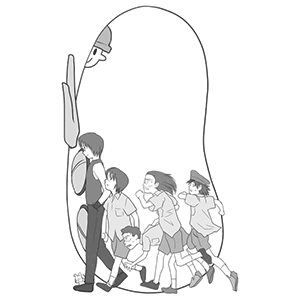
Dennō Coil (literally ‘Electric Brain Coil’) is a Japanese anime television series depicting a near future where semi-immersive augmented reality (AR) technology has just begun to enter the mainstream. The series takes place in the fictional city of Daikoku, a hotbed of AR development with an emerging city-wide virtual infrastructure.
It follows a group of children as they use AR glasses to unravel the mysteries of the half real, half Internet city, using a variety of illegal software tools, techniques, and virtual pets to manipulate the digital landscape. The show was in development for over a decade, and was the directorial debut of Japanese animator Mitsuo Iso. It premiered on NHK Educational TV in 2007. Continue reading
Internet of Things
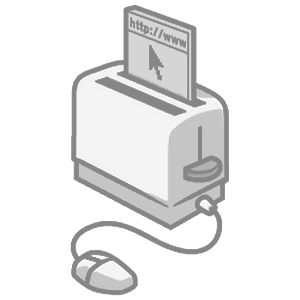
The Internet of Things refers to uniquely identifiable objects (things) and their virtual representations in an Internet-like structure. The term ‘Internet of Things’ was first used by British technology pioneer Kevin Ashton in 1999.
The concept first became popular through his Auto-ID Center at MIT, which created a global standard system for RFID (radio-frequency identification) and other sensors. RFID is often seen as a prerequisite for the Internet of Things. If all objects and people in daily life were equipped with radio tags, they could be identified and inventoried by computers. However, unique identification of things may be achieved through other means such as barcodes, QR codes, and advanced computer object recognition. Continue reading
Head-mounted Display

A head-mounted display is a display device worn on the head or as part of a helmet, that has a small display optic in front of one (monocular HMD) or each eye (binocular HMD). A typical HMD has either one or two small displays with lenses and semi-transparent mirrors embedded in a helmet, eye-glasses (also known as data glasses), or visor. The display units are miniaturised and may include CRT, LCDs, Liquid crystal on silicon (LCos), or OLED. Some vendors employ multiple micro-displays to increase total resolution and field of view.
HMDs differ in whether they can display just a computer generated image (CGI), show live images from the real world, or a combination of both. Some HMDs allow a CGI to be superimposed on a real-world view. This is referred to as augmented reality or mixed reality. Combining real-world view with CGI can be done by projecting the CGI through a partially reflective mirror and viewing the real world directly. This method is often called ‘Optical See-Through.’ Combining real-world view with CGI can also be done electronically by accepting video from a camera and mixing it electronically with CGI. This method is often called ‘Video See-Through.’
Project Glass

Project Glass is a research and development program by Google to develop an augmented reality head-mounted display (HMD). The intended purpose of Project Glass products would be the hands free displaying of information currently available to most smartphone users, and allowing for interaction with the Internet via natural language voice commands, in a manner which has been compared to the iPhone feature Siri.
The functionality and physical appearance (minimalist design of the aluminium strip with 2 nose pads) has been compared to the EyeTap (developed by Steve Mann at the University of Toronto), which was also referred to as ‘Glass’ (‘EyeTap Digital Eye Glass’). Though head-worn displays for augmented reality are not a new idea, the project has drawn media attention primarily due to its backing by Google, as well as the prototype, which is smaller and slimmer than previous designs for head-mounted displays. Continue reading
WIMP

In human–computer interaction, WIMP stands for ‘windows, icons, menus, pointer.’ denoting a style of interaction using these elements of the user interface. It was coined by Merzouga Wilberts in 1980. Although its usage has fallen out of favor, it is often incorrectly used as an approximate synonym of ‘graphical user interface’ (GUI). Any interface that utilizes graphics can be termed a GUI, and WIMP systems are a derivative of such systems.
However, while all WIMP systems utilize graphics as a key element (namely the Icon and Pointer element) and therefore all WIMPs are GUIs, the reverse is not true – some GUIs are not based in windows, icons, menus and pointers and thus are not WIMPs. For example, most mobile phones utilize icons (graphics represent and result in an action being performed) and some may have menus but very few include a pointer or run their utilities/programs in a window.
Post-WIMP
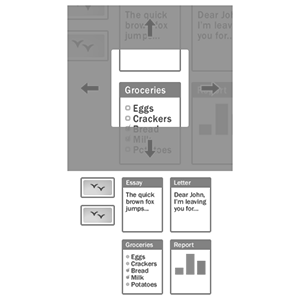
In computing post-WIMP comprises work on user interfaces, mostly graphical user interfaces, which attempt to go beyond the paradigm of windows, icons, menus and a pointing device, i.e. WIMP interfaces.The reason WIMP interfaces have become so prevalent since their conception at Xerox PARC is that they are very good at abstracting workspaces, documents, and their actions. Their analogous paradigm to documents as paper sheets or folders makes WIMP interfaces easy to introduce to novice users. Furthermore their basic representations as rectangular regions on a 2D flat screen make them a good fit for system programmers, thus favoring the abundance of commercial widget toolkits in this style.
However WIMP interfaces are not optimal for working with complex tasks such as computer-aided design, working on large amounts of data simultaneously, or interactive games. WIMPs are usually pixel-hungry, so given limited screen real estate they can distract attention from the task at hand. Thus, custom interfaces can better encapsulate workspaces, actions, and objects for specific complex tasks. Applications for which WIMP is not well suited include those requiring continuous input signals, showing 3D models, or simply portraying an interaction for which there is no defined standard widget. Continue reading



