February 2, 2012

‘Games People Play: The Psychology of Human Relationships’ is a 1964 bestselling book by psychiatrist Eric Berne. Since its publication it has sold more than five million copies. The book describes both functional and dysfunctional social interactions.
In the first half of the book, Berne introduces transactional analysis as a way of interpreting social interactions. He describes three roles or ego states, known as the Parent, the Adult, and the Child, and postulates that many negative behaviors can be traced to switching or confusion of these roles. The book uses casual, often humorous phrases such as ‘See What You Made Me Do,’ ‘Why Don’t You — Yes But,’ and ‘Ain’t It Awful’ as a way of briefly describing each game. In reality, the ‘winner’ of a mind game is the person that returns to the Adult ego-state first. Continue reading →
Posted in Games, Health, Language |
1 Comment »
February 2, 2012

Submarine aircraft carriers are submarines equipped with fixed wing aircraft for observation or attack missions. These submarines saw their most extensive use during World War II, although their operational significance remained rather small.
The most famous of them were the Japanese I-400 class submarine and the French submarine Surcouf, although a few similar craft were built by other nations’ navies as well. Except for the I-400, submarine aircraft carriers used their aircraft in a supporting role (usually for reconnaissance), unlike the typical surface aircraft carrier, which describes a ship whose main function is serving as a base for combat aircraft.
Continue reading →
Posted in Technology, War, World |
Leave a Comment »
February 2, 2012

The Sen Toku I-400-class Imperial Japanese Navy submarines were the largest submarines of World War II and remained the largest ever built until the construction of nuclear ballistic missile submarines in the 1960s. They were submarine aircraft carriers able to carry three Aichi M6A Seiran aircraft underwater to their destinations. They were designed to surface, launch the planes then dive again quickly before they were discovered. They also carried torpedoes for close-range combat. The I-400-class was designed with the range to travel anywhere in the world and return. A fleet of 18 boats was planned in 1942, of which only three were completed.
Located approximately amidships on the top deck was a cylindrical watertight aircraft hangar, 31 m (102 ft) long and 3.5 m (11 ft) in diameter. The outer access door could be opened hydraulically from within or manually from the outside by turning a large hand-wheel connected to a rack and spur gear. The door was made waterproof with a 51-millimeter-thick (2 in.) rubber gasket.
Posted in Technology, War, World |
Leave a Comment »
January 31, 2012

Pixy Stix is a powdered candy packaged in a wrapper that resembles a drinking straw. Pixy Stix used to be made by Sunline which was started 1952 in St. Louis. Originally it was a drink mix in the late 1940s, sold as Frutola, but J. Fish Smith found that kids were eating the sweet & sour powder right from the package instead of putting it in water. He shifted the name to Fruzola and added a spoon. Later it was repackaged with a dipping candy stick as Lik-M-Aid and also sold in little straws called Pixy Stix. It wasn’t until parents complained about the grainy, sticky powder that Sunline came up with a compressed tablet form, the SweeTart in 1963.
The candy is usually poured into the mouth from the wrapper, which is made out of plastic (large size) or paper (small). The ingredients in Pixy Stix are as follows: Dextrose, Citric Acid, less than 2% artificial and natural flavors. Pixy Stix do not contain protein or essential vitamins or minerals.
Posted in Food, Money |
Leave a Comment »
January 31, 2012

‘It girl‘ is a term for a young woman who possesses the quality ‘It,’ absolute attraction.’ The early usage of the concept is seen in a story by Rudyard Kipling: ‘It isn’t beauty, so to speak, nor good talk necessarily. It’s just ‘It.” British writer Elinor Glyn lectured: ‘With ‘It’ you win all men if you are a woman and all women if you are a man. ‘It’ can be a quality of the mind as well as a physical attraction.’
The expression reached global attention in 1927, with the film ‘It,’ starring Clara Bow. While ‘it girls’ of today are commonly young females in the worlds of fashion or show-business, the original concept focused on personality. Kipling’s ‘Mrs. Bathurst’ was a middle-aged widow, and Glyn significantly kept both Benito Mussolini and the doorman at the Ambassador hotel on her ‘It men’ list. Continue reading →
Posted in Language, Love, Sex |
1 Comment »
January 31, 2012

15 minutes of fame is short-lived, often ephemeral, media publicity or celebrity of an individual or phenomenon. The expression was coined by Andy Warhol, who said in 1968 that ‘In the future, everyone will be world-famous for 15 minutes.’ The phenomenon is often used in reference to figures in the entertainment industry or other areas of popular culture, such as reality TV and YouTube. It is believed that the statement was an adaption of a theory of Marshall McLuhan, explaining the differences of media, where TV differs much from other media using contestants.
The expression is a paraphrase of a line in Warhol’s catalog for a 1968 exhibit at the Moderna Museet in Stockholm. In 1979 Warhol reiterated his claim, ‘…my prediction from the sixties finally came true: In the future everyone will be famous for 15 minutes.’ Becoming bored with continually being asked about this particular statement, Warhol attempted to confuse interviewers by changing the statement variously to ‘In the future 15 people will be famous’ and ‘In 15 minutes everybody will be famous.’
Continue reading →
Posted in Art, Humor, Language |
Leave a Comment »
January 30, 2012

The walk of shame refers to where a person must walk past strangers or peers alone for an embarrassing reason before reaching a place of privacy. Most commonly, it occurs the morning after a night out at a bar, dance club, or party.
People undertaking the walk of shame are understood to have spent the night at the house, apartment, or dorm of a sexual partner (or perceived sexual partner), particularly a one night stand. The topic is often the subject of college newspaper commentary. The ‘walker’ may often be identified by his or her disheveled appearance and incongruous evening attire, particularly on Saturday or Sunday mornings.
Posted in Humor, Sex |
1 Comment »
January 30, 2012

The Yiddish Policemen’s Union is a 2007 novel by American author Michael Chabon. The novel is a detective story set in an alternative history version of the present day, based on the premise that during World War II, a temporary settlement for Jewish refugees was established in Sitka, Alaska, in 1941, and that the fledgling State of Israel was destroyed in 1948.
The novel is set in Sitka, which it depicts as a large, Yiddish-speaking metropolis. As a result, two million Jews are killed in the Holocaust, instead of the six million in reality. Continue reading →
Posted in Language, Philosophy, War |
Leave a Comment »
January 30, 2012

An eruv [air-oov] is a ritual enclosure that orthodox Jewish communities construct in their neighborhoods as a way to permit carrying objects outdoors on Shabbat, which they would otherwise understand to be prohibited by Jewish law (Halakha). There are 39 categories of activity prohibited on Shabbat including moving an object from one domain to another, no matter its weight or purpose. The prohibition is not found in the Torah, but in the Talmud (Rabbinical law and commentary).
The eruv permits traditionally observant Jews to, among other things, carry keys, tissues, medicines, or babies with them, and to use strollers and canes. According to tradition, the eruv must be made of walls or doorways at least one meter in height. In public areas where it is impractical to put up walls, doorways are constructed out of wire and posts. It is these doorways, which often serve no practical purpose, that are what is usually referred to as an eruv. Continue reading →
Posted in Philosophy, Politics |
Leave a Comment »
January 30, 2012


In psychology and cognitive science, the positivity effect is the tendency to make situational attributions about negative behaviors and dispositional attributions about positive behaviors for individuals one prefers.The term also refers to age differences in emotional attention and memory. Studies have found that older adults are more likely than younger adults to pay attention to positive than negative stimuli. In addition, compared with younger adults’ memories, older adults’ memories are more likely to consist of positive than negative information and more likely to be distorted in a positive direction. This version of the positivity effect was coined by Laura L. Carstensen’s research team.
Gender roles effect the behavior of the individual as well, and how they perceive others. Males tend to take more dominant roles, whereas females tend to be more nurturing and caregiving. Person-perception studies state that the characteristics of the perceiver are as important as the characteristics of the one being perceived. Since females are deemed to be the more nurturing and selfless by nature, they perceive others more favorably than men do. This is known as the ‘Female Positivity Effect.’ For example, women are more likely to be social and agreeable in a group task situation whereas the males are going to be mainly focused on the task at hand.
Posted in Health, Science |
1 Comment »
January 30, 2012

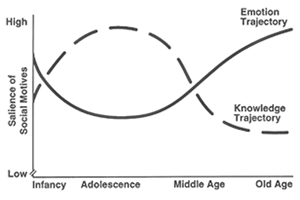
Socioemotional Selectivity Theory, developed by Stanford psychologist, Laura Carstensen, a life-span theory of motivation, maintains that as time horizons shrink, as they typically do with age, people become increasingly selective, investing greater resources in emotionally meaningful goals and activities.
According to the theory, motivational shifts also influence cognitive processing. Aging is associated with a relative preference for positive over negative information in attention and memory (called the ‘positivity effect’). Continue reading →
Posted in Death, Health, Science |
Leave a Comment »
January 30, 2012

A maven [mey-vuhn] is a trusted expert in a particular field, who seeks to pass knowledge on to others. The word maven comes from Hebrew, via Yiddish, and means one who understands, based on an accumulation of knowledge. The Hebrew word ‘mevin’ (‘one who understands’) relates to the word ‘binah,’ which denotes understanding or wisdom in general.
It was first recorded in English around 1952, and popularized in the United States in the 1960s by a series of commercials created by Martin Solow for Vita Herring, featuring The Beloved Herring Maven. In network theory and sociology, a maven is someone who has a disproportionate influence on other members of the network. The role of mavens in propagating knowledge and preferences has been established in various domains, from politics to social trends.
Posted in Language, Money, Science |
Leave a Comment »