June 1, 2011
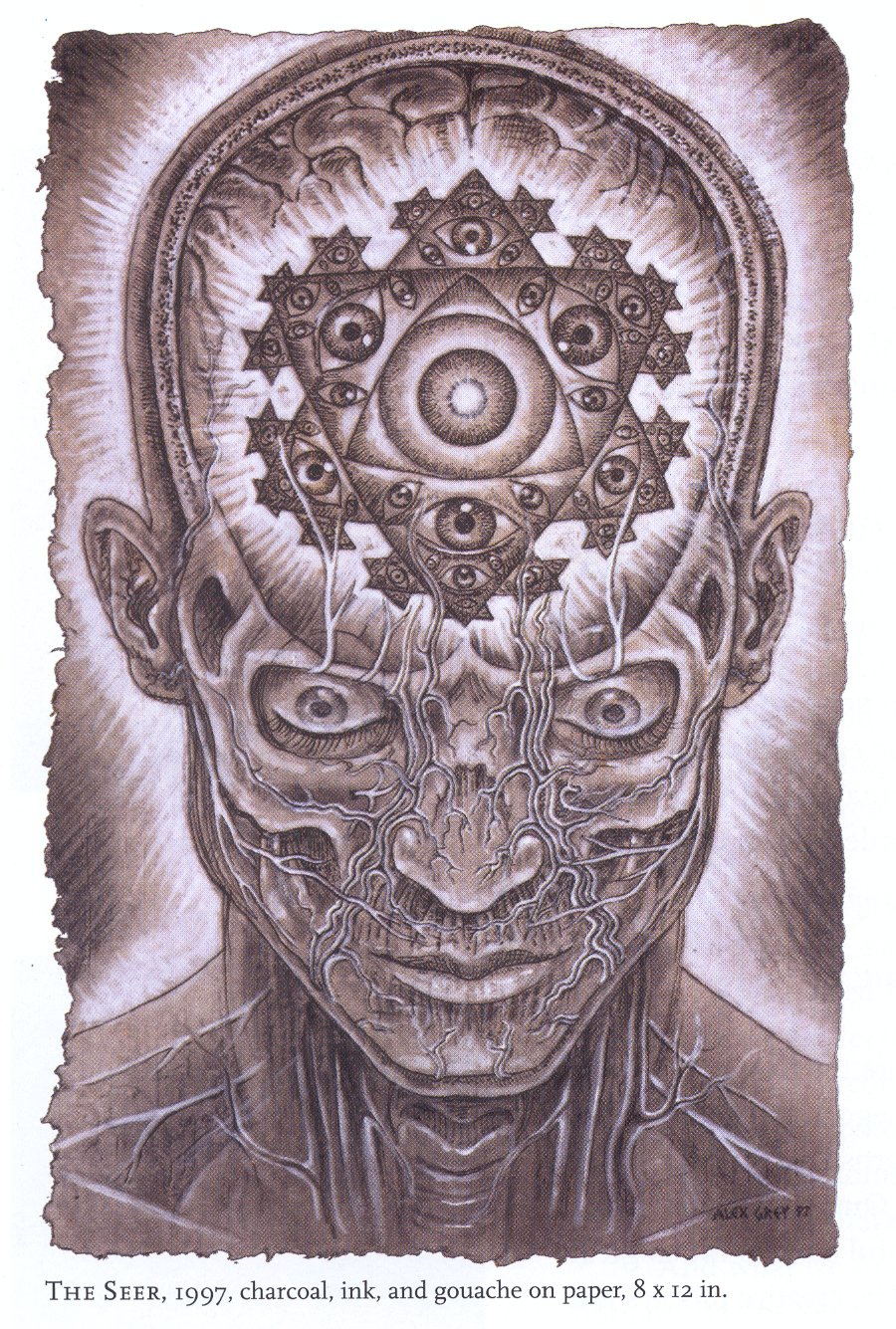
Alex Grey (b. 1953) is an American artist specializing in spiritual and psychedelic art (or visionary art) that is sometimes associated with the New Age movement. Grey is a Vajrayana practitioner, one the three main sects of Buddhism. His body of work spans a variety of forms including performance art, process art, installation art, sculpture, and painting. He and his wife Allyson Grey are the co-founders of the Chapel of Sacred Mirrors, a non-profit institution supporting Visionary Culture in New York City.
Grey’s paintings can be described as a blend of sacred, visionary art and postmodern art. He is best known for his paintings of glowing anatomical human bodies, images that ‘x-ray’ the multiple layers of reality. His art is a complex integration of body, mind, and spirit. ‘The Sacred Mirrors,’ a life-sized series of 21 paintings, took 10 years to complete, and examines in detail the physical and metaphysical anatomy of the individual. Continue reading →
Posted in Art, Philosophy, Science |
1 Comment »
June 1, 2011

The Ethiopians is a ska, rocksteady, and reggae vocal group, founded by Leonard Dillon, Stephen Taylor and Aston Morris. The group started out recording for Clement ‘Coxsone’ Dodd in 1966. Dillon had previously released some mento songs under the name Jack Sparrow. Around late 1966, Morris left the Ethiopians.
Having left Dodd, the Ethiopians started recording at Dynamic Studios for the W.I.R.L. label, releasing the rocksteady classic ‘Train to Skaville,’ which was their first success. In 1968 they recorded the song ‘Everything Crash,’ their first big hit. The song criticised the political situation in Jamaica at the time, such as water rationing and power cuts that led to unrest; such as an incident in which 31 people were shot by police.
Posted in Art, Politics, World |
Leave a Comment »
June 1, 2011


Toots and the Maytals are a Jamaican ska and reggae vocal group. The Maytals were key figures in reggae music. Formed in the early 1960s when ska was hot, the Maytals had a reputation for having strong, well-blended voices and a seldom-rivaled passion for their music. Frederick ‘Toots’ Hibbert (b. 1945) is the group’s frontman.
He met Henry ‘Raleigh’ Gordon and Nathaniel ‘Jerry’ Mathias, forming in 1961 a group whose early recordings were incorrectly attributed to ‘The Flames’ and ‘The Vikings’ in the UK by Island Records. The Maytals first had chart success recording for producer Clement ‘Coxsone’ Dodd at Studio One. With musical backing from Dodd’s house band, The Skatalites, the Maytals’ close-harmony gospel singing overshadowed Dodd’s other up-and-coming vocal group, The Wailers. Continue reading →
Posted in Art, World |
Leave a Comment »
June 1, 2011

‘54-46 (That’s My Number)‘ is a song by Fred ‘Toots’ Hibbert, recorded by Toots & the Maytals and originally released on the Beverly’s label in Jamaica and the Pyramid label in the UK. It was one of the first ska songs to receive widespread popularity outside Jamaica and is seen as being one of the defining songs of the reggae genre. It has been anthologized repeatedly and the titles of several reggae anthologies include ’54-46′ in their title.
The lyrics describe Toots’ time in prison for an arrest for possession of marijuana. The song features the same riddim (instrumental accompaniment) to a song as ‘Train to Skaville’ by Toots & the Maytals’ contemporaries The Ethiopians. Hibbert later admitted that 54-46 was not his actual jail number, and that he was not arrested for a crime related to marijuana.
Posted in Art, Drugs, Politics |
Leave a Comment »
June 1, 2011
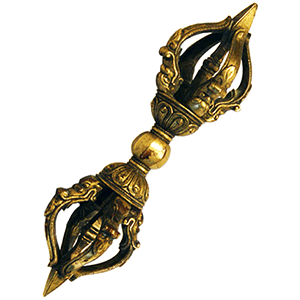
Vajra [vuhj-ruh] is a Sanskrit word meaning both thunderbolt and diamond. It is a short metal weapon – originally a kind of fist-iron like Japanese yawara – that has the symbolic nature of a diamond (it can cut any substance but not be cut itself) and that of the thunderbolt (irresistible force). The vajra is believed to represent firmness of spirit and spiritual power. It is a ritual tool or spiritual implement which is symbolically used by Buddhism, Jainism and Hinduism, all of which are traditions of Dharma. In Buddhism the vajra is the symbol of Vajrayana, one of the three major branches of Buddhism. Vajrayana is translated as ‘Thunderbolt Way’ or ‘Diamond Way’ and can imply the thunderbolt experience of Buddhist enlightenment or bodhi. It also implies indestructibility, just as diamonds are harder than other gemstones.
The vajra is made up of several parts. In the center is a sphere which represents Sunyata, the primordial nature of the universe, the underlying unity of all things. Emerging from the sphere are two eight petaled lotus flowers. One represents the phenomenal world (or in Buddhist terms Samsara), the other represents the noumenal world (or Nirvana). This is one of the fundamental dichotomies which are perceived by the unenlightened. Arranged equally around the mouth of the lotus are two, four, or eight mythical creatures which are called makaras. These are mythological half-fish, half-crocodile creatures made up of two or more animals, often representing the union of opposites, (or a harmonisation of qualities that transcend our usual experience). From the mouths of the makaras come tongues which come together in a point.
Posted in Philosophy, War |
Leave a Comment »
June 1, 2011

New Belgium Brewing Company is a regional brewery located in Fort Collins, Colorado. The brewery was founded by husband-and-wife team Jeff Lebesch and Kim Jordan in 1991 and emphasizes eco-friendly practices and employee ownership in its marketing materials. Fat Tire, an amber ale, is the company’s flagship beer. Its recipe originates from a co-founder’s bicycle trip through Belgium from brewery to brewery. The company promotes its Fat Tire ale locally by the public placement of colorful vintage bicycles outside its brewery, which is located adjacent to the public bike path along the Cache La Poudre River. New Belgium beer labels are designed by Anne Fitch, a watercolorist. Kim Jordan, the President of New Belgium Brewery, credits the success of New Belgium Brewery in part on Anne’s artwork, ‘Our beers were good, our labels were interesting to people, and we pretty quickly had a fairly robust following.’ In 2006, her artwork appeared on each of the over 125 million bottles sold by New Belgium.
Tour de Fat is a bicycle parade and festival sponsored by New Belgium. The events, which take place annually in various large- and medium-sized cities around the West, include music, New Belgium beer, circus- and -vaudeville type acts, bicycle dance troupes, and the main activist spectacle, a giant group bike ride/parade wherein the participants, many of whom are in fanciful costume, ride through town. The actual activist climax of the tour, however, is the bike trade, in which a local participant transfers the keys and title of their motor vehicle to New Belgium in exchange for a new commuter bike and trailer in order to promote bike riding and sustainability. The ‘Fat Tire’ bike is so strongly associated with New Belgium Breweries that employees of the brewery are given a ‘cruiser bike’ ‘like the one pictured on its Fat Tire Amber Ale label’ on their one -year anniversary with the company.
Posted in Art, Food, Money |
Leave a Comment »
May 31, 2011
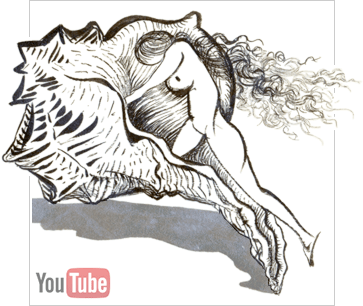
Destino is an animated short film released in 2003 by The Walt Disney Company. The six-minute short follows the story of Chronos and the ill-fated love he has for a mortal female. It is unusual in that its production originally began in 1945.
The project was a collaboration between Walt Disney and Salvador Dalí, and features music written by Mexican songwriter Armando Dominguez and performed by Dora Luz. Continue reading →
Posted in Art |
1 Comment »
May 31, 2011


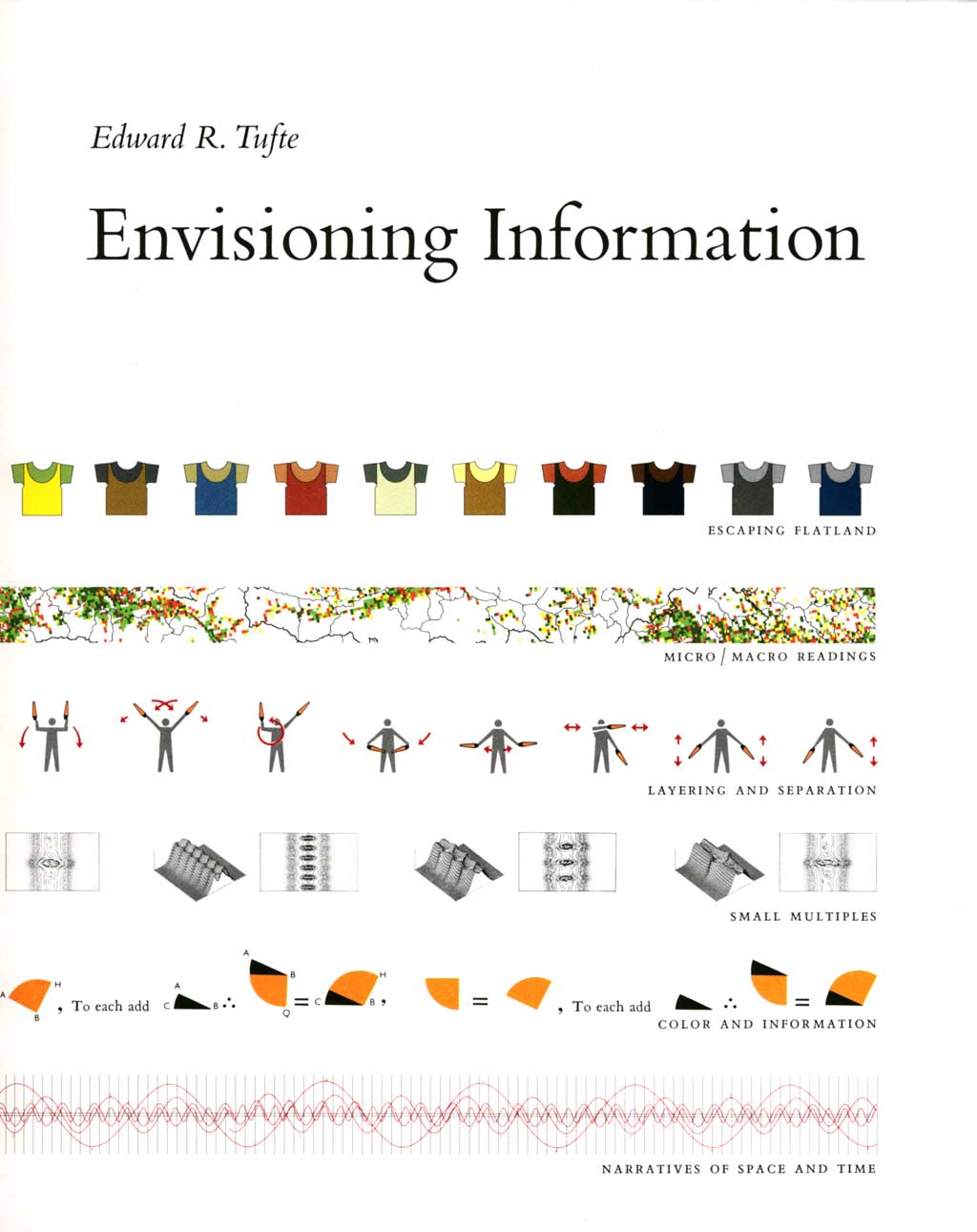
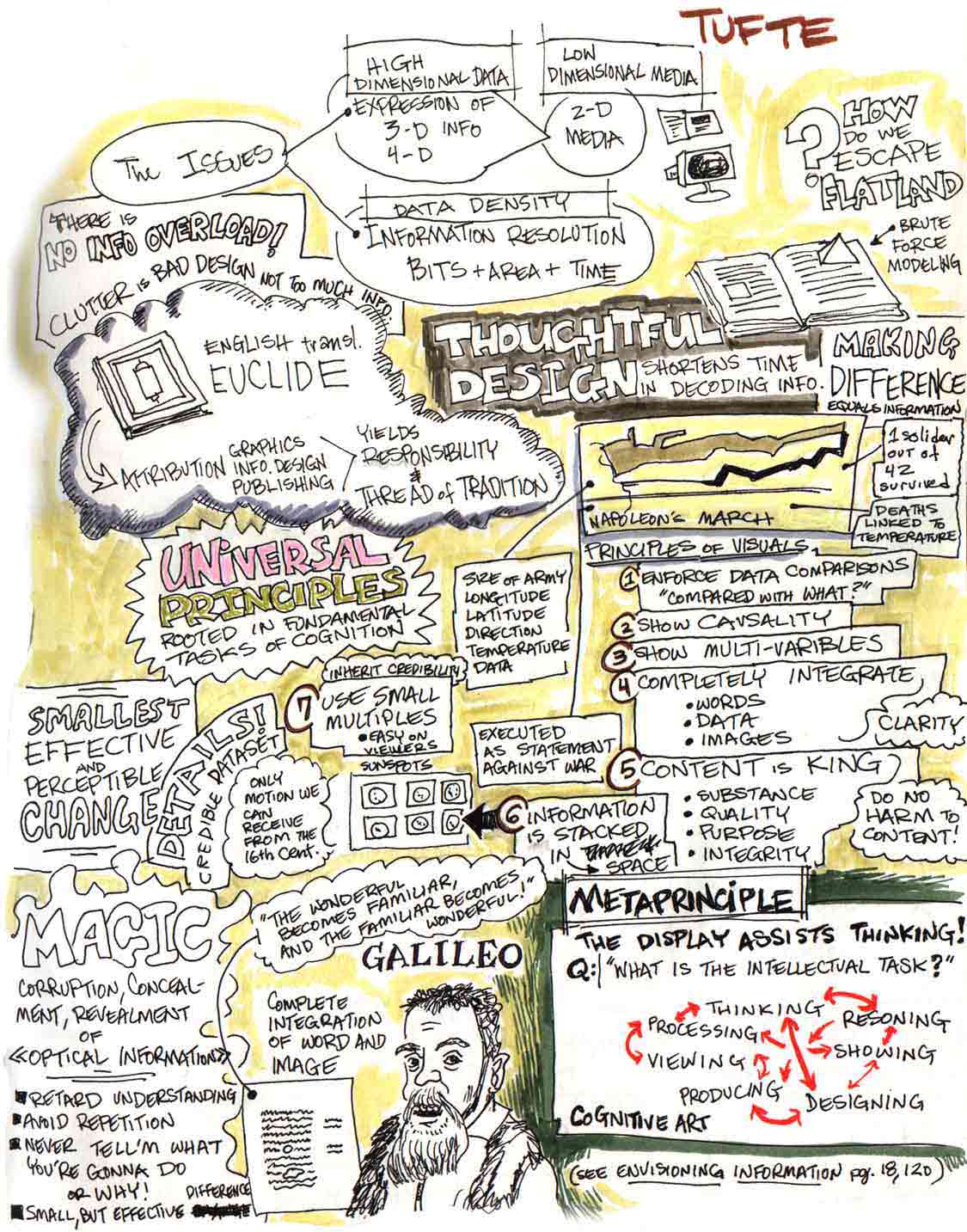
Edward Tufte (b. 1942) is an American statistician and professor emeritus of political science, statistics, and computer science at Yale University. He is noted for his writings on information design and as a pioneer in the field of data visualization.Tufte’s writing is important in such fields as information design and visual literacy, which deal with the visual communication of information. He coined the term ‘chartjunk’ to refer to useless, non-informative, or information-obscuring elements of quantitative information displays. Other key concepts of Tufte are the ‘lie factor,’ the ‘data-ink ratio,’ and the ‘data density’ of a graphic.
He uses the term ‘data-ink ratio’ to argue against using excessive decoration in visual displays of quantitative information. Tufte states, ‘Sometimes decorations can help editorialize about the substance of the graphic. But it’s wrong to distort the data measures—the ink locating values of numbers—in order to make an editorial comment or fit a decorative scheme.’
Continue reading →
Posted in Art, Money, Science |
Leave a Comment »
May 31, 2011

Jellyfish Lake is located on Eil Malk island in Palau. Eil Malk is part of the Rock Islands, a group of small, rocky, mostly uninhabited islands in Palau’s Southern Lagoon. Jellyfish Lake is one of Palau’s most famous dive (snorkeling only) sites. It is notable for the millions of golden jellyfish which migrate horizontally across the lake daily.
The jellyfish found in the lake have stinging cells, but are not in general powerful enough to cause harm to humans. It has been reported that it is possible to notice the stings on sensitive areas like the area around the mouth.
Continue reading →
Posted in Science, World |
Leave a Comment »
May 26, 2011

Lowbrow describes an underground visual art movement that arose in Los Angeles in the late 1970s. Lowbrow is a widespread populist art movement with origins in the underground comix world, punk music, hot-rod street culture, and other subcultures. It is also often known by the name pop surrealism. Lowbrow art often has a sense of humor – sometimes the humor is gleeful, sometimes impish, and sometimes it is a sarcastic comment.
Some of the first artists to create what came to be known as lowbrow art were underground cartoonists like Robert Williams and Gary Panter. Early shows were in alternative galleries in New York and Los Angeles such as Psychedelic Solutions Gallery in Greenwich Village, La Luz de Jesus, and 01 gallery. The lowbrow magazine Juxtapoz by Robert Williams, first published in 1994, has been a mainstay of writing on lowbrow art and has helped direct and grow the movement.
Continue reading →
Posted in Art, Money |
1 Comment »
May 26, 2011

Todd Schorr (b. 1954) is an American artist and one of the most prominent members of the ‘Lowbrow’ art movement or pop surrealism. His work combines a cartoon visual vocabulary with painting methods of the Old Masters with large canvases (+80″), and is darkly satirical.
His piece, ‘Clash of Holidays,’ aroused controversy when it was exhibited in 2002. It depicts Santa Claus and the Easter Bunny locked in mortal combat. Santa’s wielding an axe, and the rabbit has a knife. Rudolph the Red-Nosed Reindeer and Baby Jesus, who’s munching on an ear from a chocolate rabbit, stand by. Schorr was accused of blasphemy by civic leaders in South Florida. ‘It was just a joke, really, like lot of my paintings that poke fun at things,’ comments Schorr, who completed the piece in 2000, then sold it to Courteney Cox. Continue reading →
Posted in Art, Humor, Money |
Leave a Comment »
May 26, 2011


Addictive TV is a UK film remixer and chop-up duo formed in 1992. The DJ/producers and audiovisual artists are the team behind Optronica – the visual music and VJ festival held in London. In 1998 they produced Transambient for Channel 4 in the UK and from 2000 – 2005 produced the ground-breaking DJ:VJ music series Mixmasters for the UK’s ITV1. In 2003, working closely with the R&D area of Japanese manufacturer Pioneer Electronics they became instrumental with the testing and development of their DVD turntables, the first being the Pioneer DVJ-X1 released in 2004.
They are known for their bootleg film remixes, and in 2006 they became the first group to officially remix a Hollywood film, reworking New Line Cinema’s dance-centric Take the lead into an audiovisual Viral video. In 2006 they also worked on Snakes on a Plane remixing the film for its TV commercials.
Posted in Art, Technology |
Leave a Comment »