November 22, 2016
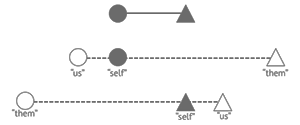

In social psychology, naïve realism is the human tendency to believe that we see the world around us objectively, and that people who disagree with us must be uninformed, irrational, or biased. It provides a theoretical basis for several other cognitive biases, which are systematic errors in thinking and decision-making.
Naïve realism causes people to exaggerate differences between themselves and others. Psychologists believe that it can spark and exacerbate conflict, as well as create barriers to negotiation through several different mechanisms. Continue reading →
Posted in Health, Science |
Leave a Comment »
November 20, 2016

‘Sanctuary city‘ is an unofficial and sometimes pejorative term for a city that has deprioritized the enforcement of national immigration laws. Some so-called ‘sanctuary cities’ have adopted regulations prohibiting police or municipal employees from inquiring about a person’s immigration status. Others decline to prosecute immigrants if they have committed no crime other than entering illegally. The designation has no precise legal meaning and is viewed negatively by some and positively by others. Toronto has been a declared sanctuary city since 2014. President-elect Donald Trump has promised to cut all federal funding for sanctuary cities on his first day in office.
Local governments in a few cities in the US began designating themselves as sanctuary cities during the 1980s. However, the term is often used incorrectly to describe trust acts or community policing policies that limit entanglement between local police and federal immigration authorities. The policy was first initiated in 1979 in Los Angeles, to prevent police from inquiring about the immigration status of arrestees. The internal policy, ‘Special Order 40,’ states: ‘Officers shall not initiate police action with the objective of discovering the alien status of a person. Officers shall not arrest nor book persons for violation of title 8, section 1325 of the United States Immigration code (Illegal Entry).’ Continue reading →
Posted in Politics, World |
Leave a Comment »
November 16, 2016

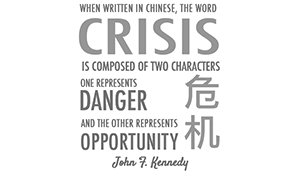
‘May you live in interesting times’ is an English expression purported to be a translation of a traditional Chinese curse. While seemingly a blessing, the expression is always used ironically, with the clear implication that ‘uninteresting times,’ of peace and tranquillity, are more life-enhancing than interesting ones, which from historical perspective usually include disorder and conflict.
Despite being so common in English as to be known as ‘the Chinese curse,’ the saying is apocryphal, and no actual Chinese source has ever been produced. The nearest related Chinese expression is usually translated as ‘Better to be a dog in a peaceful time, than to be a human in a chaotic (warring) period.’ The expression originates from a 1627 short story collection, ‘Stories to Awaken the World.’
Posted in Humor, Philosophy, World |
Leave a Comment »
November 15, 2016


Steve Ditko (b. 1927) is an American comic book artist and writer best known as the artist and co-creator, with Stan Lee, of ‘Spider-Man’ and ‘Doctor Strange.’ As of mid-2012, Ditko continues to work at a studio in Manhattan’s Midtown West neighborhood. He has refused to give interviews or make public appearances since the 1960s, explaining in 1969 that, ‘When I do a job, it’s not my personality that I’m offering the readers but my artwork. It’s not what I’m like that counts; it’s what I did and how well it was done…. I produce a product, a comic art story. Steve Ditko is the brand name.’ He has, however, contributed numerous essays to Robin Snyder’s fanzine ‘The Comics.’
Ditko studied under ‘Batman’ artist Jerry Robinson in Manhattan at the Cartoonist and Illustrators School (later the School of Visual Arts). He began his professional career in 1953, working in the studio of Joe Simon and Jack Kirby, beginning as an inker and coming under the influence of artist Mort Meskin. During this time, he then began his long association with Charlton Comics, where he did work in the genres of science fiction, horror, and mystery. He also co-created the superhero ‘Captain Atom’ in 1960. Continue reading →
Posted in Art, Language |
Leave a Comment »
November 14, 2016
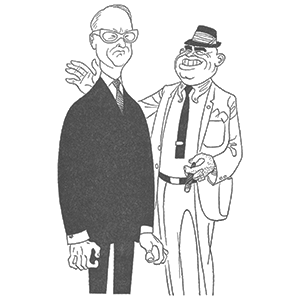
A snob is a pejorative term for a person who believes there is a correlation between social status and human worth. The term also refers to a person who judges, stigmatizes others and believes that some people are inherently inferior to others result from the perception of beliefs, values, intellect, creativity, talent, wealth, occupation, education, ancestry, ethnicity, relationship, power, religion, physical strength, class, taste, prestige, beauty, nationality, and fame. The word ‘snobbery’ came into use the first time in England during the 1820s.
English social commentator William Hazlitt observed, in a culture where deference to class was accepted as a positive and unifying principle, ‘Fashion is gentility running away from vulgarity, and afraid of being overtaken by it,’ adding subversively, ‘It is a sign the two things are not very far apart.’ The English novelist Bulwer-Lytton remarked in passing, ‘Ideas travel upwards, manners downwards.’ It was not the deeply ingrained and fundamentally accepted idea of ‘one’s betters’ that has marked snobbery in traditional European and American culture, but ‘aping one’s betters.’ Continue reading →
Posted in Language, Money, Politics |
Leave a Comment »
November 12, 2016
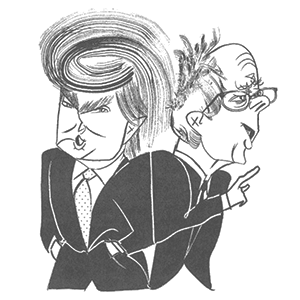
Populism is a political ideology that holds that virtuous citizens are mistreated by a small circle of elites, who can be overthrown if the people recognize the danger and work together. Populism depicts elites as trampling on the rights, values, and voice of the legitimate people.
Populist movements are found in many democratic nations. According to Cas Mudde, a Dutch political scientist who focuses on political extremism and populism in Europe: ‘Many observers have noted that populism is inherent to representative democracy; after all, do populists not juxtapose ‘the pure people’ against ‘the corrupt elite?” Continue reading →
Posted in Money, Politics, World |
1 Comment »
November 11, 2016

‘Don’t mourn, organize!‘ is an expression often incorrectly supposed to be the last words spoken by labor activist and songwriter Joe Hill, who was charged with murder and executed in Utah in 1915. In truth, the expression is part of a telegram sent to Bill Haywood, the founding member and leader of the Industrial Workers of the World (IWW), in which Joe wrote, ‘Goodbye, Bill, I die like a true blue rebel. Don’t waste any time mourning. Organize!’ It wasn’t Joe’s last telegram; he sent another in which he implored Haywood, ‘Could you arrange to have my body hauled to the state line to be buried? I don’t want to be found dead in Utah.’
Since the death of Hill, the phrase has been used in association with other labor leaders’ deaths. The phrase has also been used in conjunction with a severe defeat and not the death of an individual.
Posted in Death, Money, Politics |
Leave a Comment »
November 1, 2016
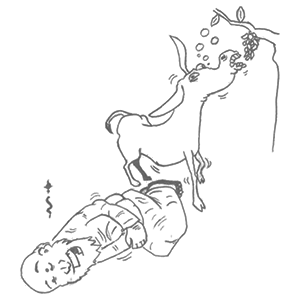
Death from laughter is a rare form of death, usually resulting from cardiac arrest or asphyxiation, caused by a fit of laughter. Instances of death by laughter have been recorded from the times of ancient Greece to the modern day. Certain brain injuries can cause pathological, uncontrollable laughter such as infarction of the pons and medulla oblongata.
Laughter can cause atonia and collapse (‘gelastic syncope,’ a short episode of low blood pressure caused by laughter), which in turn can cause trauma. Gelastic seizures, a rare type of seizure that involves a sudden burst of energy, usually in the form of laughing or crying, can be due to focal lesions to the hypothalamus. Depending upon the size of the lesion, the emotional lability (mood swings) may be a sign of an acute condition, and not itself the cause of the fatality. Gelastic syncope has also been associated with the cerebellum. Continue reading →
Posted in Death, Health, Humor |
Leave a Comment »
October 31, 2016


Tootsie Pops are hard candy lollipops filled with chocolate-flavored chewy Tootsie Rolls (a taffy-like candy that has been manufactured in the U.S. since 1907). They were invented in 1931 by Lukas R. ‘Luke’ Weisgram, an employee of The Sweets Company of America. The company changed its name to Tootsie Roll Industries in 1969.
Tootsie Pops are known for the catch phrase ‘How many licks does it take to get to the Tootsie Roll center of a Tootsie Pop?’ The phrase was first introduced in 1969 an animated commercial. In the original television ad, a questioning boy poses the question to a cow, a fox, a turtle and an owl. Each one of the first three animals tells the boy to ask someone else, explaining that they’d bite a Tootsie Pop every time they lick one. Eventually, he asks the owl, who starts licking it, but bites into the lollipop after only three licks, much to the chagrin of the boy, who gets the empty stick back. The commercial ends the same way, with various flavored Tootsie Pops unwrapped and being ‘licked away’ until being crunched in the center. Continue reading →
Posted in Food |
Leave a Comment »
October 30, 2016
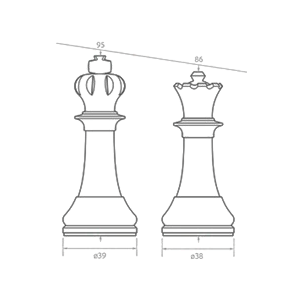
The Staunton chess set is the style of chess pieces approved for competitions. Nathaniel Cook patented the design in the U.K. in 1849, and they are named after English chess master Howard Staunton. The first 500 sets were hand signed and numbered by Staunton. The pieces were first made available by games and sporting goods retailer Jaques of London and quickly became a standard. They have been used around the world since.
The increased interest in the game of chess, particularly in international play during the late 18th century and early 19th century, brought about a renewed demand for a more universal model for chess pieces. The variety and styles of the conventional form, begun in the 15th century, had expanded tremendously by the beginning of the nineteenth century. Conventional types popular during the period included the English ‘Barleycorn’ set, the French ‘Regence’ chess set, and the central ‘European.’ Most pieces were tall, easily tipped and cumbersome during play, but their major disadvantage was the similarity of the pieces within a set. A player’s unfamiliarity with an opponent’s set could alter the outcome of a game. Continue reading →
Posted in Games |
Leave a Comment »
October 26, 2016

Birdwell, makers of Birdwell Beach Britches, is an American surf clothing company headquartered in Santa Ana, California. Founded by Carrie Birdwell Mann in 1961, the company manufactures and sells customized heavy-duty swimsuits, which are sold internationally. With four basic models, various fabrics, including Surfnyl, Tectyl, heavy nylon, sailcloth, and canvas, more than 40 colors, and various other options, the combinations that can be created are nearly endless. The company’s motto is ‘We don’t build 1000 things. We build one thing 1000 ways.’
The swimsuits themselves, which resemble board shorts, are paneled swimsuits, with waistbands resembling those of boxing trunks, always double-stitched, always with two layers of fabric. These shorts are known and favored among surfers, lifeguards, and paddleboarders, because of their quick-drying design and extreme durability; with an estimated 10 years for average use, and two to five years for more strenuous use. On all of the trunks there is a 2 square inch logo, of a stylized anthropomorphic surfboard, wearing, of course, Birdwell Beach Britches, nicknamed ‘Birdie.’
Posted in Games, Money |
Leave a Comment »
October 25, 2016
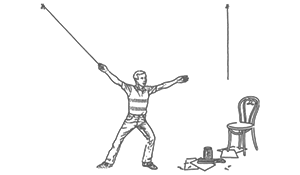

Einstellung [ahyn-stel-luhng] (German: ‘attitude’) is the development of a mechanized state of mind. Often called a ‘problem solving set,’ Einstellung refers to a person’s predisposition to solve a given problem in a specific manner even though better or more appropriate methods of solving the problem exist. The Einstellung effect is the negative effect of previous experience when solving new problems. It has been tested experimentally in many different contexts.
The Einstellung effect occurs when a person is presented with a problem or situation that is similar to problems they have worked through in the past. If the solution (or appropriate behavior) to the problem/situation has been the same in each past experience, the person will likely provide that same response without giving the problem too much thought. This behavior is heuristical (related to mental shortcuts), it is one of the human brain’s ways of finding solutions as efficiently as possible. Continue reading →
Posted in Education, Health, Science |
1 Comment »


 The Daily Omnivore