June 5, 2016

Divide and choose (or ‘I cut, you choose‘) is a procedure for envy-free cake-cutting between two partners. It involves a heterogeneous good or resource (‘the cake’) and two partners which have different preferences over parts of the cake. The protocol proceeds as follows: one person cuts the cake into two pieces, and the other person chooses his piece first.
Divide-and-choose is mentioned in the Bible. In Genesis, when Abraham and Lot come to the land of Canaan, Abraham suggests that they divide it among them. Then Abraham, coming from the south, divides the land to a ‘left’ (western) part and a ‘right’ (eastern) part, and lets Lot choose. Lot chooses the eastern part which contains Sodom and Gomorrah. Continue reading →
Posted in Games, Money, Science |
Leave a Comment »
May 31, 2016

Typography is the art and technique of arranging type to make written language legible, readable, and appealing when displayed. The arrangement of type involves selecting typefaces, point size, line length, line-spacing (leading), letter-spacing (tracking), and adjusting the space within letters pairs (kerning). The term ‘typography’ is also applied to the style, arrangement, and appearance of the letters, numbers, and symbols created by the process.
In contemporary use, the practice and study of typography is very broad, covering all aspects of letter design and application, both mechanical (typesetting and typefaces) and manual (handwriting and calligraphy). Type design is a closely related craft, sometimes considered part of typography; most typographers do not design typefaces, and some type designers do not consider themselves typographers. Typography also may be used as a decorative device, unrelated to communication of information. Continue reading →
Posted in Art, Language, Technology |
Leave a Comment »
May 29, 2016
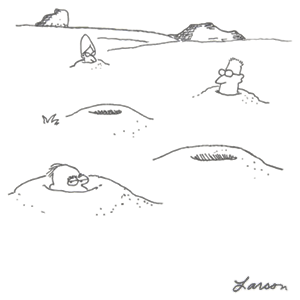
‘The Far Side‘ is a single-panel comic created by Gary Larson and syndicated by Universal Press Syndicate, which ran from January 1, 1980, to January 1, 1995. Its surrealistic humor is often based on uncomfortable social situations, improbable events, an anthropomorphic view of the world, logical fallacies, impending bizarre disasters, (often twisted) references to proverbs, or the search for meaning in life. Larson’s frequent use of animals and nature in the comic is popularly attributed to his background in biology. The series was preceded by a similar panel called ‘Nature’s Way,’ also by Larson.
Most of Larson’s comics relied on some combination of a visual and verbal gag, rather than just one or the other. Some recurring themes in the comic include people being stranded on desert islands, aliens, heaven, hell, and the life of cavemen. Many cartoons focused on animals, especially cows, bears, dogs, flies, and ducks. Notably, virtually all characters portrayed in the comic were overweight or obese, and usually wearing glasses. In addition, unless needed for a facial or comic expression, eyes are almost never drawn and characters usually show only a brow ridge.
Posted in Art, Humor, Language |
1 Comment »
May 28, 2016

The Pygmalion effect, or ‘Rosenthal effect,’ is the phenomenon whereby higher expectations lead to an increase in performance. The effect is named after the Greek myth of Pygmalion, a sculptor who fell in love with a statue he had carved. By the Pygmalion effect, people internalize their positive labels, and those with positive labels succeed accordingly. A corollary of the Pygmalion effect is the ‘golem effect,’ in which low expectations lead to a decrease in performance.
Psychologists Robert Rosenthal and Lenore Jacobson’s first showed that, if teachers were led to expect enhanced performance from children, then the children’s performance was enhanced. This study supported the hypothesis that reality can be positively or negatively influenced by the expectations of others, the ‘observer-expectancy effect.’ Rosenthal theorized that biased expectancies could affect reality and create self-fulfilling prophecies (predictions that directly or indirectly cause themselves to become true)
Continue reading →
Posted in Education, Health, Science |
Leave a Comment »
May 24, 2016
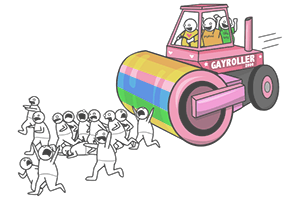

The ‘Gay Mafia‘ and the ‘Velvet Mafia’ are pejorative terms for the expansion of gay rights groups in politics, media, and everyday life. The terms are typically associated with a perceived ‘elite’ within the fashion and entertainment industries; although they are also used ironically by gay people themselves.
An early use of the term was when English critic Kenneth Tynan proposed an article to ‘Playboy’ editor AC Spectorsky in late 1967 on the ‘Homosexual Mafia’ in the arts. Spectorsky declined, although he admitted that ‘culture hounds were paying homage to ‘faggotismo’ as they have never done before.’ Playboy would run a panel on gay issues in 1971. Continue reading →
Posted in Politics, Sex |
1 Comment »
May 20, 2016
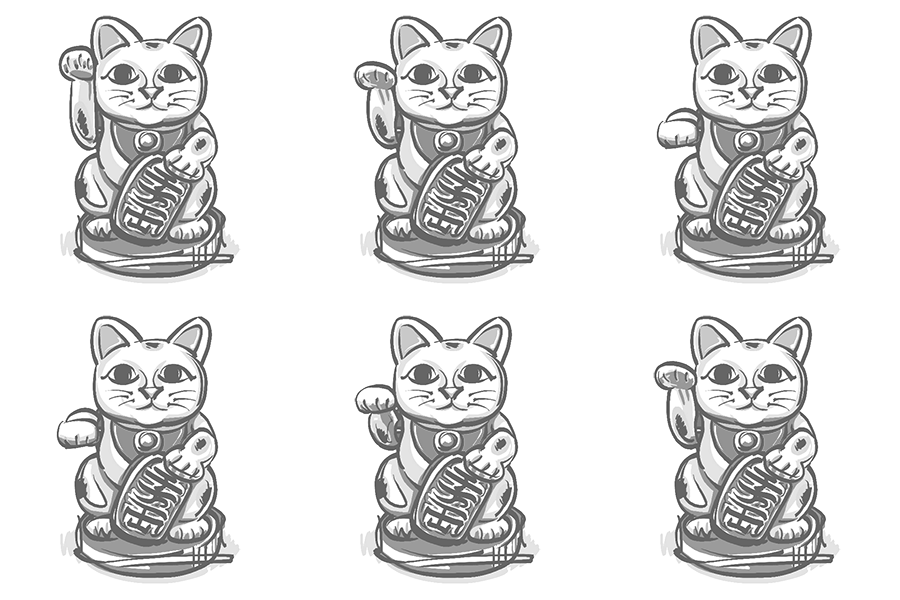
The maneki-neko (Japanese: ‘beckoning cat’) is a common Japanese figurine (lucky charm, talisman) which is often believed to bring good luck to the owner. In modern times, they are usually made of ceramic or plastic. The figurine depicts a cat (traditionally a calico Japanese Bobtail) beckoning with an upright paw, and is usually displayed in—often at the entrance of—shops, restaurants, pachinko parlors, and other businesses. Some of the sculptures are electric or battery-powered and have a slow-moving paw beckoning. The maneki-neko is sometimes also called the ‘welcoming cat,’ ‘lucky cat,’ ‘money cat,’ ‘happy cat,’ or ‘fortune cat’ in English.
Maneki-neko come in different variations. Common colors are white, black, gold and sometimes red. In addition to figurines, maneki-neko can be found as keychains, piggy banks, air fresheners, house-plant pots, and miscellaneous ornaments, as well as large statues. It is also sometimes called the ‘Chinese lucky cat’ due to its popularity among Chinese merchants. Continue reading →
Posted in Money, World |
1 Comment »
May 18, 2016

A late bloomer is a person whose talents or capabilities are not visible to others or do not manifest until later than usual. The term is used metaphorically to describe a child or adolescent who develops slower than others in their age group, but eventually catches up and in some cases overtakes their peers, or an adult whose talent or genius in a particular field only appears later in life than is normal – in some cases only in old age.
A notable example of a child who overcame early developmental problems is Albert Einstein, who suffered from speech difficulties as a young child. Other late-talking children who became highly successful engineers, mathematicians, and scientists include physicists Richard Feynman and Edward Teller. Neuroscientist Steven Pinker postulates that a certain form of language delay may in fact be associated with exceptional and innate analytical prowess in some individuals. Continue reading →
Posted in Education, Health |
1 Comment »
May 16, 2016

Mukbang is a live online audiovisual broadcast in which a host eats large amounts of foods while interacting with their audience. Usually done through an internet webcast, mukbang became popular in South Korea in the 2010s. Foods ranging from pizza to noodles are consumed in front of a camera for an internet audience (who pay or not, depending on which platform one is watching). The word is a portmanteau of the Korean words for ‘eating’ (‘meokneun’) and ‘broadcast’ (‘bangsong’).
Some mukbangs involve eating large amounts of food rapidly, while others features hosts savoring small meals at a more normal pace. In 2018, the South Korean government announced that it would create and regulate mukbang guidelines by launching the ‘National Obesity Management Comprehensive Measures,’ which was intended to discourage binge eating. Continue reading →
Posted in Food, Humor, World |
Leave a Comment »
May 9, 2016


Guerrilla marketing is an advertisement strategy concept designed for businesses to promote their products or services in an unconventional way with little budget to spend. This involves high energy and imagination focusing on grabbing the attention of the public in more personal and memorable level. Some large companies use unconventional advertising techniques, proclaiming to be guerrilla marketing but those companies will have larger budget and the brand is already visible. The main point of guerrilla marketing is that the activities are done exclusively on the streets or other public places, such as shopping centers, parks or beaches with maximum exposure.
The term and concept were first described by Jay Conrad Levinson in his 1984 book ‘Guerrilla Marketing.’ Traditional advertising media channels such as print, radio, television, and direct mail are falling out of fashion, forcing marketers and advertisers to look for new strategies to get their commercial messages to the consumer. Guerrilla marketing tries to create surprising and memorable experiences for potential consumer, to increases the likelihood that will tell their friends about it and via word of mouth. Continue reading →
Posted in Money |
Leave a Comment »
May 6, 2016


A bellwether is something that leads or indicates trends. The term is derived from the Middle English and refers to the practice of placing a bell around the neck of a castrated ram (a wether) leading his flock of sheep. The movements of the flock could be noted by hearing the bell before the flock was in sight.
In politics, the term is more often applied in the passive sense to describe a geographic region where political tendencies match in microcosm those of a wider area, such that the result of an election in the former region might predict the eventual result in the latter. Continue reading →
Posted in Politics, World |
1 Comment »
May 4, 2016

‘The Demolished Man,’ by Alfred Bester, is an American science fiction novel and inverted detective story, that was the first Hugo Award winner in 1953. The story is a police procedural set in a future where telepathy is common, although much of its effectiveness is derived from one individual having greater telepathic skill than another. In the 24th century, telepaths—’Espers’ (short for Extrasensory perception), colloquially known as ‘peepers’—are completely integrated into all levels of a class-based society.
Class 3 Espers, the most common, can detect only conscious thoughts at the time they are formed and are often employed as secretaries or administrators; Class 2 Espers can dig more deeply, to the pre-conscious level, detecting subliminal patterns, epiphanies and tenuous associations, and they are employed in the professional middle class—lawyers, managers, psychologists, etc. Class 1 Espers can detect all of the foregoing plus sub-conscious primitive urges, and they occupy only the highest levels of power in fields such as the police, government and medicine (such as psychiatry).
Posted in Art, Philosophy, Technology |
Leave a Comment »
May 3, 2016
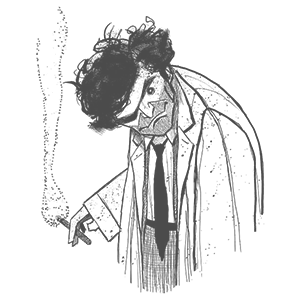
An inverted detective story, also known as a ‘howcatchem,’ is a murder mystery fiction structure in which the commission of the crime is shown or described at the beginning, usually including the identity of the perpetrator.
The story then describes the detective’s attempt to solve the mystery. There may also be subsidiary puzzles, such as why the crime was committed, but those are cleared up along the way. This format is the opposite of the more typical ‘whodunit,’ where all of the details of the crime and the perpetrator are not revealed until the story’s climax. Continue reading →
Posted in Art |
1 Comment »


 The Daily Omnivore