February 3, 2012

Blue balls is a slang term for the condition of temporary fluid congestion (vasocongestion) in the testicles and prostate region, accompanied by acute testicular pain, or a prolonged dull aching pain emanating from the prostate, caused by prolonged and unsatisfied sexual arousal in the human male. The term is thought to have originated in the United States, first appearing in 1916. Some urologists call the condition ‘epididymal hypertension.’ The condition is not universally experienced by all males.
Although widely discussed, there has been scant information in the medical research literature until a 2000 article by Chalett and Nerenberg in ‘Pediatrics’ which found little formal data regarding the condition but concluded that ‘the treatment is sexual release, or perhaps straining to move a very heavy object—in essence doing a Valsalva maneuver,’ a moderately forceful attempted exhalation against a closed airway.
Posted in Health, Sex |
Leave a Comment »
February 3, 2012
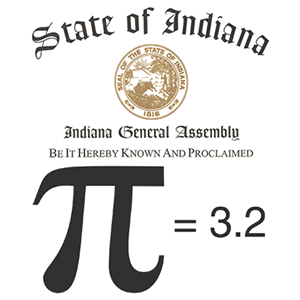
The Indiana Pi Bill is the popular name for bill #246 of the 1897 sitting of the Indiana General Assembly, one of the most famous attempts to establish scientific truth by legislative fiat. Despite that name, the main result claimed by the bill is a method to square the circle, rather than to establish a certain value for the mathematical constant π (pi), the ratio of the circumference of a circle to its diameter. However, the bill does contain text that appears to dictate various incorrect values of π, such as 3.2.
The bill never became law, due to the intervention of a mathematics professor who happened to be present in the legislature. The impossibility of squaring the circle using only compass and straightedge, suspected since ancient times, was rigorously proved in 1882 by Ferdinand von Lindemann. Better approximations of π than those inferred from the bill have been known since ancient times.
read more »
Posted in Humor, Politics, Science |
1 Comment »
February 3, 2012


Hyperthymesia [hi-per-thy-mee-zee-uh], also known as piking, is a condition in which the individual possesses a superior autobiographical memory, meaning they can recall the vast majority of personal experiences and events in their lives.
The term ‘hyperthymesia’ is derived from the Greek words thymesis, meaning ‘remembering’ and hyper meaning ‘excessive.’ As first described in a 2006 ‘Neurocase’ article, the two defining characteristics of hyperthymesia are ‘the person spends an abnormally large amount of time thinking about his or her personal past, and the person has an extraordinary capacity to recall specific events from his or her personal past.’
read more »
Posted in Health |
Leave a Comment »
February 3, 2012


Larry Cuba (b. 1950) is a computer-animation artist who became active in the late 1970s and early 80s. Born in Atlanta, he did his Master’s Degree at California Institute of the Arts which includes parallel schools of Dance, Music, Film, Theater, Fine Arts, and Writing.
In 1975, early computer animator John Whitney, Sr. invited Cuba to be the programmer on one of his films. The result of this collaboration was ‘Arabesque.’ Subsequently, Cuba produced three more computer-animated films: ‘3/78 (Objects and Transformations),’ ‘Two Space,’ and ‘Calculated Movements.’ Cuba also provided computer graphics for ‘Star Wars Episode IV: A New Hope’ in 1977. His animation of the Death Star is shown to pilots in the Rebel Alliance.
read more »
Posted in Art, Technology |
Leave a Comment »
February 3, 2012


John Whitney (1917 – 1995) was an American animator, composer and inventor, widely considered to be one of the fathers of computer animation. Whitney was born in Pasadena, California and attended Pomona College. His first works in film were 8 mm movies of a lunar eclipse which he made using a homemade telescope. In 1937-38 he spent a year in Paris, studying twelve-tone composition under French composer Rene Leibowitz. In 1939 he returned to America and began to collaborate with his brother James on a series of abstract films.
During the 1950s Whitney used his mechanical animation techniques to create sequences for television programs and commercials. In 1952 he directed engineering films on guided missile projects. One of his most famous works from this period was the animated title sequence from Alfred Hitchcock’s 1958 film ‘Vertigo,’ which he collaborated on with the graphic designer Saul Bass.
read more »
Posted in Art, Technology |
Leave a Comment »
February 3, 2012

Spirograph is a geometric drawing toy that produces mathematical curves of the variety technically known as hypotrochoids and epitrochoids. The term has also been used to describe a variety of software applications that display similar curves, and applied to the class of curves that can be produced with the drawing equipment (so in this sense it may be regarded as a synonym of hypotrochoid).
The name is a registered trademark of Hasbro, Inc. Drawing toys based on gears have been around since at least 1908, when The Marvelous Wondergraph was advertised in the Sears catalog. The ‘Boys Mechanic’ publication of 1913 had an article describing how to make a Wondergraph drawing machine. An instrument called a spirograph was invented by the mathematician Bruno Abakanowicz between 1881 and 1900 for calculating an area delimited by curves. The Spirograph toy was developed by the British engineer Denys Fisher, who exhibited it in 1965 at the Nuremberg International Toy Fair. In 1968, Kenner introduced Spirotot, a less complex version of Spirograph, for preschool-age children, too young for Spirograph.
Posted in Art, Games, Science |
Leave a Comment »
February 2, 2012

Goldbricking, in today’s terms, generally refers to staff who use their work internet access for personal reasons while maintaining the appearance of working, which can lead to inefficiency. The term originates from the confidence trick of applying a gold coating to a brick of worthless metal. Some employees do two non-work activities at once, a practice known as multishirking. In modern usage, the practice is also known as cyberslacking, cyberloafing or cyberbludging.
Instances of goldbricking have increased markedly since broadband Internet connections became commonplace in workplaces. Before that the slow speed of dial-up connections meant that the practice was rarely worthwhile. Many firms employ surveillance software to track employees’ Internet activity in an effort to limit liability and improve productivity. Other methods used to reduce goldbricking include installation of proxy servers to prevent programs from accessing resources like Internet Relay Chat, AOL Instant Messenger, or some online gambling services, strict disciplinary measures for employees found goldbricking, and carrot and stick measures like providing free or subsidized Internet access for employees outside of working hours.
read more »
Posted in Language, Money, Technology |
Leave a Comment »
February 2, 2012
Richard Feynman (1918 – 1988) was an American physicist known for his work in quantum mechanics. For his contributions to the development of quantum electrodynamics, Feynman, jointly with Julian Schwinger and Sin-Itiro Tomonaga, received the Nobel Prize in Physics in 1965. He developed a widely used pictorial representation scheme for the mathematical expressions governing the behavior of subatomic particles, which later became known as Feynman diagrams.
During his lifetime, Feynman became one of the best-known scientists in the world. He assisted in the development of the atomic bomb and was a member of the panel that investigated the Space Shuttle Challenger disaster. In addition to his work in theoretical physics, Feynman has been credited with pioneering the field of quantum computing, and introducing the concept of nanotechnology.
read more »
Posted in Science, War |
Leave a Comment »
February 2, 2012

Steve McQueen (1930 – 1980) was an American movie actor. He was nicknamed ‘The King of Cool.’ His ‘anti-hero’ persona, which he developed at the height of the Vietnam counterculture, made him one of the top box-office draws of the 1960s and 1970s.
His popular films include ‘The Magnificent Seven,’ ‘The Great Escape,’ ‘The Thomas Crown Affair,’ ‘Bullitt,’ ‘The Getaway,’ ‘Papillon,’ and ‘The Towering Inferno.’ In 1974, he became the highest-paid movie star in the world. Although McQueen was combative with directors and producers, his popularity put him in high demand and enabled him to command large salaries.
read more »
Posted in Art |
1 Comment »
February 2, 2012

Charles Bronson (1921 – 2003), born Charles Dennis Buchinsky was an American actor, best-known for such films as ‘Once Upon a Time in the West,’ ‘The Magnificent Seven,’ ‘The Dirty Dozen,’ ‘The Great Escape,’ ‘Rider on the Rain,’ ‘The Mechanic,’ and the popular ‘Death Wish’ series.
He often cast in the role of a police officer or gunfighter, often in revenge-oriented plot lines.
read more »
Posted in Art |
1 Comment »
February 2, 2012

The Celestine Prophecy is a 1993 novel by James Redfield that discusses various psychological and spiritual ideas which are rooted in many ancient Eastern Traditions and New Age spirituality. The main character of the novel undertakes a journey to find and understand a series of nine spiritual insights on an ancient manuscript in Peru. The book is a first-person narrative of the narrator’s spiritual awakening as he goes through a transitional period of his life and begins to notice instances of synchronicity, which is the realization that coincidences may have deep meaning. Redfield has acknowledged that the work of Dr. Eric Berne, the developer of Transactional Analysis, and his 1964 bestseller ‘Games People Play’ as a major influence on his work. Specifically, the ‘games’ which Berne refers in his theories are tools used in an individual’s quest for energetic independence.
The novel has received some criticism, mostly from the literary community, who point out that the plot of the story is not well developed and serves only as a delivery tool for the author’s ideas about spirituality. Redfield has admitted that, even though he considers the book to be a novel, his intention was to write a story in the shape of a parable, a story meant to illustrate a point or teach a lesson. Critics point to Redfield’s heavy usage of subjective validation (a cognitive bias by which a person will consider a piece of information to be correct if it has any personal significance to them) and reification (making something real). Another point of criticism has been directed at the book’s attempt to explain important questions about life and human existence in an overly simplified fashion.
Posted in Language, Philosophy |
Leave a Comment »
February 2, 2012

Emotional blackmail is a term used to cover a central form of psychological manipulation – ‘the use of a system of threats and punishment on a person by someone close to them in an attempt to control their behavior.’ ‘Emotional blackmail… typically involves two people who have established a close personal or intimate relationship (mother and daughter, husband and wife, sister and sister, two close friends).’ When subjected to emotional blackmail, ‘we become the other’s emotional hostage.’ As French sociologist Jean Baurdrillard puts it, emotional blackmail is telling someone: ‘If you don’t give me that, you will be responsible for my breakdown.’
According to psychotherapist Susan Forward, who did much to popularize the term, ’emotional blackmail’ is a powerful form of manipulation in which blackmailers who are close to the victim threaten, either directly or indirectly, to punish them to get what they want. They may know the victim’s vulnerabilities and their deepest secrets. ‘Many of the people who use emotional blackmail are friends, colleagues and family members with whom we have close ties that we want to strengthen and salvage’ – parents, partners, bosses or lovers. No matter how much the blackmailer cares about the victim, they use their intimate knowledge to win compliance.
read more »
Posted in Health |
1 Comment »



 The Daily Omnivore