February 6, 2013

Give-away shops, swap shops, freeshops, or free stores are stores where all goods are free. They are similar to charity shops, with mostly second-hand items—only everything is available at no cost. Whether it is a book, a piece of furniture, a garment or a household item, it is all freely given away, although some operate a one-in, one-out–type policy (swap shops).
The free store is a form of constructive direct action that provides a shopping alternative to a monetary framework, allowing people to exchange goods and services outside of a money-based economy.
read more »
Posted in Money, Politics |
Leave a Comment »
February 6, 2013
A femme fatale [fem fuh-tahl] is a mysterious and seductive woman whose charms ensnare her lovers in bonds of irresistible desire, often leading them into compromising, dangerous, and deadly situations. She is an archetype of literature and art. Her ability to entrance and hypnotize her victim with a spell was in the earliest stories seen as being literally supernatural; however, the femme fatale today is still often described as having a power akin to an enchantress, seductress, vampire, witch, or demon, having some power over men. The phrase is French for ‘deadly woman.’
A femme fatale tries to achieve her hidden purpose by using feminine wiles such as beauty, charm, and sexual allure. In some situations, she uses lying or coercion rather than charm. She may also make use of some subduing weapon such as sleeping gas, a modern analog of magical powers in older tales. She may also be (or imply that she is) a victim, caught in a situation from which she cannot escape; ‘The Lady from Shanghai’ (a 1947 film noir) is one such example. A younger version of a femme fatale would be called a fille fatale, or ‘deadly girl.’
read more »
Posted in Art, Sex |
1 Comment »
February 6, 2013
The ingénue [awn-zhuh-nyoo] is a stock character in literature, film, and a role type in the theater generally a girl or a young woman who is endearingly innocent and wholesome. Ingenue may also refer to a new young actress or one typecast in such roles.
The term comes from the French adjective ‘ingénu’ meaning ‘ingenuous’ or innocent, virtuous, and candid. The term may also imply a lack of sophistication and cunning.
read more »
Posted in Art, Language |
Leave a Comment »
February 6, 2013

‘Help at Any Cost: How the Troubled-Teen Industry Cons Parents and Hurts Kids’ is a 2006 non-fiction book by science journalist Maia Szalavitz analyzing the controversy surrounding the tough love behavior modification industry. Szalavitz focuses on four programs: Straight, Incorporated, a copy of the Straight Inc. program called KIDS, North Star wilderness boot camp, and the World Wide Association of Specialty Programs and Schools.
She discusses the background, history and methodology of the troubled teen industry, including techniques drawn from attack therapy, Erhard Seminars Training (est), and Synanon, all of which are highly controversial. She uses first-person accounts and court testimony in her research, and states that no evidence exists proving that these programs are effective. The book also includes advice for parents and an appendix with additional resources on how to get responsible help for teenagers.
read more »
Posted in Health, Money, Politics |
Leave a Comment »
February 5, 2013
Magical thinking is thinking that one’s thoughts by themselves can bring about effects in the world or that thinking something corresponds with doing it. It is a type of causal reasoning or causal fallacy that looks for meaningful relationships of grouped phenomena between acts and events. In religion, folk religion, and superstition, the correlation posited is between religious ritual, such as prayer, sacrifice, or the observance of a taboo, and an expected benefit or recompense.
In clinical psychology, magical thinking is a condition that causes the patient to experience irrational fear of performing certain acts or having certain thoughts because they assume a correlation with their acts and threatening calamities. ‘Quasi-magical thinking’ describes ‘cases in which people act as if they erroneously believe that their action influences the outcome, even though they do not really hold that belief.’
read more »
Posted in Health, Philosophy |
Leave a Comment »
February 5, 2013

Flaming Carrot Comics is a comic book series by cartoonist Bob Burden. The title character first appeared in ‘Visions’ #1, a magazine published by the Atlanta Fantasy Fair in 1979. ‘Flaming Carrot’ can be seen as a parody of various aspects of the superhero genre (though his origin story is much the same as that of Don Quixote).
‘The Flaming Carrot’ origin states that ‘having read 5,000 comics in a single sitting to win a bet, this poor man suffered brain damage and appeared directly thereafter as — the Flaming Carrot!’ Carrot, who lives in Palookaville, a neighborhood of Iron City, has staved off at least three alien invasions, a Communist take over, flying dead dogs, the Man in the Moon, Death itself, and a cloned horde of evil marching Hitler’s boots. Possessing no real super powers, the Carrot wins the day through sheer grit, raw determination, blinding stupidity, and bizarre luck.
read more »
Posted in Art, Humor, Language |
Leave a Comment »
February 5, 2013

Democratic peace theory posits that democracies are hesitant to engage in armed conflict with other identified democracies. In contrast to theories explaining war engagement, it is a ‘Theory Of Peace’ outlining motives that dissuade state-sponsored violence. Some theorists prefer terms such as ‘mutual democratic pacifism’ or ‘inter-democracy nonaggression hypothesis’ so as to clarify that a state of peace is not singular to democracies, but rather that it is easily sustained between democratic nations. Several factors are held as motivating peace between liberal states:
Democratic leaders are forced to accept culpability for war losses to a voting public; Publicly accountable statesmen are more inclined to establish diplomatic institutions for resolving international tensions; Democracies are less inclined to view countries with adjacent policy and governing doctrine as hostile; and Democracies tend to possess greater public wealth than other states, and therefore eschew war to preserve infrastructure and resources.
read more »
Posted in Politics, War, World |
Leave a Comment »
February 5, 2013
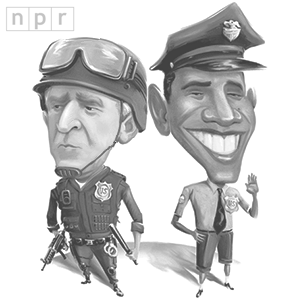
Pax Americana (Latin: ‘American Peace’) is a term applied to the historical concept of relative peace in the Western Hemisphere and later the Western world resulting from the preponderance of power enjoyed by the United States beginning around the start of the 20th century. Although the term finds its primary utility in the later half of the 20th century, it has been used in various places and eras, such as the post-Civil War era in North America and globally during the time between the World Wars.
Pax Americana is primarily used in its modern connotations to refer to the peace established after the end of World War II in 1945. In this modern sense, it has come to indicate the military and economic position of the United States in relation to other nations. The term derives from and is inspired by the Pax Romana of the Roman Empire, the Pax Britannica of the British Empire, and the Pax Mongolica of the Mongol Empire.
read more »
Posted in Politics, War, World |
Leave a Comment »
February 5, 2013
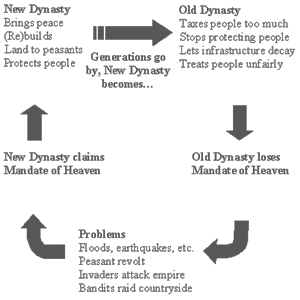
Social cycle theories are among the earliest social theories in sociology. Unlike the theory of social evolutionism, which views the evolution of society and human history as progressing in some new, unique direction(s), sociological cycle theory argues that events and stages of society and history are generally repeating themselves in cycles. Such a theory does not necessarily imply that there cannot be any social progress. In the early theory of ancient Chinese historian Sima Qian and the more recent theories of long-term (‘secular’) political-demographic cycles as well as in the Varnic theory of 20th century Indian philosopher P.R. Sarkar an explicit accounting is made of social progress.
The interpretation of history as repeating cycles of Dark and Golden Ages was a common belief among ancient cultures. The more limited cyclical view of history defined as repeating cycles of events was put forward in the academic world in the 19th century in historiosophy (a branch of historiography) and is a concept that falls under the category of sociology. However, Polybius, Ibn Khaldun, and Giambattista Vico can be seen as precursors of this analysis. The Saeculum (a length of time roughly equal to the potential lifetime of a person or the equivalent of the complete renewal of a human population) was identified in Roman times.
read more »
Posted in Politics, Science, World |
Leave a Comment »
February 5, 2013
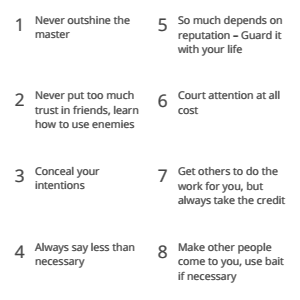
‘The 48 Laws of Power‘ (2000) is the first book by American author Robert Greene. The book, an international bestseller, is a practical guide for anyone who wants power, observes power, or wants to arm himself against power, and is popular with famous rappers, entrepreneurs, celebrities, athletes and actors including 50 Cent, Jay-Z, Kanye West, Dov Charney, Brian Grazer, Chris Bosh, and Will Smith. ‘The 48 Laws of Power’ is taught in business management classes and is one of the most requested books in American prison libraries.
The 48 Laws of Power are a distillation of 3,000 years of the history of power, drawing on the lives of strategists and historical figures like Niccolò Machiavelli, Sun Tzu, Carl von Clausewitz, Queen Elizabeth I, Henry Kissinger, and P.T. Barnum. The book is intended to show people how to gain power, preserve it, and defend themselves against power manipulators.
read more »
Posted in Language, Money, Politics |
Leave a Comment »
February 4, 2013
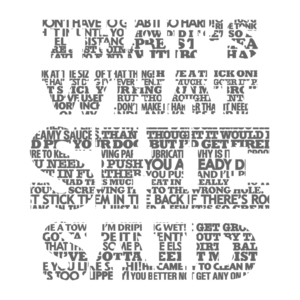
A double entendre is a figure of speech in which a spoken phrase is devised to be understood in either of two ways. Typically one of the interpretations is rather obvious whereas the other is more subtle. The more subtle of the interpretations may have a humorous, ironic, or risqué purpose. It may also convey a message that would be socially awkward, or even offensive, to state directly (the Oxford English Dictionary describes a double entendre as being used to ‘convey an indelicate meaning’).
A double entendre may exploit puns to convey the second meaning. Double entendres generally rely on multiple meanings of words, or different interpretations of the same primary meaning. They often exploit ambiguity and may be used to introduce it deliberately in a text. Sometimes a homophone (i.e. a different spelling that yields the same pronunciation) can be used as a pun as well as a ‘double entendre’ of the subject.
read more »
Posted in Humor, Language, Sex |
Leave a Comment »
February 4, 2013
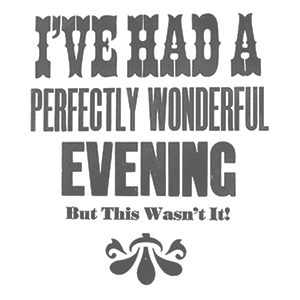
A paraprosdokian [par-uh-pros-doke-ee-uhn] is a figure of speech in which the latter part of a sentence or phrase is surprising or unexpected in a way that causes the reader or listener to reframe or reinterpret the first part. It is frequently used for humorous or dramatic effect, sometimes producing an anticlimax. For this reason, it is extremely popular among comedians and satirists. Some paraprosdokians not only change the meaning of an early phrase, but they also play on the double meaning of a particular word, creating a form of syllepsis.
‘Paraprosdokian’ comes from Greek for ‘against ‘expectation.’ Canadian linguist and etymology author William Gordon Casselman argues that, while the word is now in wide circulation, it is not a term of classical (or medieval) Greek or Latin rhetoric, but a late 20th century neologism. However, it occurs—with the same meaning—in Greek rhetorical writers of the 1st century BCE and the 1st and 2nd centuries CE.
Posted in Humor, Language |
2 Comments »


 The Daily Omnivore