February 21, 2012

Post-painterly abstraction is a term created by art critic Clement Greenberg as the title for an exhibit he curated for the Los Angeles County Museum of Art in 1964, which subsequently travelled to the Walker Art Center and the Art Gallery of Toronto. Greenberg had perceived that there was a new movement in painting that derived from the abstract expressionism of the 1940s and 1950s but ‘favored openness or clarity’ as opposed to the dense painterly surfaces of that painting style.
As painting continued to move in different directions, initially away from abstract expressionism, powered by the spirit of innovation of the time, the term, which had obtained some currency in the 1960s, was gradually supplanted by minimalism, hard-edge painting, lyrical abstraction, and color field painting.
Posted in Art |
Leave a Comment »
February 21, 2012

Hard-edge painting is painting in which abrupt transitions are found between color areas. The style is related to Geometric abstraction, Op Art, Post-painterly Abstraction, and Color Field painting. The term was coined by writer, curator and ‘LA Times’ art critic Jules Langsner, along with art historian Peter Selz, in 1959, to describe the work of painters from California, who, in their reaction to the more painterly or gestural forms of Abstract expressionism, adopted a knowingly impersonal paint application and delineated areas of color with particular sharpness and clarity.
This approach to abstract painting became widespread in the 1960s, though California was its creative center. Curated by Langsner, ‘Four Abstract Classicists’ opened at the Los Angeles County Museum of Art in 1959 featuring Karl Benjamin, Lorser Feitelson, Frederick Hammersley, and John McLaughlin. Other, earlier, movements, or styles have also contained the quality of hard-edgedness, for instance the Precisionists also displayed this quality to a great degree in their work.
Posted in Art |
Leave a Comment »
February 21, 2012


Electronica includes a wide range of contemporary electronic music designed for a wide range of uses, including listening, dancing, and background music for other activities. Unlike electronic dance music, which is sub-genre in the category, all examples of electronica are not necessarily made for dancing. Genres such as techno, drum and bass, downtempo, and ambient are among those encompassed by the umbrella term, entering the American mainstream from ‘alternative’ or ‘underground’ venues during the late 1990s.
With newly prominent music styles such as reggaeton, and subgenres such as electroclash, indie pop, and favela funk, electronic music styles in the current decade are seen to permeate nearly all genres of the mainstream and indie landscape such that a distinct ‘electronica’ genre of pop music is rarely noted.
read more »
Posted in Art, Language, Technology |
1 Comment »
February 20, 2012
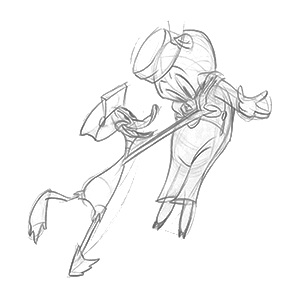
Baby Bottleneck is a 1945 Warner Brothers Looney Tunes theatrical cartoon short released in 1946 and directed by Bob Clampett and written by Warren Foster. In the short, there is a baby boom in the postwar US; an overworked stork (a clear Jimmy Durante reference) gets drunk in the ‘Stork Klub.’ A mix up results in babies getting sent to the wrong parents (such as a baby Hippopotamus to a Scottish Terrier).
To clear up the confusion, Porky Pig is brought in to manage the factory, with Daffy Duck as his assistant. The babies are seen going through a conveyor belt (to the tune of Raymond Scott’s famous ‘Powerhouse’) and getting sent by various animals, while Daffy mans the phones, making quick references to Bing Crosby, Eddie Cantor, and the Dionne Quintuplets.
read more »
Posted in Art, Humor |
Leave a Comment »
February 20, 2012


The Ren & Stimpy Show, often simply referred to as Ren & Stimpy, is an American animated television series, created by Canadian animator John Kricfalusi for Nickelodeon. The series focuses on the titular characters: Ren Höek, a psychotic chihuahua, and Stimpson J. Cat, a good-natured, dimwitted cat. The show premiered in 1991, on the same day as the debut of ‘Rugrats’ and ‘Doug,’ the three of which comprised the original Nicktoons. The show ran for five seasons on the network.
Throughout its run, the show was controversial for its off-color humor, black comedy, toilet humor, sexual innuendo, and violence, all of which contributed to the production staff’s altercations with Nickelodeon’s Standards and Practices department. The show developed a cult following during and after its run. It was pioneering for satirical animated shows like ‘Beavis and Butt-head’ and ‘South Park.’
read more »
Posted in Art, Humor, Money |
1 Comment »
February 20, 2012
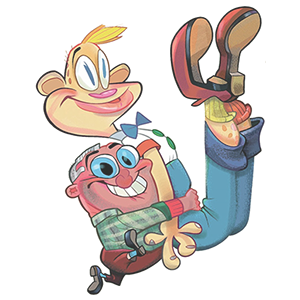
George Liquor (often taking his epithet as George Liquor, American), most famous for his appearances on ‘The Ren and Stimpy Show,’ is a cartoon character created by John Kricfalusi and is a mascot for Kricfalusi’s defunct animation studio, Spümcø. Kricfalusi portrayed George Liquor as a patriotic, outspoken, politically conservative blowhard. Kricfalusi described Liquor as his favorite character to animate.
Kricfalusi described George Liquor as ‘the greatest American’ who is so conservative ‘that he thinks the Republicans are Commies.’ George harbors a deep antipathy for the political left; in one issue of Spümcø’s ‘Comic Book,’ George Liquor becomes enraged after a fish calls him a Democrat. George is a middle-aged, crass, religious, ultra-patriotic American who favors his nephew, Jimmy The Idiot Boy, and tries to teach Jimmy how to be ‘a Real Man.’
read more »
Posted in Art, Humor, Money |
Leave a Comment »
February 20, 2012


Michael John Kricfalusi [kris-fuh-loo-see] better known as John K., is a Canadian animator. He is creator of ‘The Ren & Stimpy Show,’ its adults-only spin-off ‘Ren & Stimpy ‘Adult Party Cartoon,” ‘The Ripping Friends’ animated series, and ‘Weekend Pussy Hunt,’ an interactive web-based cartoon, as well as the founder of animation studio Spümcø.
He spent his early childhood in Germany and Belgium, while his father served in the Canadian air force. At age seven he returned with his family to Canada. Having moved in the middle of a school season, he spent much of his time that year at home, watching Hanna-Barbera cartoons and drawing them. Kricfalusi’s interest in Golden Age animation crystallized during his stay at Sheridan College, where an acquaintance of his held weekly screenings of old films and cartoons, among them the cartoons of Bob Clampett and Tex Avery, which left a deep impression on him.
read more »
Posted in Art, Humor, Money |
Leave a Comment »
February 18, 2012

‘In the Year 2525 (Exordium and Terminus)’ is a hit song from 1969 by American pop-rock duo Zager and Evans. It opens with the words ‘In the year 2525, If man is still alive, If woman can survive, They may find…’ Subsequent verses pick up the story at 1,010-year intervals from 2525 to 6565. Disturbing predictions are given for each selected year. In the year 3535, for example, all of a person’s actions, words and thoughts will be preprogrammed into a daily pill. Then the pattern as well as the music changes, going up a half step in the key of the song, after two stanzas, first from A flat minor, to A minor, and, then, finally, to B flat minor, and verses for the years 7510, 8510 and 9595 follow.
The overriding theme, of a world doomed by its passive acquiescence to and overdependence on its own overdone technologies, struck a resonant chord in millions of people around the world in the late 1960s. The song describes a nightmarish vision of the future as man’s technological inventions gradually dehumanize him. It includes a colloquial reference to the Second Coming (In the year 7510, if God’s a-coming, He ought to make it by then.), which echoed the zeitgeist of the Jesus Movement.
Posted in Art, Politics, Technology |
1 Comment »
February 17, 2012

VitaliV (or ‘Vitali V,’ real name Vitali Vinogradov) is a Soviet-born painter and sculptor now living in the United Kingdom, who has developed an artistic style based on the designs of computer microchips. Some works have been laser-cut in relief and then hand-painted as 3D objects.
His style, ‘Via Art,’ was created in the late 90’s while attempting to imprint an unusual, digital circuit-like pattern upon jewelry. In appreciation of the simplicity and logic of digital circuits, the artist decided to use the pattern as the structural basis for a new style. The following decade led to the creation of over 1000 designs including jewelry, furniture sketches, fashion collections, and hundreds of porcelain wares. The essence of the Via Art style are simple geometrical patterns—circles and lines connected at 45° angles.
Posted in Art, Technology |
2 Comments »
February 17, 2012

Wes Anderson (b. 1969) is an American director and screenwriter. Anderson has been called an auteur, as he is involved in every aspect of his films’ production. His films employ similar aesthetics, using a deliberate, methodical cinematography, with mostly primary colors. His soundtracks feature folk and early rock music, in particular classic British rock. Anderson’s films combine dry humor with poignant portrayals of flawed characters – often a mix of the wealthy and the working class. He is also known for working with many of the same actors and crew on varying projects, particularly Owen Wilson (who co-wrote three of Anderson’s feature films), Bill Murray, and Jason Schwartzman. Other frequent collaborators include writer Noah Baumbach, who co-wrote ‘The Life Aquatic with Steve Zissou’ and ‘Fantastic Mr. Fox,’ with Anderson co-producing his film ‘The Squid and the Whale.’
Anderson went to India to film his 2007 film ‘The Darjeeling Limited’ partly as a tribute to the legendary Indian filmmaker Satyajit Ray, whose ‘films have also inspired all my other movies in different ways’ (the film is dedicated to him). Jason Schwartzman reunited with Anderson for it, acting as well as co-writing the script with Anderson and Roman Coppola. In 2006, following the disappointing commercial and critical reception of ‘The Life Aquatic with Steve Zissou,’ Steely Dan’s Walter Becker and Donald Fagen released a tongue-in-cheek ‘letter of intervention’ of Anderson’s artistic ‘malaise.’ Proclaiming themselves to be fans of ‘World Cinema’ and Anderson in particular, they offered Anderson their soundtrack services for his ‘The Darjeeling Limited,’ including lyrics for a title track.
Posted in Art |
1 Comment »
February 16, 2012

The three individuals most closely associated with the birth of Detroit techno as a genre are Juan Atkins, Kevin Saunderson and Derrick May, also known as ‘The Belleville Three.’ High school friends from Belleville, Michigan, the trio created electronic music tracks in their basement(s). Eventually, they were in demand at local dance clubs, thanks in part to seminal Detroit radio personality ‘The Electrifying Mojo.’
Ironically, Derrick May once described Detroit techno music as being a ‘complete mistake…like George Clinton and Kraftwerk caught in an elevator, with only a sequencer to keep them company.’ The location of Belleville was key to the formation of the three as musicians. Because the town was still ‘pretty racial at the time,’ according to Saunderson, ‘we three kind of gelled right away.’
read more »
Posted in Art, Technology |
1 Comment »
February 16, 2012

Emil Schult (b. 1946) is a German painter, poet and musician. He is most famous for his collaborations with the electronic music band Kraftwerk. He has created most of their sleeve designs since 1973. He also co-wrote the lyrics of some famous Kraftwerk songs.
For a short while around 1973, Schult also played guitar in the group; this was to be short-lived, since Schult by his own admission is not quite good enough to be a professional musician, and since the group had started to develop its synth-based sound it no longer had any use for a guitarist.
Posted in Art |
Leave a Comment »




 The Daily Omnivore