December 6, 2011

Non-pneumatic tires (NPT), or Airless tires, are tires that are not supported by air pressure. They are used on some small vehicles such as riding lawn mowers and motorized golf carts. They are also used on heavy equipment such as backhoes, which are required to operate on sites such as building demolition, where tire puncture is likely. Tires composed of closed-cell polyurethane foam are also made for bicycles and wheelchairs. Airless tires generally have higher rolling friction and provide much less suspension than similarly shaped and sized pneumatic tires. Other problems for airless tires include dissipating the heat buildup that occurs when they are driven. Airless tires are often filled with compressed polymers (plastic), rather than air.
Michelin is currently developing an integrated tire and wheel combination, the ‘Tweel,’ that operates entirely without air. The automotive engineering department at Clemson University is developing a low energy loss airless tire with Michelin through the NIST ATP project. Resilient Technologies and the University of Wisconsin’s Polymer Engineering Center are creating a ‘non-pneumatic tire,’ which is basically a round polymeric honeycomb wrapped with a thick, black tread. The initial version of the tire is for the Humvee.
Posted in Language, Money, Technology |
1 Comment »
December 4, 2011

The door-in-the-face (DITF) technique is a persuasion method whereby a persuader attempts to convince someone to comply with a request by first making an extremely large request that the respondent will obviously turn down, with a metaphorical slamming of a door in the persuader’s face. The respondent is then more likely to accede to a second, more reasonable request than if this second request were made without the first, extreme request.
Psychology and marketing professor Robert Cialdini suggests this as a form of reciprocity, i.e. the (induced) sharp negative response to the first request creates a sense of debt or guilt that the second request offers to clear, and the reduced second request is interpreted by the receiver as a concession which is reciprocated by compliance with the request. Alternately, a reference point (or framing) construal may explain this phenomenon, as the initial bad offer sets a reference point from which the second offer looks like an improvement.
read more »
Posted in Language, Money, Politics |
1 Comment »
December 1, 2011

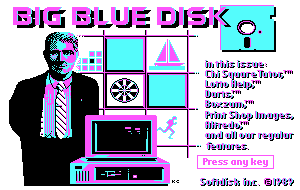
A disk magazine, colloquially known as a diskmag, is a magazine that is distributed in electronic form to be read using computers. These had some popularity in the 1980s and 1990s as periodicals distributed on floppy disk, hence their name. The rise of the Internet in the late 1990s caused them to be superseded almost entirely by online publications, which are sometimes still called ‘diskmags’ despite the lack of physical disks.
A unique and defining characteristic about a diskmag in contrast to a typical ASCII ‘zine’ is that a diskmag usually comes housed as an executable program file that will only run on a specific hardware platform. A diskmag tends to have an aesthetically appealing and custom graphical user interface (or even interfaces), background music and other features that take advantage of the hardware platform the diskmag was coded for. Diskmags have been written for many platforms, ranging from the C64 on up to the IBM PC and have even been created for video game consoles, like ‘scenedicate’ for the Dreamcast.
read more »
Posted in Games, Language, Technology |
Leave a Comment »
December 1, 2011
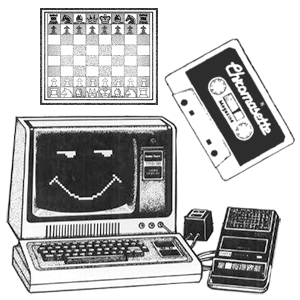
‘Chromasette‘ was the first ever, cassette-based TRS-80 Color Computer magazine produced by David Lagerquist and was an offshoot of ‘CLOAD’ magazine. It was published monthly from 1981 – 1984. It was advertised in ‘Creative Computing’ magazine in 1983 as $45 a year for 12 issues, or $5 each.
The first issue contained 5 Basic programs, and the ‘cover’ of the electronic magazine (which had to be loaded onto a TRS-80 Color Computer and then run) was dynamic. Included with each cassette was a 5-6 page newsletter explaining the programs included on the cassette, including their PMODE and PCLEAR values (if needed), their locations on tape, and several paragraphs of documentation about each (sometimes suggesting program alterations that change or improve the results).
Posted in Language, Money, Technology |
Leave a Comment »
December 1, 2011

Leet (or ‘1337’), short for ‘elite,’ also known as leetspeak, is an alternative alphabet for the English language that is used primarily on the Internet. It uses various combinations of ASCII characters to replace Latinate letters. For example, leet spellings of the word leet include 1337 and l33t; eleet may be spelled 31337 or 3l33t.
The term is derived from the word ‘elite.’ Leet may also be considered a substitution cipher, although many dialects or linguistic varieties exist in different online communities. The term ‘leet’ is also used as an adjective to describe formidable prowess or accomplishment, especially in the fields of online gaming and in its original usage, computer hacking.
read more »
Posted in Language, Technology |
Leave a Comment »
December 1, 2011

Cyberculture is the culture that has emerged, or is emerging, from the use of computer networks for communication, entertainment and business. It is also the study of various social phenomena associated with the Internet and other new forms of network communication, such as online communities, online multi-player gaming, social media and texting.
Since the boundaries of cyberculture are difficult to define, the term is used flexibly, and its application to specific circumstances can be controversial. It generally refers at least to the cultures of virtual communities, but extends to a wide range of cultural issues relating to ‘cyber-topics,’ e.g. cybernetics. It can also embrace associated intellectual and cultural movements, such as cyborg theory in feminism and cyberpunk in literature. The term often incorporates an implicit anticipation of the future.
read more »
Posted in Language, Technology, World |
Leave a Comment »
November 30, 2011

Steven Heller (b. 1950) is an American author, and editor who specializes on topics related to graphic design. He is author and co-author of many works on the history of illustration, typography, and many subjects related to graphic design. He has published more than eighty titles.
For thirty-three years Heller was a senior art director of ‘U&lc’ magazine, a publication devoted to typography. As of 2007, he is co-chair with Lita Talarico of the MFA Designer as Author program at the School of Visual Arts in New York City. He has collaborated on books with graphic designer, Louise Fili, who is his wife, as well as with others including the Design Dialogue series.
Posted in Art, Language, Money |
1 Comment »
November 30, 2011
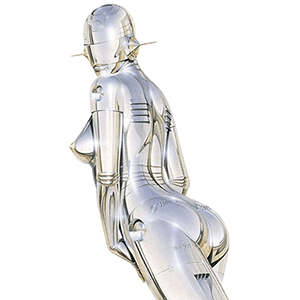
Hajime Sorayama (b.1947) is a Japanese illustrator, known for his precisely detailed, erotic airbrush portrayals of women and feminine robots. Sorayama’s work ‘Sexy Robot,’ published by Genko-sha in 1983, made his organic robotic forms famous around the world.
For the work, he used ideas from pin-up art, which in the book then appear as chrome-plated gynoids in suggestive poses. His next book, ‘Pin-up’ (1984), continues in the same line. A number of his other works similarly revolve around figures in suggestive poses, including highly realistic depictions in latex and leather. His pinups appeared frequently in the pages of ‘Penthouse’ magazine.
Posted in Art, Language, Technology |
1 Comment »
November 30, 2011
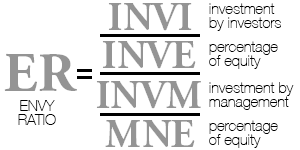

In finance, leverage (sometimes referred to as ‘gearing’ in the UK) is a general term for any technique to multiply gains and losses; common ways to attain leverage are borrowing money, buying fixed assets (non liquid assets such as real estate) and using derivatives (contracts to buy or sell something, such as call and put options respectively).
The most obvious risk of leverage is that it multiplies losses. A corporation that borrows too much money might face bankruptcy during a business downturn, while a less-levered corporation might survive. An investor who buys a stock on 50% margin will lose 40% of his money if the stock declines 20%.
read more »
Posted in Language, Money |
Leave a Comment »
November 29, 2011

A jalopy [juh-lop-ee] (also clunker or hooptie or beater) is a decrepit car, often old and in a barely functional state. A jalopy is not a well kept antique car, but a car which is mostly rundown or beaten up.
As a slang term in American English, ‘jalopy’ was noted in 1924 but is now slightly passé. The term was used extensively in the book ‘On the Road’ by Jack Kerouac, first published in 1957, although written from 1947. The equivalent English term is old banger, often shortened to banger, a reference to older poorly maintained vehicles’ tendency to backfire.
read more »
Posted in Language, Money, Technology |
1 Comment »
November 28, 2011

A highly sensitive person (HSP) is a person having the innate trait of high psychological sensitivity (or innate sensitiveness as Carl Jung originally coined it). According to American pyschologist Elaine N. Aron, who coined the term, highly sensitive people comprise about a fifth of the population, and process sensory data much more deeply and thoroughly due to a biological difference in their nervous systems.
This is a specific trait with key consequences that in the past has often been confused with innate shyness, social anxiety problems, inhibitedness, or even social phobia and innate fearfulness, introversion, and so on. The existence of the trait of innate sensitivity was demonstrated using a test that was shown to have both internal and external validity. Although the term is primarily used to describe humans, the trait is present in nearly all higher animals.
read more »
Posted in Health, Language, Philosophy |
Leave a Comment »
November 25, 2011
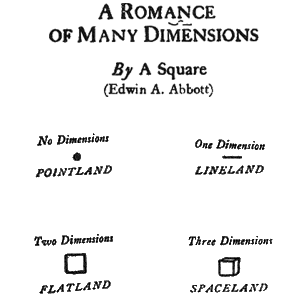
‘Flatland: A Romance of Many Dimensions’ is an 1884 satirical novella by the English schoolmaster Edwin Abbott Abbott. Writing pseudonymously as ‘A Square,’ Abbott used the fictional two-dimensional world of Flatland to offer pointed observations on the social hierarchy of Victorian culture.
However, the novella’s more enduring contribution is its examination of dimensions, for which the novella is still popular amongst mathematics, physics, and computer science students.
read more »
Posted in Art, Language, Politics |
2 Comments »


 The Daily Omnivore