February 27, 2016

Psychological pricing (also known as ‘price ending’ and ‘charm pricing’) is a pricing/marketing strategy based on the theory that certain prices have a psychological impact. Consumers tend to perceive ‘odd prices’ as being significantly lower than they actually are, mentally rounding to the next lowest monetary unit. Thus, prices such as $1.99 are associated with spending $1 rather than $2. Now that many customers are used to odd pricing, some restaurants and high-end retailers psychologically-price in even numbers in an attempt to reinforce their brand image of quality and sophistication.
In a traditional cash transaction, fractional pricing imposes tangible costs on the vendor (printing fractional prices), the cashier (producing awkward change) and the customer (stowing the change). These factors have become less relevant with the increased use of checks, credit and debit cards and other forms of currency-free exchange; also, the addition of sales tax makes the pre-tax price less relevant to the amount of change (although in Europe the sales tax is generally included in the shelf price).
read more »
Posted in Money |
Leave a Comment »
February 20, 2016
In marketing, brand management is the analysis and planning on how a brand is perceived in the market, with the goal of developing a good relationship with the target market. Tangible elements of brand management include the product itself (i.e. the look, price, packaging). Intangible elements include the experience that the consumer has had with the brand, and also their relationship with it. A brand manager would oversee all of these things. The modern discipline of brand management is considered to have been started by a famous memo at Procter & Gamble by Neil H. McElroy.
Marketing scholar Molly Hislop defined branding as ‘the process of creating a relationship or a connection between a company’s product and emotional perception of the customer for the purpose of generating segregation among competition and building loyalty among customers.’ It is a fulfillment in customer expectations and consistent customer satisfaction. Brand management aims to create an emotional connection between products, companies and their customers and constituents. Brand managers create strategies to convert a suspect to prospect; prospect to buyer; buyer to customer and customer to brand advocates.
read more »
Posted in Money |
Leave a Comment »
February 19, 2016


Inbound marketing is promoting a company through blogs, podcasts, video, eBooks, electronic newsletters, whitepapers, SEO (search engine optimization), physical products, social media marketing, and other forms of content marketing which serve to attract customers through the different stages of the purchase funnel. In contrast, buying attention (marketing stunts), cold-calling, direct paper mail, radio, TV advertisements, sales flyers, spam, telemarketing, and traditional advertising are considered ‘outbound marketing.’
Inbound marketing refers to marketing activities that bring visitors in, rather than marketers having to go out to get prospects’ attention. Inbound marketing earns the attention of customers, makes the company easy to be found, and draws customers to the website by producing interesting content. Many companies are now realizing that their technical documentation, often considered a ‘necessary evil,’ is authoritative, trustworthy content that can be their most effective inbound marketing channel, generating more than half of overall site traffic and over half of lead generation.
read more »
Posted in Money |
Leave a Comment »
February 18, 2016


Earned media refers to publicity gained through promotional efforts other than advertising, as opposed to ‘paid media,’ which refers to publicity gained through advertising. There are many types of media available to online marketers and fit into the broad categories. Owned media is defined as communication channels that are within one’s control, such as websites, blogs, or email. Paid media refers mostly to traditional advertising. Earned media, on the other hand, is generated when content receives recognition and a following outside of traditional paid advertising, through communication channels such as social media and word of mouth.
A Nielsen study in 2013 found that earned media (also described in the report as ‘word-of-mouth’) is the most trusted source of information in all countries it surveyed worldwide. It also found that earned media is the channel most likely to stimulate the consumer to action. Other authorities make the distinction between online and offline earned media / word-of-mouth, and have shown that offline word-of-mouth has been found to be more effective than online word-of-mouth.
read more »
Posted in Money |
Leave a Comment »
February 17, 2016

The study of the history of marketing as an academic field emerged only recently with the publication of ‘The History of Marketing Thought’ by Robert Bartels in 1976. Broadly defined marketing is any activity that connects producers with consumers, which was previously considered a subtopic of economics. Wroe Alderson’s book, ‘Marketing Behavior and Executive Action’ (1957) is also considered a break-point in the history of marketing thought. After Alderson, marketing began to incorporate other fields of knowledge besides economics, notably behavioral science, developing into a multidisciplinary field.
Marketing historian Jagdish Shethhave identified three schools of marketing: Managerial (systematized marketing emerged during the late 1950s and became arguably the predominant and most influential school of thought in the field), Consumer/Buyer Behavior (the use of behavioral science to market goods and services was popularized in the second half of the twentieth century), and Social Exchange (recently, ‘exchange’ has been forwarded as the fundamental concept of marketing).
read more »
Posted in Money |
Leave a Comment »
February 8, 2016

Helmut Krone (1925 – 1996) was a pioneer of modern advertising. He spent over 30 years at the advertising agency Doyle Dane Bernbach where he was the art director for the popular 1960s campaign for the Volkswagen Beetle, which featured a large unadorned photo of the car with the tiny word ‘Lemon’ underneath it. He was also responsible for the series of ‘When you’re only No. 2, you try harder’ advertisements for Avis, and the creation of Juan Valdez, who personified Colombian coffee. His work has been collected by the Museum of Modern Art and the Smithsonian. Krone’s ‘Think Small’ advertisement for Volkswagen was voted the best campaign of all time in Advertising Age’s 1999 ‘The Century of Advertising issue.’
Krone was born in Yorkville, on the upper east side of Manhattan, which was at that time a German neighborhood. He attended Public School 77 in Queens before enrolling at the School of Industrial Art, where he hoped to become a product designer. When he was 21, he took his first step towards advertising, working with designer Robert Greenwell doing freelance advertisements for magazines. He followed naval service in World War II with postwar classes with Alexey Brodovitch and stints at ‘Esquire’ and ‘Sudler & Hennessey.’ Then, at the age of 29, he began to work for Doyle Dane Bernbach.
Posted in Art, Money |
Leave a Comment »
February 6, 2016

Super Bowl ads are commercials run during the National Football League (NFL) championship game, among the United States’ most watched television broadcasts, with Nielsen having estimated that Super Bowl XLIX in 2015 was seen by at least 114.4 million domestic viewers, surpassing the previous year’s game as the highest-rated television broadcast in US history. As such, advertisers have typically used commercials during the Super Bowl as a means of building awareness for their products and services among this wide audience, while also trying to generate buzz around the ads themselves so they may receive additional exposure, such as becoming a viral video.
Super Bowl commercials have become a cultural phenomenon of their own alongside the game itself with some viewers reporting that they are more interested in the commercials than the game. In 2015, Dish Network went as far as allowing the ‘commercial skipping’ features on its Hopper digital video recorder to function in reverse and allow users to view a recording of the Super Bowl that skips over the game itself and only shows the commercials.
read more »
Posted in Games, Money |
1 Comment »
February 4, 2016


Rebranding is a marketing strategy in which a new name, term, symbol, design, or combination thereof is created for an established brand with the intention of developing a new, differentiated identity in the minds of consumers, investors, competitors, and other stakeholders. Often, this involves radical changes to a brand’s logo, name, legal names, image, marketing strategy, and advertising themes. Such changes typically aim to reposition the brand/company, occasionally to distance itself from negative connotations of the previous branding, or to move the brand upmarket; they may also communicate a new message a new board of directors wishes to communicate.
Rebranding can be applied to new products, mature products, or even products still in development. The process can occur intentionally through a deliberate change in strategy or occur unintentionally from unplanned, emergent situations, such as a ‘Chapter 11 corporate restructuring,’ ‘union busting,’ or ‘bankruptcy.’ Rebranding can also refer to a change in a company/ corporate brand that may own several sub-brands for products or companies.
read more »
Posted in Language, Money |
Leave a Comment »
February 3, 2016
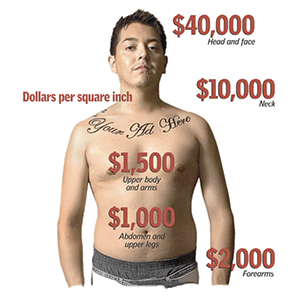
Forehead Advertising is a type of nontraditional advertising that involves using a person’s forehead as advertising space. John Carver and his London Creative Agency, CUNNING, is credited with inventing the concept in 2003 with ForeheADS. In a 2004 CUNNING campaign, forty young adults were paid $11 per hour to wear temporary tattoos on their foreheads for a 2004 campaign promoting the launch of the Scion tC for Toyota. A short lived startup in Rhode Island, Headvertise, offered up to $150 per week for wearing a temporary logo tattoo on one’s forehead. It was last reported that 64 students had featured ads on their foreheads for companies such as Roommates.com.
Forehead advertising made headlines in early 2005 when a 20-year-old man, Andrew Fischer, auctioned his forehead for advertising space on eBay. The winning company, SnoreStop, bid $37,375 to display their logo via temporary tattoo on his forehead for 30 days. Later that year forehead advertising moved beyond temporary tattoos. Kari Smith auctioned her forehead for advertising space on eBay for an asking price of $10,000. GoldenPalace.com, a Canadian Internet gambling company, paid $10,000 for Smith to permanently tattoo ‘GoldenPalace.com’ on her forehead. GoldenPalace.com has also advertised its logo via temporary and permanent tattoos on the backs of boxers, bellies of pregnant women, women’s legs, and the chest of a swimsuit model.
read more »
Posted in Humor, Money |
1 Comment »
February 2, 2016

Catvertising is the use of cats in advertising. The tongue-in-cheek portmanteau was coined in the late 1990s, and enjoyed a spike in popularity beginning 2011 as a result of a parody of commercialization of cat viral videos by the advertising agency st. john in Toronto.
The video was part of a series of spoofs beginning with ‘Pink Ponies: A Case Study,’ then ‘Catvertising,’ and finally ‘Buyral’ (a blend of ‘buy’ and ‘viral’). A University of Arizona marketing team competes under the name ‘Catvertising.’
Posted in Humor, Money |
Leave a Comment »
January 24, 2016

Miquela Sousa, better known as Lil Miquela, is a fictional character and digital art project. Miquela is an Instagram model and music artist claiming to be from Downey, California. In 2017, Miquela released her first single, ‘Not Mine.’ Her pivot into music has been compared to virtual musicians Gorillaz and Hatsune Miku.
The project began in 2016 as an Instagram profile. By 2018, the account had amassed more than a million followers. Miquela portrays the lifestyle of an Instagram it-girl over social media. The account also details a fictional narrative which presents her as a sentient robot in conflict with other digital projects.
read more »
Posted in Art, Money, Technology |
Leave a Comment »
January 14, 2016

The ADE 651 is a fake bomb detector produced by ATSC (UK), which claimed that the device could effectively and accurately, from long range, detect the presence and location of various types of explosives, drugs, ivory, and other substances. The device has been sold to 20 countries in the Middle East and Asia, including Iraq and Afghanistan, for as much as US$60,000 each. The Iraqi government is said to have spent £52 million on the devices.
Investigations by the BBC and other organizations found that the device is little more than a ‘glorified dowsing rod’ with no ability to perform its claimed functions. In 2010, export of the device was banned by the British government and the managing director of ATSC was arrested on suspicion of fraud. The company was dissolved in 2013, and the founder, Jim McCormick, was sentenced to ten years’ imprisonment. Similar ‘bomb sniffing’ devices, which are still widely used, have also come under scrutiny in the wake of the revelations about the ADE 651.
read more »
Posted in Money, Technology, War |
Leave a Comment »


 The Daily Omnivore