March 12, 2012

A polymath [pol-ee-math] (Greek: ‘having learned much’) is a person whose expertise spans a significant number of different subject areas. In less formal terms, a polymath (or polymathic person) may simply be someone who is very knowledgeable. Most ancient scientists were polymaths by today’s standards. The common term Renaissance man is used to describe a person who is well educated or who excels in a wide variety of subjects or fields. The concept emerged from the numerous great thinkers of that era who excelled in the arts and sciences, including Leonardo da Vinci, Michelangelo, Galileo Galilei, Copernicus, and Francis Bacon.
The emergence of these thinkers was likewise attributed to the then rising notion in Renaissance Italy expressed by one of its most accomplished representatives, Leon Battista Alberti (1404–1472): that ‘a man can do all things if he will.’ It embodied the basic tenets of Renaissance humanism, which considered humans empowered, limitless in their capacities for development, and led to the notion that people should embrace all knowledge and develop their capacities as fully as possible. Thus the gifted people of the Renaissance sought to develop skills in all areas of knowledge, in physical development, in social accomplishments, and in the arts. The term has since expanded from original usage and has been applied to other great thinkers before and after the Renaissance such as Aristotle, Johann Goethe, and Isaac Newton.
read more »
Posted in Education, Games, Science |
Leave a Comment »
March 8, 2012
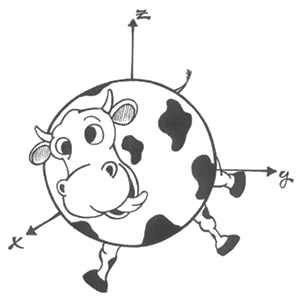
Spherical cow is a metaphor for highly simplified scientific models of complex real life phenomena.The phrase comes from a joke about theoretical physicists: ‘Milk production at a dairy farm was low, so the farmer wrote to the local university, asking for help from academia. A multidisciplinary team of professors was assembled, headed by a theoretical physicist, and two weeks of intensive on-site investigation took place. The scholars then returned to the university, notebooks crammed with data, where the task of writing the report was left to the team leader. Shortly thereafter the physicist returned to the farm, saying to the farmer ‘I have the solution, but it only works in the case of spherical cows in a vacuum.’
It is told in many variants. In Russian, it is called a spherical horse in a vacuum, from a joke about a physicist who said he could predict the winner of any horse race to multiple decimal points – provided it was a spherical horse moving through a vacuum.The point of the joke is that physicists will often reduce a problem to the simplest form they can imagine in order to make calculations more feasible, even though such simplification may hinder the model’s application to reality.
Posted in Humor, Science |
2 Comments »
March 8, 2012
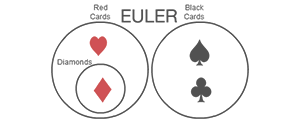
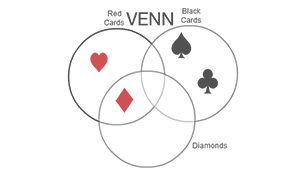
Venn diagrams are diagrams that show all possible logical relations between a finite collection of sets (aggregation of things). Venn diagrams were conceived around 1880 by John Venn. They are used to teach elementary set theory, as well as illustrate simple set relationships in probability, logic, statistics, linguistics and computer science. Venn diagrams normally comprise overlapping circles. The interior of the circle symbolically represents the elements of the set, while the exterior represents elements that are not members of the set.
For instance, in a two-set Venn diagram, one circle may represent the group of all wooden objects, while another circle may represent the set of all tables. The overlapping area or intersection would then represent the set of all wooden tables. Shapes other than circles can be employed as in Venn’s own higher set diagrams. Venn diagrams do not generally contain information on the relative or absolute sizes (cardinality) of sets; i.e. they are schematic diagrams.
Posted in Science |
Leave a Comment »
March 7, 2012

Fisherian runaway is a model of sexual selection, first proposed by R.A. Fisher in 1915, and expanded upon in his 1930 book ‘The Genetical Theory of Natural Selection,’ that suggests an explanation for sexual selection of traits that do not obviously increase fitness of survival, based upon a positive feedback ‘runaway’ mechanism. Fisher’s explanation is that selection of such traits is a result of sexual preference; that members of the opposite sex find a trait desirable. This preference makes the trait advantageous, which in a circular fashion makes having a preference for the trait advantageous.
The process is termed ‘runaway’ because over time, it would facilitate the development of greater preference and more pronounced traits, until the costs of producing the trait balance the reproductive benefit of possessing it. By way of example, the peacock’s tail requires a great deal of energy to grow and maintain, it reduces the bird’s agility, and it may increase the animal’s visibility to predators. Yet it has evolved, indicating that birds with longer tails have some advantage.
read more »
Posted in Science, Sex |
Leave a Comment »
March 7, 2012

The court jester hypothesis is a term coined by UC, Berkeley professor Anthony D. Barnosky in 1999, that describes the antithesis of the ‘Red Queen Hypothesis’ in evolutionary theory (the evolutionary ‘arms race’). It refers to the idea that abiotic forces including climate, rather than biotic competition between species, is a major driving force behind the processes in evolution that produce speciation.
Despite the fact that the court jester metaphor is coined in reference to the Red Queen hypothesis, the Jester reference, metaphorically, is not a direct reference to ‘Through The Looking Glass.’ Instead referencing Tarot, where the Jester or Fool is the symbol of death triumphing over all.
read more »
Posted in Science |
1 Comment »
March 7, 2012
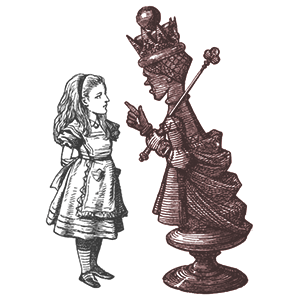
The Red Queen is the name of an evolutionary theory of Leigh Van Valen and, later, a book by Matt Ridley. The term is taken from the Red Queen’s race in Lewis Carroll’s ‘Through the Looking-Glass.’ The Red Queen said, ‘It takes all the running you can do, to keep in the same place.’ The Red Queen principle can be stated as follows: ‘For an evolutionary system, continuing development is needed just to maintain its fitness relative to the systems it is co-evolving with.’
The hypothesis is used to explain two different phenomena: the advantage of sexual reproduction at the level of individuals, and the constant evolutionary arms race between competing species. Ridley’s book takes Van Valen’s idea, which is about co-evolution, and extends it into a discussion about sexual selection in humans. It argues that few aspects of human nature can be understood apart from sex, since human nature is a product of evolution, and evolution in our case is driven by sexual selection. Its counterpart is the Court Jester Hypothesis, which proposes that evolution is driven mostly by abiotic environmental events and forces like climate.
read more »
Posted in Science, Sex |
Leave a Comment »
March 7, 2012
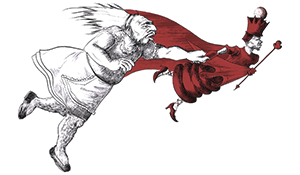

An evolutionary arms race is a struggle between competing sets of co-evolving genes that develop adaptations and counter-adaptations against each other, resembling an arms race, which are also examples of positive feedback (the effects of a small disturbance on a system include an increase in the magnitude of the disturbance). The co-evolving gene sets may be in different species, as in an evolutionary arms race between a predator species and its prey, or a parasite and its host.
Alternatively, the arms race may be between members of the same species, as in the manipulation/sales resistance model of communication or as in runaway evolution or Red Queen effects. One example of an evolutionary arms race is in sexual conflict between the sexes. Thierry Lodé emphasized the role of such antagonist interactions in evolution leading to character displacements and antagonist coevolution. The Escalation hypothesis put forward by Geerat Vermeij speaks of more general conflicts and was originally based on his work with marine gastropod fossils.
read more »
Posted in Science, War |
Leave a Comment »
March 7, 2012

Concealed ovulation or hidden estrus is the lack of distinctive signaling that the adult female of a species is ‘in heat’ and near ovulation. These signals may include swelling and redness of the genitalia in baboons and bonobos, pheromone release in the feline family, etc. By comparison, the females of humans and a few other species have few external signs of fecundity, making it difficult to tell, by means of external signs only, whether or not a female is near ovulation.
Several hypotheses regarding human evolution integrate the idea that human females increasingly required supplemental paternal investment in their offspring. This suggests human females concealed ovulation to obtain male aid in rearing offspring. If human females no longer signaled the time of ovulation, males would be unable to detect the exact period in which they were fecund. This led to a change in their mating strategy; rather than seeking multiple female partners and mating with them hoping they were fecund during that period, males instead chose to mate with a particular female multiple times throughout her menstrual cycle. A mating would be successful in resulting in conception when it occurred during ovulation, and thus, frequent matings, necessitated by the effects of concealed ovulation, would be most successful.
read more »
Posted in Science, Sex |
Leave a Comment »
March 6, 2012

Eternal return is a concept which posits that the universe has been recurring, and will continue to recur, in a self-similar form an infinite number of times across infinite time or space. The concept, initially inherent in Indian philosophy, was later found in ancient Egypt and was subsequently taken up by the Pythagoreans and Stoics in Greece. With the decline of antiquity and the spread of Christianity, the concept fell into disuse in the western world, though Friedrich Nietzsche resurrected it as a thought experiment to argue for ‘amor fati’ (seeing everything that happens in one’s life, including suffering and loss, as good).
The basic premise proceeds from the assumption that the probability of a world coming into existence exactly like our own is finite. If either time or space are infinite, then mathematics tells us that our existence will recur an infinite number of times. In 1871, Louis Auguste Blanqui, assuming a Newtonian cosmology where time and space are infinite proceeded to show that the eternal recurrence was a mathematical certainty. In the post-Einstein period, there are doubts that time or space is in fact infinite, but many models exist which provide the notion of spatial or temporal infinity required by the eternal return hypothesis.
read more »
Posted in Death, Philosophy, Science |
Leave a Comment »
March 5, 2012

The Narwhal is a rarely seen Arctic whale known for the very long tooth that males have. The tusk’s function is uncertain, perhaps used as a formidable jousting weapon in courtship and dominance rivalry, in getting food, and/or for channeling and amplifying sonar pulses (which they emit), however the tusk is not used in hunting. Long ago, narwhal sightings probably reinforced (or started) the unicorn legends. At times, people found the horn of a dead narwhal washed up on shore and thought that they had found the horn of a unicorn. Narwhal can dive up to 1,500 meters; this makes them one of the deepest diving sea mammals.
Narwhals live in the icy waters of the Arctic seas. They do not go far away from ice and migrate in the summer closer to land where they can sometimes be seen in the estuaries, deep fjords, and bays of Greenland and Northern Canada. These groups can be as big as 10 or even as big as 100 sometimes. But when Winter comes around again, they move back to the icy waters, where they breath from small holes in the ice. Narwhals eat cod, shrimp and squid, and are hunted by polar bears and killer whales. The native Inuit people who are sometimes called the Eskimos, are allow to hunt the Narwhals for food.
Posted in Science |
Leave a Comment »
March 5, 2012

Active camouflage is camouflage which adapts to the actual surroundings of an object such as an animal or military vehicle. It is used in several groups of animals including cephalopods (e.g. squid, octopus) and flatfish in the sea, and reptiles on land (e.g. chameleon). Some sea creatures can counterilluminate (emit light to match the background) because in the sea, light comes down from the surface, so animals tend to appear dark when seen from below. Bioluminescence and color change also have other functions in animals including attracting prey and signalling mates.
In military usage, counterillumination camouflage was first investigated during the WWII for marine use. Current research aims at achieving crypsis (avoidance of detection) using cameras to sense the visible background, and panels or coatings which can vary their appearance. Military active camouflage has its origins in the diffused lighting camouflage tested on Canadian Navy corvettes during WWII. Later, a US Air Force program placed low-intensity blue lights on aircraft as counterillumination camouflage. As night skies are not pitch black, a 100 percent black-colored aircraft might be rendered visible.
Posted in Science, Technology, War |
1 Comment »
March 5, 2012
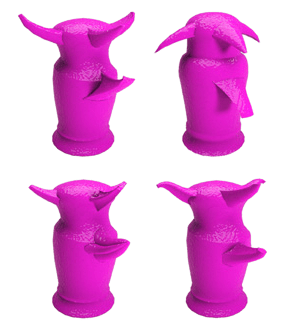
The Greebles refers to a category of novel objects used as stimuli in psychological studies of object and face recognition, created by Scott Yu at Yale University. They were named by the psychologist Robert Abelson. The greebles were created for Isabel Gauthier’s dissertation work at Yale, so as to share constraints with faces: they have a small number of parts in a common configuration.
This makes it difficult to distinguish any individual object on the basis of the presence of a feature, and this is thought to encourage the use of all features and the relationships between them. In other words, greebles, just like faces, can be processed configurally. Yu’s originals (both the symmetrical and asymmetrical sets) can be obtained from Michael Tarr.[1] Greebles appear in over 25 scientific articles.
Posted in Health, Science, Technology |
Leave a Comment »



 The Daily Omnivore