February 3, 2011

Petrichor [peh-truh-kuhr] is the name of the scent of rain on dry earth. The term was coined in 1964 by two Australian researchers, Bear and Thomas, for an article in the journal Nature. In the article, the authors describe how the smell derives from an oil exuded by certain plants during dry periods, whereupon it is absorbed by clay-based soils and rocks. During rain, the oil is released into the air along with another compound, geosmin, producing the distinctive scent. In a follow-up paper, Bear and Thomas (1965) showed that the oil retards seed germination and early plant growth.
Posted in Language, Science |
Leave a Comment »
February 3, 2011

Eigengrau [eye-gen-graw] (German for ‘intrinsic gray’), also called eigenlicht (‘intrinsic light’), dark light, or brain gray, is the color seen by the eye in perfect darkness. Even in the absence of light, some action potentials are still sent along the optic nerve, causing the sensation of a uniform dark gray color. Eigengrau is perceived as lighter than a black object in normal lighting conditions, because contrast is more important to the visual system than absolute brightness. For example, the night sky looks darker than eigengrau because of the contrast provided by the stars.
Posted in Language, Science, World |
Leave a Comment »
February 3, 2011
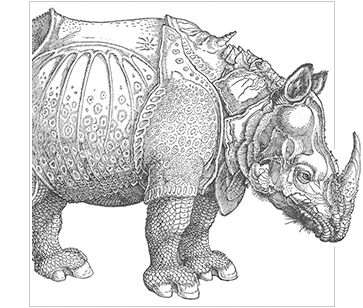
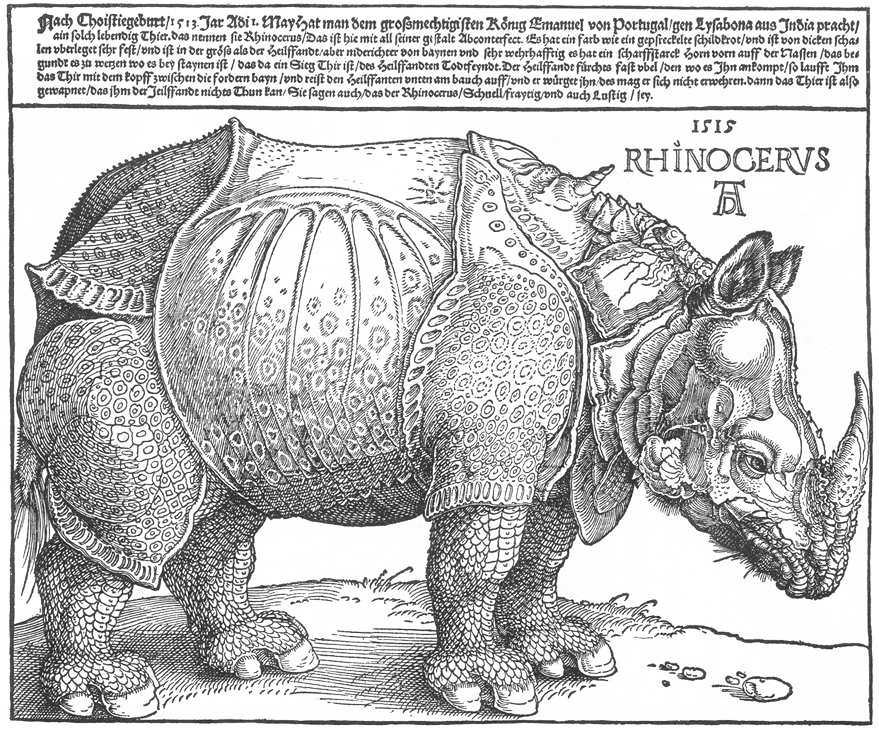
Dürer’s [door-ers] Rhinoceros is the name commonly given to a woodcut created by German painter and printmaker Albrecht Dürer in 1515. The image was based on a written description and brief sketch by an unknown artist of an Indian rhinoceros that had arrived in Lisbon earlier that year. Dürer never saw the actual rhinoceros, which was the first living example in Europe since Roman times. In late 1515, the King of Portugal, Manuel I, sent the animal as a gift for Pope Leo X, but it died in a shipwreck off the coast of Italy in early 1516. A live rhinoceros was not seen again in Europe until a second specimen arrived from India at the court of Sebastian of Portugal in 1577, being later inherited by Philip II of Spain around 1580.
Dürer’s woodcut is not an entirely accurate representation of a rhinoceros. He depicts an animal with hard plates that cover its body like sheets of armor, with a gorget at the throat, a solid-looking breastplate, and rivets along the seams; he also places a small twisted horn on its back, and gives it scaly legs and saw-like rear quarters. Despite these anatomical inaccuracies, it was a very popular woodcut in Europe and was copied many times in the following three centuries. It was regarded as a true representation of a rhinoceros into the late 18th century, when it was supplanted by more realistic drawings and paintings, particularly those of Clara the rhinoceros, who toured Europe in the 1740s and 1750s.
Posted in Art, Science |
Leave a Comment »
February 3, 2011

Endorphins (‘endogenous morphine’) are proteins that are similar to opioids. They are hormones made by the endocrine system of many vertebrates. When they are released into the body, they cause a sense of well-being. They also act as analgesics, and are sometimes named ‘natural pain killers.’ Endorphins were first found in 1970s. They are produced by the pituitary gland and the hypothalamus during exercise, excitement, pain, consumption of spicy food, love and orgasm, and they resemble the opiates in their abilities to produce analgesia and a feeling of well-being. The sudden release of endorphins during strenuous exercise is sometimes called a ‘runner’s high.’
The term endorphin rush has been adopted in popular speech to refer to feelings of exhilaration brought on by pain, danger, or other forms of stress, supposedly due to the influence of endorphins. When a nerve impulse reaches the spinal cord, endorphins are released which prevent nerve cells from releasing more pain signals. Immediately after injury, endorphins allow animals to feel a sense of power and control over themselves that allows them to persist with activity for an extended time.
Posted in Drugs, Health, Science |
Leave a Comment »
February 2, 2011

Ironic processing is the psychological process whereby an individual’s deliberate attempts to suppress or avoid certain thoughts (thought suppression) render those thoughts more persistent.
read more »
Posted in Health, Science |
Leave a Comment »
February 2, 2011
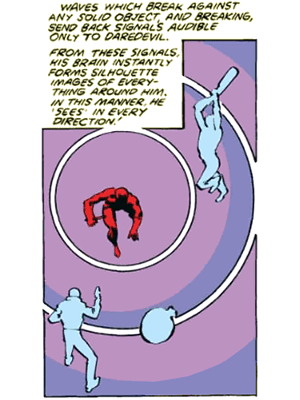
Human echolocation [ek-oh-loh-key-shuhn] is the ability of humans to detect objects in their environment by sensing echoes from those objects. This ability is used by some blind people to navigate within their environment. They actively create sounds, such as by tapping their canes, lightly stomping their foot or by making clicking noises with their mouths (however, because humans click with much lower frequencies and slower rates than other animals, only larger objects can be sensed). The principle is comparable to active sonar in submarines and to echolocation by bats and dolphins.
Vision and hearing are closely related in that they can process reflected waves of energy. Vision processes light waves as they travel from their source, bounce off surfaces throughout the environment and enter the eyes. Similarly, the auditory system processes sound waves as they travel from their source, bounce off surfaces and enter the ears. Both systems can extract a great deal of information about the environment by interpreting the complex patterns of reflected energy that they receive. In the case of sound, these waves of reflected energy are called ‘echoes.’
Posted in Health, Science |
Leave a Comment »
February 1, 2011

In vitro meat, also known as cultured meat, is an animal flesh product that has never been part of a complete, living animal. Several current research projects are growing in vitro meat experimentally, although no meat has yet been produced for public consumption. The first-generation products will most likely be minced meat, and a long-term goal is to grow fully developed muscle tissue. Potentially, any animal’s muscle tissue could be grown through the in vitro process.
Posted in Food, Money, Science |
Leave a Comment »
January 29, 2011
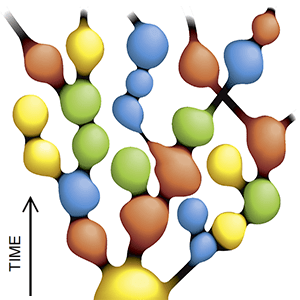
The multiverse is the hypothetical set of multiple possible universes (including the historical universe we consistently experience) that together comprise everything that exists: the entirety of space, time, matter, and energy as well as the physical laws and constants that describe them. The term was coined in 1895 by the American philosopher and psychologist William James. The various universes within the multiverse are sometimes called parallel universes.
The structure of the multiverse, the nature of each universe within it and the relationship between the various constituent universes, depend on the specific multiverse hypothesis considered. Multiverses have been hypothesized in cosmology, physics, astronomy, religion, and philosophy. In these contexts, parallel universes are also called ‘alternative universes,’ ‘quantum universes,’ and ‘alternative realities,’ among others.
read more »
Posted in Language, Philosophy, Science |
Leave a Comment »
January 29, 2011

The universe is commonly defined as the totality of everything that exists, including all physical matter and energy, the planets, stars, galaxies, and the contents of intergalactic space. The term universe may be used in slightly different contextual senses, denoting such concepts as the cosmos, the world, or nature. Observations of earlier stages in the development of the universe, which can be seen at great distances, suggest that the universe has been governed by the same physical laws and constants throughout most of its extent and history.
The word universe derives from the Old French word Univers, which in turn derives from the Latin word universum. The Latin word was used by Cicero and later Latin authors in many of the same senses as the modern English word is used. The Latin word derives from the poetic contraction Unvorsum — first used by Roman poet, Lucretius, to describe ‘everything rolled into one,’ or ‘everything combined into one.’
Posted in Language, Philosophy, Science |
Leave a Comment »
January 29, 2011


The ‘magnitude’ of a mathematical object is its size: a property by which it can be larger or smaller than other objects of the same kind. If two things, an elephant and a rhinoceros for example, have the same order of magnitude they are similar in size. Conversely, an elephant is many orders of magnitude smaller than, for example, a planet.
Orders of magnitude are generally used to make very approximate comparisons. If two numbers differ by one order of magnitude, one is about ten times larger than the other. If they differ by two orders of magnitude, they differ by a factor of about 100. The ‘orders’ describe exponential change (by powers of ten).
Posted in Language, Science |
Leave a Comment »
January 28, 2011

In sports science theory, supercompensation [soo-per-kom-puhn-sey-shuhn] is the post training period during which the trained function/parameter has a higher performance capacity than it did prior to the training period. First put forth by Hungarian scientist Nikolai Jakowlew in 1976, this theory is a basic principle of athletic training.
read more »
Posted in Games, Health, Science |
Leave a Comment »
January 26, 2011

Thundersnow is a rare kind of thunderstorm with snow falling as the primary precipitation instead of rain. It typically falls in regions of strong upward motion within the cold sector of an extratropical cyclone, where the precipitation consists of ice pellets rather than snow. One unique aspect of thundersnow is that the snowfall acts as an acoustic suppressor of the thunder.
The thunder from a typical thunderstorm can be heard many miles away, while the thunder from thundersnow can usually only be heard within a two to three mile radius from the lightning. In the United States, March is their peak month of formation, and on average, only 6.3 events are reported per year.
Posted in Language, Science |
Leave a Comment »


 The Daily Omnivore