April 3, 2013
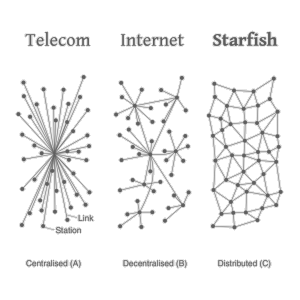
‘The Starfish and the Spider: The Unstoppable Power of Leaderless Organizations’ is a 2006 book by Ori Brafman (author of the 2010 book ‘Click: The Magic of Instant Connections’) and Rod Beckstrom (President of ICANN); it is an exploration of the implications of the recent rise of decentralized organizations such as Wikipedia, Grokster and YouTube.
The book contrasts them to centralized organizations, such as Encyclopædia Britannica. The spider and starfish analogy refers to the contrasting biological nature of the respective organisms, starfish have a decentralized neural structure permitting regeneration, whereas spiders have in a hierarchical nervous system.
read more »
Posted in Language, Money, Technology |
Leave a Comment »
April 3, 2013

Experimental archaeology puts archaeological source material, like ancient structures or artifacts, to real world tests. It should not be confused with primitive technology which is not concerned with any archaeological or historical evidence. Living history and historical reenactment, which are generally undertaken as a hobby, are the lay person’s version of this academic discipline.
One of the main forms of experimental archaeology is the creation of copies of historical structures using only historically accurate technologies. This is sometimes known as reconstruction archaeology or reconstructional archaeology; however, reconstruction implies an exact replica of the past, when it is in fact just a construction of one person’s idea of the past; the more archaeologically correct term is a ‘working construction of the past.’
read more »
Posted in Science, Technology, World |
Leave a Comment »
April 3, 2013
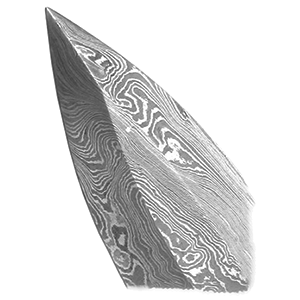
Damascus steel was a type of steel used in Middle Eastern swordmaking. Damascus steel was created from wootz steel, a steel developed in India around 300 BCE. These swords are characterized by distinctive patterns of banding and mottling reminiscent of flowing water.
Such blades were reputed to be tough, resistant to shattering and capable of being honed to a sharp, resilient edge. The original method of producing Damascus steel is not known. Recreating Damascus steel is a subfield of experimental archaeology. Many have attempted to discover or reverse-engineer the process by which it was made.
read more »
Posted in Technology, World |
Leave a Comment »
March 31, 2013

A one-man band is a musician who plays a number of musical instruments simultaneously using their hands, feet, limbs, and various mechanical contraptions. The simplest type of ‘one-man band’ — a singer accompanying themselves on acoustic guitar and harmonica mounted in a metal ‘harp rack’ below the mouth — is often used by buskers.
More complicated setups may include wind instruments strapped around the neck, a large bass drum mounted on the musician’s back with a beater which is connected to a foot pedal, cymbals strapped between the knees or triggered by a pedal mechanism, tambourines and maracas tied to the limbs, and a stringed instrument strapped over the shoulders (e.g., a banjo, ukulele or guitar). Since the development of Musical Instrument Digital Interface (MIDI) in the 1980s, musicians have also incorporated chest-mounted MIDI drum pads, foot-mounted electronic drum triggers, and electronic pedal keyboards into their set-ups.
read more »
Posted in Art, Humor, Technology |
1 Comment »
March 27, 2013

Genetic algorithms are a kind of algorithm used to find approximations in search problems. Genetic algorithms are a class of evolutionary algorithms (algorithms that simulate evolution: each generation of solution is subjected to some kind of fitness function; those that survive are then recombined in some way to make the next generation of solution).
The concept of genetic algorithms is a search technique often used in computer science to find complex, non-obvious solutions to algorithmic optimization and search problems. Genetic algorithms are categorized as global search heuristics, and have a wide variety of applications, particularly in generating useful Artificial Intelligence agents in computer games.
read more »
Posted in Games, Technology |
Leave a Comment »
March 27, 2013

In Computer Science, especially in artificial intelligence, evolutionary algorithms (EA) are a kind of algorithm that simulate evolution to optimize something.
Each generation of solution is subjected to some kind of fitness function; those that survive are then recombined in some way to make the next generation of solution. This is done until a certain level of fitness is reached, or a determined number of generations have been used.
read more »
Posted in Technology |
Leave a Comment »
March 25, 2013

A number of self-balancing unicycle have been created which are self-balancing only in the forwards-backwards direction, and still need a human being to balance them from side to side.
Aleksander Polutnik’s Enicycle (2006) is probably the first two-axis balancing human-ridable unicycle. In 2009, RYNO Motors of Portland, Oregon created a one-wheeled electric motorcycle called the Micro-Cycle. According to the company, a commercial version is scheduled to go into production in mid 2013.
Posted in Technology |
Leave a Comment »
March 24, 2013

A monowheel is a one-wheeled single-track vehicle similar to a unicycle. However, instead of sitting above the wheel, the rider sits either within it or next to it. The wheel is a ring, usually driven by smaller wheels pressing against its inner rim. Most are single-passenger vehicles, though multi-passenger models have been built. Hand-cranked and pedal-powered monowheels were built in the late 19th century; most built in the 20th century have been motorized.
Some modern builders refer to these vehicles as monocycles, though that term is also sometimes used to describe motorized unicycles. Today, monowheels are generally built and used for fun and entertainment purposes, though from the 1860s through to the 1930s, they were proposed for use as serious transportation.
read more »
Posted in Technology |
Leave a Comment »
March 22, 2013
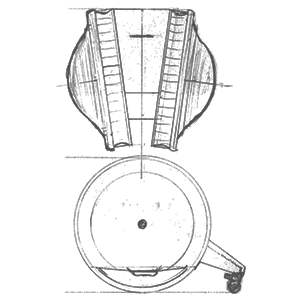
The Kugelpanzer (‘spherical tank’) was a prototype reconnaissance tank built by Nazi Germany during World War II. It was one of the most unusual armored fighting vehicles ever built.
Only one example of this Rollzeug (rolling vehicle) exists in Russia as part of the Kubinka Tank Museum’s collection of German armored vehicles. The Kugelpanzer is simply listed as Item #37 and is painted gloss gray. From fragmentary information, the drive has been removed from the vehicle and no metal samples are allowed to be taken from it.
read more »
Posted in Technology, War |
Leave a Comment »
March 22, 2013

Robert Venturi (b. 1925) is an American architect, founding principal of the firm Venturi, Scott Brown and Associates, and one of the major architectural figures in the twentieth century. Together with his wife and partner, Denise Scott Brown, he helped to shape the way that architects, planners and students experience and think about architecture and the American built environment.
Their buildings, planning, theoretical writings and teaching have contributed to the expansion of discourse about architecture. He is also known for coining the maxim ‘Less is a bore’ a postmodern antidote to Mies van der Rohe’s famous modernist dictum ‘Less is more.’
read more »
Posted in Money, Technology |
Leave a Comment »
March 19, 2013

Yoshiro Nakamatsu (b. 1928), also known as Dr. NakaMats, is Japanese inventor who has become something of a minor celebrity for the dubious science behind his inventions and his eccentricity. He regularly appears on Japanese talk shows which, in conjunction with his appearance, usually craft a humorous segment based on one or more of his inventions. He is a prolific inventor, and he even claims to hold the world record for number of inventions with over 4,000 patents.
In his interviews, Nakamatsu described his ‘creativity process,’ which includes listening to music and concludes with diving underwater, where he says he comes up with his best ideas and records them while underwater. Nakamatsu claims to benefit from lack of oxygen to the brain, making inventions ‘0.5 seconds before death.’ He also built a million dollar toilet room made completely out of gold that he claims helps make him think better. Nakamatsu also has an elevator in his house that he claims helps him think better. He strictly denies that it is an elevator, but rather a ‘vertical moving room.’ Nakamatsu’s goal is to live at least 144 years.
read more »
Posted in Humor, Technology, World |
Leave a Comment »
March 15, 2013


Google X Lab, sometimes known as Google X, is a secret facility run by Google thought to be located somewhere in the Bay Area of Northern California. Work at the lab is overseen by Sergey Brin, one of Google’s co-founders. Reportedly worked on at the lab is a list of 100 projects pertaining to future technologies such as a space elevator, self-driving car, augmented reality glasses, a neural network that uses semi-supervised learning, enabling speech recognition and extraction of objects from video – for instance detecting if a cat is in a frame of video, and the Web of Things (a network of objects with embedded computers).
Project Glass is a research and development program by Google to develop an augmented reality head-mounted display (HMD). The intended purpose of Project Glass products would be the hands-free displaying of information currently available to most smartphone users, and allowing for interaction with the Internet via natural language voice commands.
read more »
Posted in Money, Technology |
Leave a Comment »



