December 20, 2011
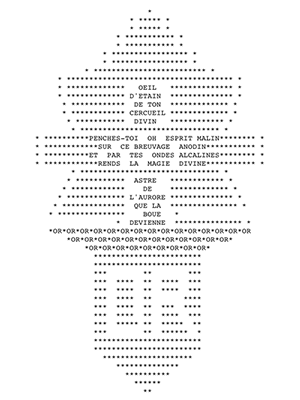
Internet art (often referred to as net art) is a form of digital artwork distributed via the Internet. Artists working in this manner are sometimes referred to as net artists. Internet art can happen outside the technical structure of the Internet, such as when artists use specific social or cultural Internet traditions in a project outside of it. Internet art is often—but not always—interactive, participatory, and multimedia-based. Internet art can be used to spread a message, either political or social, using human interactions.
The term Internet art typically does not refer to art that has been simply digitized and uploaded to be viewable over the Internet. Rather, this genre relies intrinsically on the Internet to exist, taking advantage of such aspects as an interactive interface and connectivity to multiple social and economic cultures and micro-cultures. Theoriest and curator Jon Ippolito defines it as distinct from commercial web design, and touching on issues of permanence, archivability, and collecting in a fluid medium.
read more »
Posted in Art, Technology |
Leave a Comment »
December 20, 2011

Tradigital art most commonly refers to art (including animation) that combines both traditional and computer-based techniques to implicate an image.
Artist and teacher Judith Moncrieff first coined the term in the early 1990s, while an instructor at the Pacific Northwest College of Art. The school held a competition of Moncrieff’s students, who used the medium to electronically combine everything from photographs of costumes to stills from videotapes of performing dancers.
read more »
Posted in Art, Language, Technology |
Leave a Comment »
December 20, 2011

‘Series of tubes‘ is a phrase coined originally as an analogy by then Senator Ted Stevens (R-Alaska) to describe the Internet in the context of opposing network neutrality.
In 2006, he used this metaphor to criticize a proposed amendment to a committee bill that would have prohibited Internet service providers such as AT&T and Verizon Communications from charging fees to give some companies higher priority access to their networks or their customers. This metaphor has been widely ridiculed as demonstrating Stevens’s poor understanding of the Internet, despite the fact that he was in charge of regulating it.
read more »
Posted in Humor, Politics, Technology |
1 Comment »
December 20, 2011
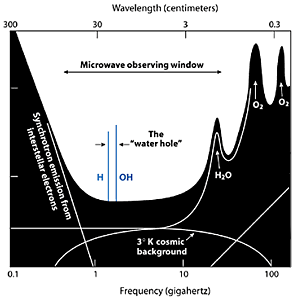
The waterhole refers to an especially quiet band of the electromagnetic spectrum between 1,420 and 1,666 megahertz, corresponding to wavelengths of 21 and 18 centimeters respectively. The term was coined by American scientist Bernard Oliver. The strongest hydroxyl radical spectral line radiates at 18 centimeters, and hydrogen at 21 centimeters. These two combined form water, and water is currently thought to be essential to extraterrestrial life advanced enough to generate radio signals.
Bernard M. Oliver theorized that the waterhole would be a good, obvious band for communication with extraterrestrial intelligence, hence the pun, in English a watering hole is a vernacular reference to a common place to meet and talk. Several programs involved in the search for extraterrestrial intelligence, including SETI@home, search in the waterhole.
Posted in Science, Technology |
Leave a Comment »
December 20, 2011
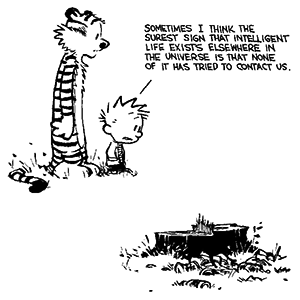
The Great Filter, in the context of the Fermi paradox, is whatever prevents ‘dead matter’ from giving rise, in time, to ‘expanding lasting life.’ The concept originates in Robin Hanson’s argument that the failure to find any extraterrestrial civilizations in the observable universe implies the possibility something is wrong with one or more of the arguments from various scientific disciplines that the appearance of advanced intelligent life is probable.
This observation is conceptualized in terms of a ‘Great Filter’ which acts to reduce the great number of sites where intelligent life might arise to the tiny number of intelligent species actually observed (currently just one: human). This probability threshold, which could lie behind us or in front of us, might work as a barrier to the evolution of intelligent life, or as a high probability of self-destruction. The main counter-intuitive conclusion of this observation is that the easier it was for life to evolve to our stage, the bleaker our future chances probably are.
read more »
Posted in Science, Technology |
Leave a Comment »
December 20, 2011

Space opera is a subgenre of science fiction that emphasizes romantic, often melodramatic adventure, set mainly or entirely in outer space, generally involving conflict between opponents possessing advanced technologies and abilities. The term has no relation to music and it is analogous to ‘soap opera.’ Perhaps the most significant trait of space opera is that settings, characters, battles, powers, and themes tend to be very large-scale.
Sometimes the term is used pejoratively to denote bad quality science fiction, but its meaning can differ, often describing a particular science fiction genre without any value judgement. The genre’s varying definitions were affected by literary politics, ‘what used to be science fantasy is now space opera, and what used to be space opera is entirely forgotten.’
read more »
Posted in Art, Language, Technology |
Leave a Comment »
December 19, 2011

Taubman Sucks is an award-winning short documentary about a precedent-setting intellectual property lawsuit. The documentary was written and directed by filmmaker Theo Lipfert. The six-minute film explores Taubman v. WebFeats, a lawsuit that involved the complex relationships between domain names, trademarks, and free speech.
As the first ‘sucks.com’ case to reach the level of the United States Court of Appeals, the decision in Taubman v. WebFeats established precedents concerning the non-commercial use of trademarks in domain names.
Posted in Money, Politics, Technology |
Leave a Comment »
December 19, 2011

Article spinning is a search engine optimization technique by which blog or website owners post a unique version of relevant content on their sites by rewriting and replacing elements to provide a slightly different perspective on the topic. Many article marketers believe that article spinning helps avoid the feared penalties in the Search Engine Results pages (SERP) for using duplicate content. If the original articles are plagiarized from other websites or if the original article was used without the copyright owner’s permission, such copyright infringements may result in the writer facing a legal challenge, while writers producing multiple versions of their own original writing need not worry about such things.
Website owners may pay writers to perform spinning manually, rewriting all or parts of articles. Writers also spin their own articles, manually or automatically, allowing them to sell the same articles with slight variations to a number of clients or to use the article for multiple purposes (e.g. content and marketing). There are also a number of software applications which will automatically replace words or phrases in articles.
Posted in Money, Politics, Technology |
Leave a Comment »
December 19, 2011


In computing, spamdexing (also known as search spam or Search Engine Poisoning) is the deliberate manipulation of search engine indexes. The earliest known reference to the term is by Eric Convey in 1996 in an article, ‘Porn sneaks way back on Web,’ for ‘The Boston Herald.’ It involves a number of methods, such as repeating unrelated phrases, to manipulate the relevance or prominence of resources indexed in a manner inconsistent with the purpose of the indexing system.
Common spamdexing techniques can be classified into two broad classes: content spam (or term spam) and link spam. Content spam methods include keyword stuffing, hidden or invisible text, meta-tag stuffing, doorway pages, scraper sites, and article spinning. Link spamming methods include link farms, hidden links, Sybil attacks, spam blogs, page hijacking, buying lapsed domains (cybersquatting), and cookie stuffing.
read more »
Posted in Money, Technology |
Leave a Comment »
December 19, 2011

Brandjacking is an activity whereby someone acquires or otherwise assumes the online identity of another entity for the purposes of acquiring that person’s or business’s brand equity. The term combines the notions of ‘branding’ and ‘hijacking’, and has been used since at least 2007 when it appeared in a Business Week article. The tactic is often associated with use of individual and corporate identities on social media or Web 2.0 sites.
While similar to cybersquatting, identity theft, and phishing, brandjacking is usually particular to a politician, celebrity or business and more indirect in its nature. A brandjacker may attempt to use the reputation of its target for selfish reasons or seek to damage the reputation of its target for malicious or for political reasons. These reasons may not be directly financial, but the effects on the original brand-holder may often include financial loss – for example, negative publicity may result in the termination of a celebrity’s sponsorship deal, or, for a corporation, potentially lead to lost sales or a reduced share price.
Posted in Money, Politics, Technology |
1 Comment »
December 19, 2011

Cybersquatting (also known as domain squatting) is registering, trafficking in, or using a domain name with bad faith intent to profit from the goodwill of a trademark belonging to someone else. Some cybersquatter offer to sell the domain to the person or company who owns a trademark at an inflated price.
Some put up derogatory remarks about the person or company the domain is meant to represent to encourage the subject to buy the domain from them. Others post paid links via Google and other advertising networks. The term is derived from ‘squatting,’ which is the act of occupying an abandoned or unoccupied space or building that the squatter does not own, rent or otherwise have permission to use.
read more »
Posted in Money, Politics, Technology |
Leave a Comment »
December 17, 2011


The terms Google bomb and Googlewashing refer to practices, such as creating large numbers of links, that cause a web page to have a high ranking for searches on unrelated or off topic keyword phrases, often for comical or satirical purposes. In contrast, search engine optimization is the practice of improving the search engine listings of web pages for relevant search terms.
Google bombs date back as far as 1999, when a search for ‘more evil than Satan himself’ resulted in the Microsoft homepage as the top result. Some of the most famous Google bombs are also expressions of political opinions (e.g. ‘liar’ leading to Tony Blair or ‘miserable failure’ leading to the White House’s biography of George W. Bush).
read more »
Posted in Humor, Money, Technology |
Leave a Comment »



