December 17, 2011


Typosquatting (URL hijacking), is a form of cybersquatting, and possibly brandjacking which relies on mistakes such as typographical errors made by Internet users when inputting a website address into a web browser. Should a user accidentally enter an incorrect website address, they may be led to an alternative website owned by a cybersquatter. Once in the typosquatter’s site, the user may also be tricked into thinking that they are in fact in the real site; through the use of copied or similar logos, website layouts or content.
In 2006, controversial evangelist Jerry Falwell failed to get the U.S. Supreme Court to review a decision allowing Christopher Lamparello to use ‘www.fallwell.com.’ Relying on a plausible misspelling of Falwell’s name, Lamparello’s gripe site presents misdirected visitors with scriptural references that counter the fundamentalist preacher’s scathing rebukes against homosexuality. In Lamparello v. Falwell, the high court let stand a 2005 lower court finding that ‘the use of a mark in a domain name for a gripe site criticizing the markholder does not constitute cybersquatting.’
Posted in Money, Politics, Technology |
1 Comment »
December 17, 2011
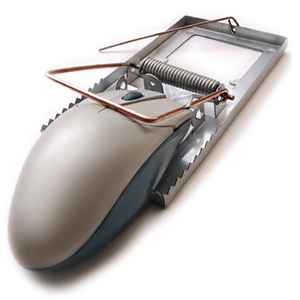
Mousetrapping is a technique used by websites (usually pornographic) to keep visitors from leaving their website, either by launching an endless series of pop-up ads—known colloquially as a ‘circle jerk’—or by re-launching their website in a window that cannot be closed. Many websites that do this also employ browser hijackers to reset the user’s default homepage. The Federal Trade Commission has brought suits against mousetrappers, charging that the practice is a deceptive and unfair competitive practice.
Typically, mousetrappers register URLs with misspelled names of celebrities (e.g. BrittnaySpears.com) or companies (WallStreetJournel.com). Once the viewer is at the site, a Javascript or a click induced by promises of free samples redirects the viewer to a URL and regular site of the mousetrapper’s client-advertiser, who pays him 10 to 25 cents for capturing and redirecting each potential customer. An FTC press release explaining states: ‘Schemes that capture consumers and hold them at sites against their will while exposing Internet users, including children, to solicitations for gambling, psychics, lotteries, and pornography must be stopped.’
Posted in Money, Politics, Technology |
Leave a Comment »
December 17, 2011

Parachute cord (also paracord or 550 cord) is a lightweight nylon kernmantle rope (consisting of two parts: an inner core, the kern and a protective sheath, the mantle ) originally used in the suspension lines of US parachutes during World War II. Once in the field, paratroopers found this cord useful for many other tasks. It is now used as a general purpose utility cord by both military personnel and civilians.
This versatile cord was even used by astronauts to repair the Hubble Space Telescope. The braided sheath has a high number of interwoven strands for its size, giving it a relatively smooth texture. The all-nylon construction makes paracord fairly elastic; depending on the application this can be either an asset or a liability.
read more »
Posted in Technology, War |
Leave a Comment »
December 17, 2011
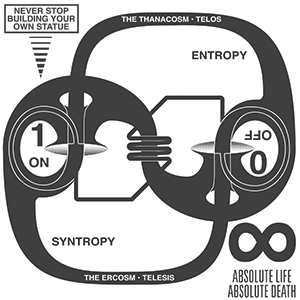
Paul Laffoley (b. 1940) is a US artist and architect. As an architect working for Emery Roth & Sons, Laffoley worked for 18 months on design for the World Trade Center Tower II.
As a painter, his work is usually classified as visionary art or outsider art; most of his pieces are painted on large canvases and combine words and imagery to depict a spiritual architecture of explanation, tackling concepts like dimensionality, time travel through hacking relativity, connecting conceptual threads shared by philosophers through the millennia, and theories about the cosmic origins of mankind.
read more »
Posted in Art, Philosophy, Technology |
Leave a Comment »
December 14, 2011
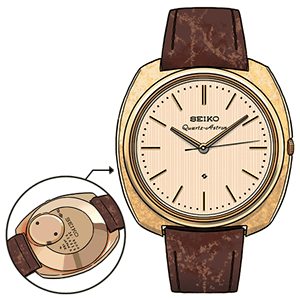
The Quartz Crisis is a term used in the watchmaking industry to refer to the economic upheavals caused by the advent of quartz watches in the 1970s and early 1980s, which largely replaced mechanical watches. It caused a decline of the Swiss watchmaking industry, which chose to remain focused on traditional mechanical watches, while the majority of world watch production shifted to Asian companies who embraced the new technology.
During World War II, Swiss neutrality permitted the watch industry to continue making consumer time keeping apparatus while the major nations of the world shifted timing apparatus production to timing devices for military ordnance. As a result, the Swiss watch Industry enjoyed a well-protected monopoly. The industry prospered in the absence of any real competition. Thus, prior to the 1970s, the Swiss watch industry had 50% of the world watch market.
read more »
Posted in Money, Technology, World |
Leave a Comment »
December 14, 2011
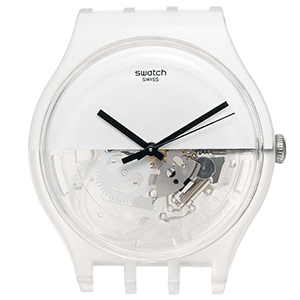
Swatch is a brand name for a line of wrist watches from the Swatch Group, a Swiss conglomerate with vertical control of the production of Swiss watches and related products. Swatch Group is the world’s largest watch company, and the Group has accelerated its acquisition of Swiss luxury brands in recent years, and currently owns: Breguet, Blancpain, Glashütte Original, Omega, Tiffany & Co., Rado, Longines, Tissot, and Hamilton. In 1984,
Swatch was conceived and it was introduced to the market in Switzerland the following year. This concept was realize with a small team of enthusiastic watch engineers led by Elmar Mock and Jacques Müller, who had had the idea to use the case back as a movement main plate (platine), as it had been done to design the thinnest watch in the world, the Delirium which made it to market in 1979. It was also designed for easy assembling.
read more »
Posted in Money, Technology |
Leave a Comment »
December 14, 2011


Stratolaunch Systems is a space transportation venture specializing in air launch to orbit, with its corporate headquarters located in Huntsville, Alabama. It was founded in 2011 by Microsoft co-founder Paul G. Allen and Scaled Composites founder Burt Rutan, who had previously collaborated on the creation of SpaceShipOne (which won the Ansari X-Prize by reaching 100 kilometers in altitude). The newly envisioned launch system will use similar components to that of Virgin Galactic though it will be made for orbital launch instead of suborbital.
The startup will build a mobile launch system with three primary components; a carrier aircraft to be build by Scaled Composites, A multi-stage launch vehicle built by Space Exploration Technologies, and a mating and integration system to be built by Dynetics. Allen and Rutan stated that the carrier craft would have a wingspan of 385 feet (117 m), making it the largest aircraft ever to fly, and will weigh in at over 1,200,000 pounds (540,000 kg). The aircraft will be powered by six turbine engines, sourced from a Boeing 747. It will use a 12,000 feet (3,700 m) long runway and is expected to test fly in 2016.
Posted in Money, Technology |
Leave a Comment »
December 12, 2011


Internet in a suitcase is a program reportedly developed or spearheaded by the U.S. Department of State to provide Internet and mobile phone service to dissidents that can bypass government censorship or shut down of telecommunications in countries such as the Islamic Republic of Iran, Syria and Libya. The plan reportedly involves utilizing common hardware components ‘into a package that could easily’ be smuggled ‘into a repressive country and quickly assembled to deliver wireless service across a wide area to maintain crucial communications between legitimately protesting citizens.’
Part of the operation includes a prototype ‘Internet in a suitcase’ being developed by a ‘group of young entrepreneurs’ led by Sascha Meinrath of the New America Foundation, a public policy think tank. Other projects employ tools ‘that have already been created by hackers in a so-called liberation-technology movement sweeping the globe,’ and stealth wireless networks.
Posted in Politics, Technology, World |
Leave a Comment »
December 12, 2011

The Stop Online Piracy Act (SOPA), also known as H.R.3261 was a proposed American law to stop copyright infringement on the Internet. The Internet community had major discussion over it, but the bill was not passed. The supporters claimed that current copyright laws are not effective in shutting down piracy websites. The opponents argued the law amounted to a broad censorship tool over the internet.
In protest, several major sites went dark on January 18, 2012. News aggregator site Reddit blocked access first and then others joined the movement. Wikipedia masked most of its pages with a banner to spotlight the value of open access to information on the Internet. Google put up a black censor board in front of its logo.
Posted in Money, Politics, Technology |
Leave a Comment »
December 8, 2011

Personalized medicine is a medical model emphasizing the customization of healthcare, with all decisions and practices tailored to individual patients. Recently, this has mainly involved the systematic use of genetic or other information about an individual patient to select or optimize preventative and therapeutic care. Over the past century, medical care has centered on standards of care based on epidemiological studies of large cohorts. However, large cohort studies have previously been unable take into account the genetic variability of individuals within a population. Personalized medicine seeks to provide an objective basis for consideration of such individual differences. Traditionally, personalized medicine has been limited to the consideration of a patient’s family history, social circumstances, environment and behaviors.
Since the late 1990s, the advent of research using biobanks (cryogenic storage facilities that archive biological samples) has brought advances in a number of molecular profiling technologies including proteomic profiling, metabolomic analysis, genetic testing, and molecular medicine. Since about 2007 the term Stratified medicine has been used for the current approach.
Posted in Health, Technology |
Leave a Comment »
December 8, 2011

Dwolla is a United States-only e-commerce company that provides an online payment system and mobile payments network by the same name. The company was founded in 2008 with services based only in Iowa. After raising $1.31 million in funding, Dwolla launched nationally in 2009 with founders Ben Milne (CEO) and Shane Neuerburg (CTO), in Des Moines, Iowa, United States, with a few small banks and retailers. Transactions using Dwolla surpassed $1 million a week and its Iowa user-base was overtaken in 2011, with 20,000 users. The company began with two employees and has approximately 15 employees as of June 2011.
The main pull for Dwolla is its low transaction fees. From its onset, Dwolla charged 25 cents per transaction, less than its main rival Paypal, which for several years has charged 30 cents, plus 1.9-2.9% of each transaction. The name Dwolla is a conjunct of ‘dollar’ and ‘web.’ Dwolla is notable for its interest among users of Bitcoin, a digital currency. Some Bitcoin exchanges allow users to buy Bitcoins with dollars transferred to the exchange via Dwolla, and allow users to sell Bitcoins and have the proceeds transferred back to them using Dwolla. Although Dwolla representatives have said that they saw growth due to Bitcoin users, they do not offer any official endorsement of Bitcoins.
Posted in Money, Technology |
Leave a Comment »
December 8, 2011

A Macquarium is an aquarium made to sit within the shell of an Apple Macintosh computer. The term was coined by computer writer Andy Ihnatko. In the early 1990s several Mac models in this form factor (the Macintosh 128K, Macintosh 512K and Macintosh Plus) were becoming obsolete, and Ihnatko considered that turning one into an aquarium might be ‘the final upgrade’ — as well as an affordable way to have a color Compact Mac.
He has mentioned in interviews that he had seen previous, overly-complex attempts at Macintosh aquariums at trade shows that among other drawbacks suffered from noticeable water level lines across the ‘screen’ that spoiled the illusion of a ‘really good screensaver,’ which drove him to design a version without a visible water line and which allowed the external case of the donor Mac to remain intact.
Posted in Humor, Technology |
Leave a Comment »



