July 18, 2011

A kludge [klooj] is a workaround, a quick-and-dirty solution, a clumsy or inelegant, yet effective, solution to a problem, typically using parts that are cobbled together. The present word has alternate spellings (kludge and kluge) and pronunciations (rhyming with fudge and stooge respectively), and several proposed etymologies.
Kluge was common Navy slang in the WWII era for any piece of electronics that worked well on shore but consistently failed at sea. In aerospace design a kluge was a temporary design using separate commonly available components that were not flight worthy to proof the design.
read more »
Posted in Humor, Language, Technology |
Leave a Comment »
July 15, 2011

Grey goo is a hypothetical end-of-the-world scenario involving nanotechnology in which out-of-control self-replicating robots consume all matter on Earth while building more of themselves, a scenario known as ecophagy (‘eating the environment’).
Self-replicating machines of the macroscopic variety were originally described by mathematician John von Neumann, and are sometimes referred to as von Neumann machines.
read more »
Posted in Language, Technology |
Leave a Comment »
July 14, 2011

Cyberdelic refers to immersion in cyberspace as a psychedelic experience; the fusion of cyberculture and the psychedelic subculture; psychedelic art created by calculating fractal objects; and trance music parties. Timothy Leary, an advocate of psychedelic drug use who became a cult figure of the hippies in the 1960s, reemerged in the 1980s as a spokesperson of the cyberdelic counterculture, whose adherents called themselves ‘cyberpunks,’ and became one of the most philosophical promoters of personal computers, the Internet, and immersive virtual reality. Leary proclaimed that the ‘PC is the LSD of the 1990s’ and admonished bohemians to ‘turn on, boot up, jack in.’
In contrast to the hippies of the 60s who were decidedly antiscience and antitechnology, the cyberpunks of the 80s and 90s ecstatically embraced technology and the hacker ethic. They believed that high technology (and smart drugs) could help human beings overcome all limits, that it could liberate them from authority and even enable them to transcend space, time, and body. They often expressed their ethos and aesthetics through cyberart and reality hacking.
Posted in Drugs, Language, Technology |
1 Comment »
July 14, 2011


Transhumanism, often abbreviated as H+, is an international intellectual and cultural movement that affirms the possibility and desirability of fundamentally transforming the human condition by developing and making widely available technologies to eliminate aging and to greatly enhance human intellectual, physical, and psychological capacities.
Transhumanist thinkers study the potential benefits and dangers of emerging technologies that could overcome fundamental human limitations, as well as study the ethical matters involved in developing and using such technologies. They predict that human beings may eventually be able to transform themselves into beings with such greatly expanded abilities as to merit the label ‘posthuman.’ Transhumanism is therefore viewed as a subset of philosophical ‘posthumanism.’
read more »
Posted in Philosophy, Politics, Technology |
Leave a Comment »
July 14, 2011

Ray Kurzweil (b. 1948) is an American author, inventor and futurist. He is involved in fields such as optical character recognition (OCR), text-to-speech synthesis, speech recognition technology, and electronic keyboard instruments. He is the author of several books on health, artificial intelligence (AI), transhumanism, the technological singularity, and futurism.
Ray Kurzweil grew up in Queens, NY. He was born to secular Jewish parents who had escaped Austria just before the onset of World War II, and he was exposed via Unitarian Universalism to a diversity of religious faiths during his upbringing. His father was a musician and composer and his mother was a visual artist. His uncle, an engineer at Bell Labs, taught young Ray the basics of computer science.
read more »
Posted in Language, Money, Technology |
1 Comment »
July 14, 2011

American author, inventor and futurist Raymond Kurzweil has become well known for predicting the future of artificial intelligence and the human race. His first book, ‘The Age of Intelligent Machines,’ published in 1990, put forth his theories on the results of the increasing use of technology and notably foresaw the explosive growth in the internet, among other predictions.
Later works, 1999’s ‘The Age of Spiritual Machines’ and 2005’s ‘The Singularity is Near’ outlined other theories including the rise of clouds of nano-robots (nanobots) called foglets and the development of Human Body 2.0 and 3.0, whereby nanotechnology is incorporated into many internal organs.
read more »
Posted in Language, Technology |
Leave a Comment »
July 14, 2011

The Big Green Egg is the brand name of a kamado-style ceramic charcoal cooker. Kamado barbecue originates in southern Japan. The kamado first came to the attention of Americans after World War II when US Air Force servicemen brought them back from Japan in empty transport planes. The Big Green Egg Company was founded in 1974 by Ed Fisher and is based in Georgia. The shape of the Egg is designed to contain the heat with only a small draft door at the bottom, and a daisy wheel damper unit on the top to give air flow control and therefore temperature regulation. Between the base and the lid is a felt gasket designed to maximize moisture retention during long cookouts.
Prices vary by model and start at approximately $700. Big Green Egg barbecues have quite an enthusiastic following of amateur chefs and the collective name given these enthusiasts is ‘Eggheads.’ Every October there is a global gathering called ‘Eggtoberfest’ held at the company’s headquarters in Tucker, GA. In addition, numerous other Big Green Egg Festivals occur throughout the US and the world, called ‘EggFests.’
Posted in Food, Money, Technology |
Leave a Comment »
July 14, 2011

MacGyver is an American action-adventure television series, where the titular character employs his resourcefulness and knowledge of chemistry, physics, technology, and survival skills to resolve what are often life-or-death crises. He creates inventions from simple items to solve these problems. These inventions became synonymous with the character and were called MacGyverisms by fans. MacGyver was unlike secret agents in other television series and films because, instead of relying on high-tech weapons and tools, he carried only a Swiss Army knife and duct tape but never a gun. A boyhood friend of his was accidentally killed by a revolver, and MacGyver has avoided them since.
The show’s writers based MacGyver’s inventions on items they found on location, concepts from scientific advisers John Koivula and Jim Green, and real events. The show also offered a monetary prize to people who sent good ideas for the show. A young fan suggested that MacGyver could patch up a vehicle’s radiator by cracking an egg into it, and the episode ‘Bushmaster’ was constructed around this trick.
Posted in Humor, Language, Technology |
Leave a Comment »
July 13, 2011

Jordan Roseman aka DJ Earworm is a San Francisco/London-based mashup artist who has achieved recognition for his technically sophisticated, songwriting oriented music and video mashups. His annual ‘United State of Pop’ mashups, short mixes featuring the top 25 songs of the year according to Billboard magazine, have reached the Top 100 for national radio play. He began making mashups recreationally in 2003 using ACID (he announced in 2008 that he had switched to Abelton Live). After encouragement from DJ Adrian at Club Bootie, Roseman created the moniker DJ Earworm (‘earworm’ referencing a song that repeats uncontrollably in one’s mind) and began releasing mashups.
DJ Earworm has a unique mashup style that consists of a compositional, songwriting approach. He gradually layers samples on top of one another, matching keys and subtly altering melodies. His mashups often convey an entirely new meaning than the original material, such as a political message in ‘No More Gas.’ He has been contrasted with mashup artist Girl Talk, who has a more DJ-oriented style. He is the author of Audio Mashup Construction Kit (2006), a how-to manual for creating mashups.
Posted in Art, Money, Technology |
Leave a Comment »
July 12, 2011

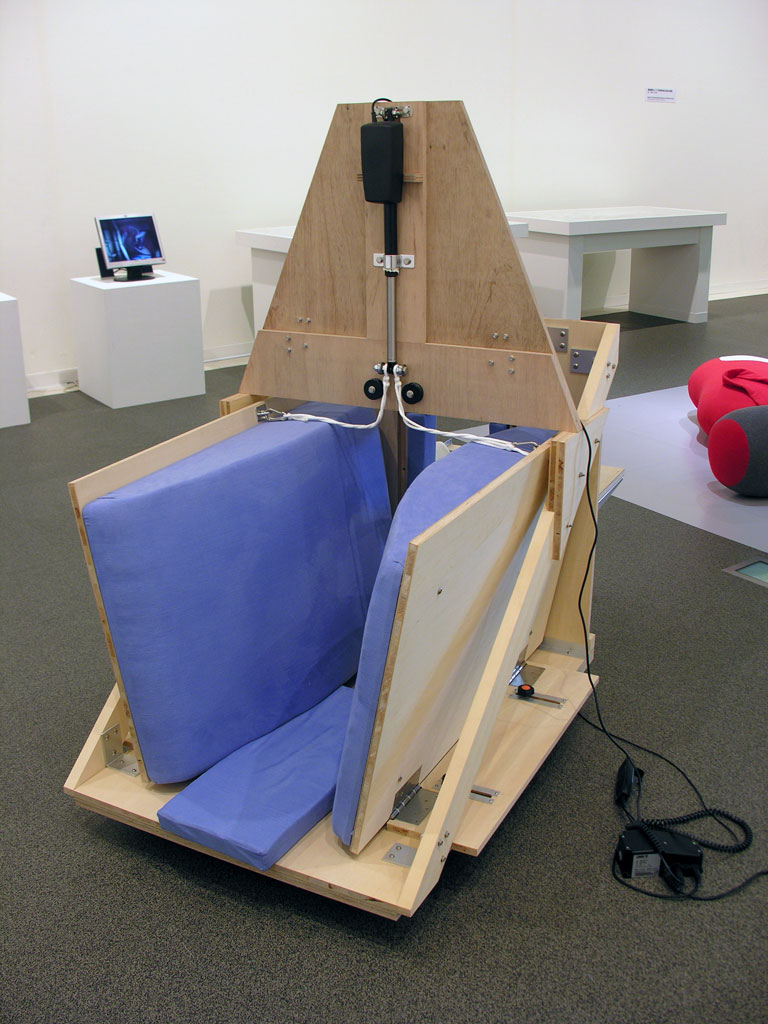
A hug machine, or squeeze box, is a deep-pressure device designed to calm hypersensitive persons, usually individuals with autism spectrum disorders. The therapeutic, stress-relieving device was invented by professor of animal science Temple Grandin in 1965.
Autism and autism-spectrum disorders have profound effects upon both social interactions and sensitivity to sensory stimulation in persons with such conditions, often making it uncomfortable or impractical for them to turn to other human beings for comfort. Grandin solved this by designing the hug machine so both she and others could turn to it for sensory relief, whenever needed or simply desired.
read more »
Posted in Health, Technology |
2 Comments »
July 12, 2011

Bionic contact lenses are being developed to provide a virtual display that could have a variety of uses from assisting the visually impaired to the video game industry. The lenses require organic materials that are biologically safe and also use inorganic material for the electronic circuits. The electronic circuits are built from a layer of metal a few nanometres thick. The light-emitting diodes are one third of a millimetre across. A grey powder is sprinkled onto the lens. Then a technique called microfabrication or ‘self-assembly’ is used to shape each tiny component. Capillary forces pull the pieces into their final position.
Wireless communication, radio frequency power transmission and solar cells are expected in future developments. The prototype does not light up or display information; however, it is proof that it is possible to create a biologically safe electronic lens that does not obstruct a person’s view. Engineers have tested the finished lenses on rabbits.
Posted in Health, Technology |
Leave a Comment »
July 12, 2011

Façade is a 2005 artificial-intelligence-based interactive story created by Michael Mateas and Andrew Stern, and exhibited at several international art shows. Façade puts the player in the role of a close friend of Grace and Trip, a couple who invited you over for cocktails.
This pleasant gathering, however, is somewhat damaged by the clear domestic confrontation between your hosts. Making full use of the incorporated language processing software, the game allows the player to type sentences to ‘speak’ with the couple, either supporting them through their troubles, driving them farther apart, or being thrown out of the apartment.
read more »
Posted in Games, Humor, Technology |
Leave a Comment »