July 11, 2011

The Tamagotchi [tom-uh-gotchee] is a handheld digital pet, created in Japan by Akihiro Yokoi of WiZ and Aki Maita of Bandai. It was first sold by Bandai in 1996 in Japan. As of 2010, over 76 million Tamagotchis have been sold world-wide. Most Tamagotchis are housed in a small egg-shaped computer with an interface usually consisting of three buttons, although the number of buttons may vary for different variations. According to Bandai, the name is a portmanteau combining the Japanese word ‘tamago,’ which means ‘egg,’ and the English word ‘watch.’
Upon removing the tag of a Tamagotchi unit, an egg will appear on the screen. After setting the Tamagotchi unit’s clock, the Tamagotchi will hatch, after which the player will be told of its gender and will be given the opportunity to give it a name. From then on, the player is given the task of raising the Tamagotchi to good health throughout its life and attending to its needs, such as feeding it, playing games to make it happy, and keep it at a healthy weight, cleaning up its excrement, punishing or praising the Tamagotchi based on its actions, returning it to proper health with medicine if it gets sick, and shutting off the lights when it goes to bed.
read more »
Posted in Games, Technology, World |
Leave a Comment »
July 11, 2011

A MiniDisc (MD) is a magneto-optical disc-based data storage device initially intended for storage of up to 74 minutes and, later, 80 minutes, of digitized audio. In the form of Hi-MD, it has also developed into a general-purpose storage medium. MiniDisc was released in 1992, first in Japan, and then in Europe and the U.S. The music format was originally based exclusively on ATRAC audio data compression, but the option of linear PCM recording was later introduced to attain audio quality comparable to that of a compact disc.
Sony’s MiniDisc was one of two rival digital systems introduced in 1992, that were both targeted as a replacement for the Philips analog cassette audio tape system: the other was Digital Compact Cassette (DCC), created by Philips and Matsushita. Sony had originally intended for Digital Audio Tape (DAT) to be the dominant home digital audio recording format, replacing the analog cassette. Unfortunately, due to technical delays, DAT was not launched until 1989, and by then, the U.S. dollar had fallen so far in relation to the yen, the introductory DAT machine Sony had intended to market for about $400 in the late 1980s now had to retail for $800 or even $1000 to break even, putting it out of reach for most users. Relegating DAT for pro use, Sony immediately set to work to come up with a simpler, more economical digital home format.
read more »
Posted in Money, Technology, World |
Leave a Comment »
July 11, 2011

The Chinese typewriter was invented and patented by Dr. Lin Yutang in 1946. One of Lin’s intentions was to help modernize China. The typewriter was called ‘MingKwai’ (‘clear and quick’). Lin had a prototype machine custom built by the Carl E. Krum Company, a small engineering-design consulting firm with an office in New York City. That multilingual typewriter was the size of a conventional office typewriter of the 1940s. The typefaces fit on a drum. A ‘magic eye’ was mounted in the center of the keyboard which magnifies and allows the typist to review a selected character. Character selection is accomplished by first pressing two keys to choose a desired character, which is arranged according to a system Lin devised for his dictionary of the Chinese language. The selected Chinese character appeared in the magic eye for preview, the typist then pressed a ‘master’ key, similar to today’s computer function key.
The typewriter could create 90,000 distinct characters using either one or two of six character-containing rollers, which in combination has 7000 full characters and 1,400 character radicals or partial characters. The inspired aspect of the typewriter was the system Lin devised for a Chinese alphabet. It had thirty geometric shapes or strokes (somewhat analogous to the elements of a glyph). These became ‘letters’ by which to alphabetize Chinese characters. He broke tradition with the long-standing system of radicals and stroke order writing and categorizing of Chinese characters, inventing a new way of seeing and categorizing. The typewriter was not produced commercially. According Lin’s daughter, the day she was to demonstrate the machine to executives of the Remington Typewriter Company, they could not make it work. Although they did get the machine fixed for a press conference the next day, it was to no avail.
Posted in Language, Technology, World |
Leave a Comment »
July 11, 2011
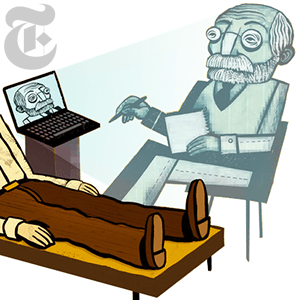
Telepsychiatry is the application of Telemedicine to the field of Psychiatry. It has been the most successful of all the telemedicine applications so far, because of its need for only a good videoconferencing facility between the patient and the psychiatrist, especially for follow-up. There are sub-specialties like forensic telepsychiatry, in which the patient is typically an inmate accessing the psychiatrist who is from a supporting institution, and home-based telepsychiatry, whereby the patient is in his own home or office, accessing the physician via webcam and high-speed internet. Another common application is for patients in rural or under served areas, and there are a large number of grassroots telepsychiatry programs springing up in the United States and elsewhere to address this problem.
A recent innovation is the development of the subspecialty of emergency psychiatry via telemedicine. Research is currently on-going to develop the unique guidelines required to provide consultation for emergency psychiatric patients such as the evaluation of the suicidal, homidical, violent, psychotic, depressed, manic, and acutely anxious patient. Emergency telepsychiatry services are being provided to hospital emergency departments, jails, community mental health centers, substance abuse treatment facilities, and schools.
Posted in Health, Technology |
1 Comment »
July 11, 2011

Turntable.fm was a social media website that allowed users to interactively share music. The site was run by Billy Chasen, who started it in January 2011 using revenue generated by his previous start-up. The service allowed users to create ‘rooms,’ which other users could join. Designated users, so-called ‘DJs,’ chose songs to be played to everyone in that room, while all users were able to talk with one another through a text interface.
The service opened to the public in May 2011, and by late June had already reached 140,000 active users. The company used the Digital Millennium Copyright Act to license the music that was played on the website; because of this, only individuals from the US were allowed to use the service.
Posted in Games, Money, Technology |
Leave a Comment »
July 8, 2011

Max is a visual programming language for music and multimedia developed and maintained by San Francisco-based software company Cycling ’74. During its 20-year history, it has been widely used by composers, performers, software designers, researchers, and artists for creating innovative recordings, performances, and installations.
The Max program itself is highly modular, with most routines existing in the form of shared libraries. As a result, Max has a large userbase of programmers not affiliated with Cycling ’74 who enhance the software with commercial and non-commercial extensions to the program.
read more »
Posted in Art, Technology |
Leave a Comment »
July 7, 2011

A skeleton watch is a mechanical watch (although occasionally quartz), in which all of the moving parts are visible through either the front of the watch, the back of the watch or a small cut outlining the dial.
Many watchmakers have skeleton watches, but Rolex has rarely made them (apart from the 1930s and early 1940s) and never made tourbillon skeletons. For this reason, one should exercise caution when buying a skeleton watch marked as a Rolex as it is likely a counterfeit.
Posted in Money, Technology |
Leave a Comment »
July 7, 2011

Audemars [awe-de-marr] Piguet [pee-gay] (AP) is a manufacturer of prestige Swiss watches which compete with Patek Philippe and Vacheron Constantin. The roots of the company date back to 1874, when the 23-year-old Jules-Louis Audemars met Edward-Auguste Piguet, then only 21, at Vallée de Joux, in western Switzerland, which is considered to be the cradle of prestige watch-making. Thus Audemars started producing component parts for movements and Piguet got the job of a repasseur, whose job it was to make the final regulation of the timepiece.
In 1875 they founded a firm later known as Audemars, Piguet et Cie, and since 1882, members of the Audemars and Piguet families have always been on the board of directors. Between 1894 and 1899 the company produced about 1,200 timepieces, including some very complex watches. When Audemars and Piguet died, in 1918 and 1919 respectively, the company was already quite famous. As the success of the company’s business was rising its customers became Tiffany & Co, Cartier and Bulgari, who rebranded and sold Audemars Piguet watches under their own house names. Today these watches are only identifiable as Audemars Piguet products by their serial numbers.
read more »
Posted in Money, Technology |
Leave a Comment »
July 5, 2011

Polara Golf is brand for a line of golf balls that correct hooks and slices, based on the physics of their design. The new design, released August 2010, utilizes state-of-the-art aerodynamics and a principle axis of inertia. The ball has shallow truncated dimples around its equator and has deep spherical and small spherical dimples on each of the ball’s poles. Officially sanctioned balls are designed to be as symmetrical as possible.
This symmetry is the result of a dispute that stemmed from the original Polara, that had six rows of normal dimples on its equator but very shallow dimples elsewhere. This asymmetrical design helped the ball self-adjust its spin-axis during the flight. The United States Golf Association refused to sanction it for tournament play and, in 1981, changed the rules to ban aerodynamic asymmetrical balls.
Posted in Games, Money, Technology |
Leave a Comment »
July 5, 2011

The Maschinenmensch [muh-sheen-en-mench] (German: ‘machine-human’) from ‘Metropolis,’ is a gynoid played by German actress Brigitte Helm in both her robotic and human incarnations. The haunting blank face and pronounced female curves have been the subject of disgust and fascination alike. The Maschinenmensch has many names given her through the years : Parody, Ultima, Machina, Futura, and Robotrix. The Maschinenmensch’s back story is detailed in Thea von Harbou’s original 1927 novel. It is described as a very delicate, but faceless, transparent figure made of crystal flesh with silver bones and its eyes filled with an expression of calm madness. Futura is perfectly obedient and the ideal agent-provocateur, able to become any woman and tempt men to their doom.
The memorable transformation scene was an early miracle of special effects, using a series of matte cutouts of the robot’s silhouette and a number of circular neon lights. All effects were filmed directly into the camera rather than edited separately. As a result the film had to be rewound and exposed many tens of times over to include the plates showing the heart and circulatory systems as well as cuts between the robot form and Maria showing her gradual transformation. The Maschinenmensch is an archetypal example of the Frankenstein complex, where artificial creations turn against their creator and go on a rampage. Artificial beings with a malevolent nature were a popular theme at the time. Original designs by Ralph McQuarrie for C-3PO in Star Wars were largely based on the Maschinenmensch, albeit in a male version. The design was later refined, but retains clear Art Deco influences.
Posted in Art, Language, Technology |
1 Comment »
July 5, 2011

Christopher Mercer (b. 1985), more commonly known as Rusko, is an English dubstep record producer and DJ. He made his production debut in 2006 on Dub Police with the song ‘SNES Dub.’
Steering away from the darker side of Dubstep, Rusko brought an upbeat sound to the scene that appealed to many outside the community. Rusko’s extremely successful hit ‘Cockney Thug’ has appeared on various DJ sets and mixes.
Posted in Art, Technology, World |
2 Comments »
July 5, 2011

Anonymous is an Internet meme that originated in 2003 on the imageboard 4chan, representing the concept of many online community users simultaneously existing as an anarchic, digitized global hive mind. It is also generally considered to be a blanket term for members of certain Internet subcultures, a way to refer to the actions of people in an environment where their actual identities are not known.
In its early form, the concept has been adopted by a decentralized online community acting anonymously in a coordinated manner, usually toward a loosely self-agreed goal, and primarily focused on entertainment. Beginning with 2008, the Anonymous collective has become increasingly associated with collaborative, international hacktivism, undertaking protests and other actions, often with the goal of promoting internet freedom and freedom of speech. Actions credited to ‘Anonymous’ are undertaken by unidentified individuals who apply the Anonymous label to themselves as attribution.
read more »
Posted in Language, Politics, Technology |
Leave a Comment »