July 5, 2011

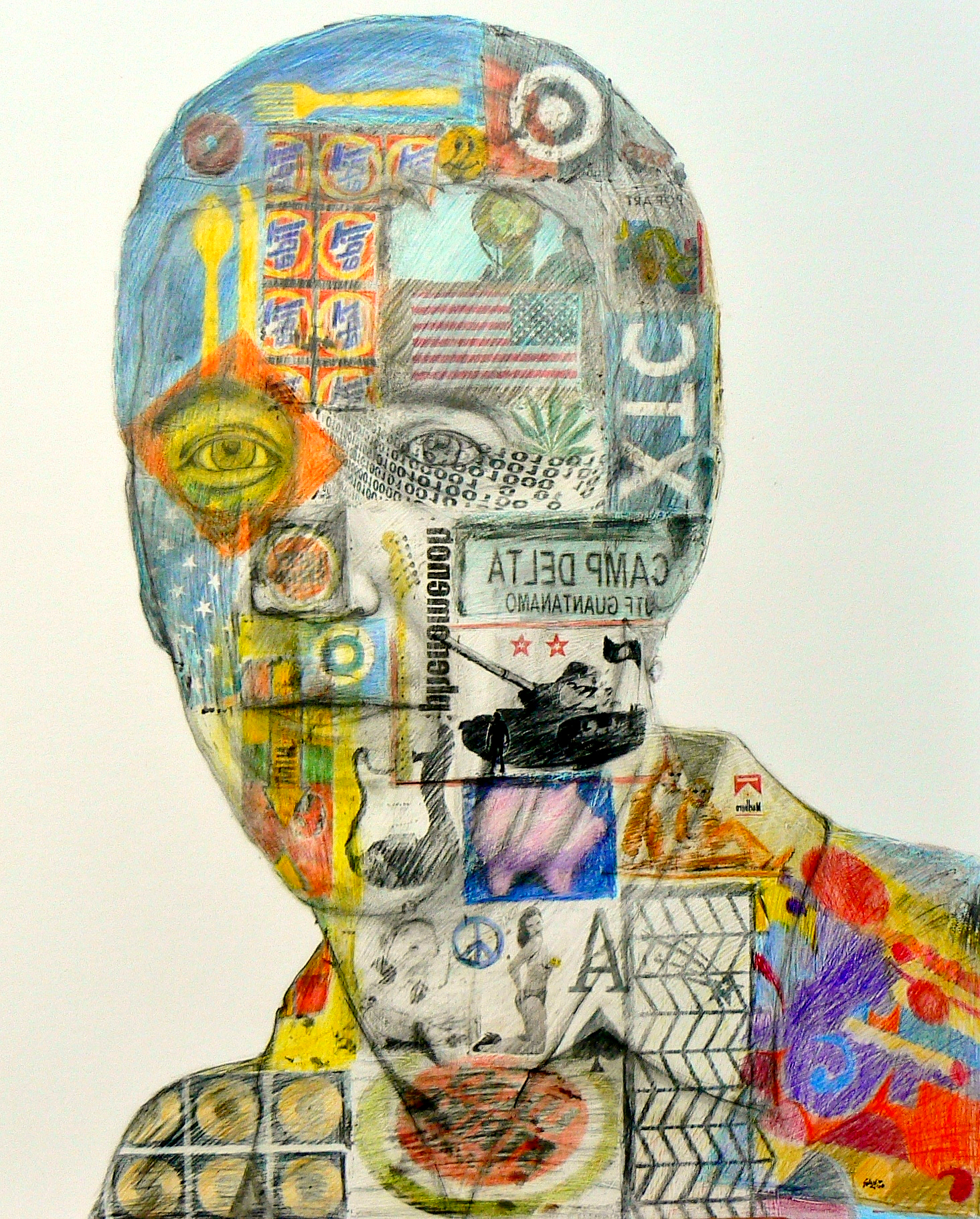
Lulz Security, commonly abbreviated as LulzSec, was a computer hacker group that claimed responsibility for several high profile attacks, including the compromise of user accounts from Sony Pictures in 2011. The group has been described as a ‘cyber terrorism group’ by the Arizona Department of Public Safety after their systems were compromised and information leaked.
It has gained attention due to its high profile targets and the sarcastic messages it has posted in the aftermath of its attacks. LulzSec released a statement claiming to to disband on June 26, 2011. The ’50 days of lulz’ statement, which they claimed to be their final release, confirming that LulzSec consisted of six members, and that their website is to be taken down.
read more »
Posted in Money, Politics, Technology |
Leave a Comment »
July 4, 2011

Netnews is a kind of online service that shares articles between a group of computers over a network. A popular type of netnews is called usenet, which was in use before the World Wide Web, and is still very active today. Usenet provided a way for people to write articles on many different topics and share them with people all over the world.
It is different from the web because articles are sent to all the computers in the community; whereas, an article on a webserver stays on one computer until a person requests it with their web browser.
read more »
Posted in Technology |
2 Comments »
July 4, 2011
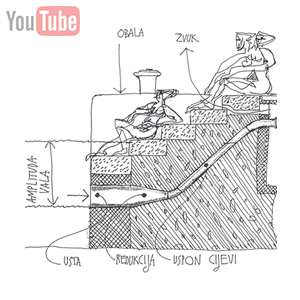
The Sea organ is an architectural object located in Croatia and an experimental musical instrument which plays music by way of sea waves and tubes located underneath a set of large marble steps. The waves create somewhat random but harmonic sounds.
The device was made by the architect Nikola Bašić as part of the project to redesign the new city coast (Nova riva), and the site was opened to the public in 2005. Chaotic reconstruction work undertaken in an attempt to repair the devastation suffered by the city of Zadar in the Second World War turned much of the sea front into an unbroken, monotonous concrete wall. The Sea Organ has drawn tourists and locals alike.
Posted in Art, Technology, World |
Leave a Comment »
July 4, 2011

Indie electronic (also called indietronica) is a music genre that combines indie, electronica, rock and pop music. Typical instruments used in indietronica music are electronic keyboard, synthesizer, sampler and drum machine.
Indie electronic began in the early ’90s with bands like Stereolab and Disco Inferno, took off in the new millennium as the new digital technology developed, with acts including Broadcast from the UK, Justice from France, Lali Puna from Germany and The Postal Service, and Ratatat from the US, mixing a variety of indie sounds with electronic music, largely produced on small independent labels.
Posted in Art, Money, Technology |
Leave a Comment »
July 3, 2011

Monoprinting is a form of printmaking that has images or lines that can only be made once, unlike most printmaking, where there are multiple originals. There are many techniques of monoprinting, including lithography, woodcut, and etching. A monoprint is a single impression of an image made from a reprintable block, such as a metal plate used for etching, a litho stone or wood block. Rather than printing an edition of multiple copies of a single image, only one impression may be produced, either by painting or making a collage on the block. Etching plates may also be inked in a way that is expressive and unique in the strict sense, in that the image cannot be reproduced exactly.
Monoprints may also involve elements that change, where the artist reworks the image in between impressions or after printing so that no two prints are aboslutely identical. Monoprints may include collage, hand-painted additions, and a form of tracing by which thick ink is laid down on a table, paper is placed on top and is then drawn on, transferring the ink onto the paper. Monoprints can also be made by altering the type, color, and pressure of the ink used to create different prints. Monoprints are known as the most painterly method among the printmaking techniques; it is essentially a printed painting. The characteristic of this method is that no two prints are alike. The beauty of this medium is also in its spontaneity and its combination of printmaking, painting and drawing media.
Posted in Art, Technology |
Leave a Comment »
July 3, 2011

Ted McCarty (1910 – 2001) was a pioneer of electric guitar design and production. This began when he was chosen as vice president of the of Gibson Guitar Corporation in 1949, then later as president from 1950 to 1966. This period became known as Gibson’s golden age of electric guitars. During his tenure, Les Paul’s electric guitar design, the first solid-body guitar produced by Gibson, came to fruition. The Gibson Les Paul later became the company’s flagship solid body.
Never satisfied, McCarty sought to create a hybrid design that would combine the sustain of a solid-body electric with the mellow warmth of a hollow-body. The ES-335 was created as a ‘semi-hollow,’ with both a central block running the length of the guitar and hollow wings. McCarty was also responsible for the development of the Tune-o-matic bridge system, the humbucking pickup, and the Explorer, Flying V, Moderne, SG and Firebird guitars. Like Leo Fender, McCarty never played the guitar. He instead talked with every guitarist he could in order to find out what guitar players were interested in.
Posted in Art, Money, Technology |
Leave a Comment »
June 30, 2011

RoboCup is an international robotics competition founded in 1997. The aim is to develop autonomous soccer robots with the intention of promoting research and education in the field of artificial intelligence.
The name RoboCup is a contraction of the competition’s full name, “‘Robot Soccer World Cup,’ but there are many other stages of the competition such as ‘Search and Rescue’ and ‘Robot Dancing.’ The official goal of the project: ‘By mid-21st century, a team of fully autonomous humanoid robot soccer players shall win the soccer game, complying with the official rule of the FIFA, against the winner of the most recent World Cup.’
Posted in Games, Technology |
Leave a Comment »
June 30, 2011

Yellow Magic Orchestra (YMO) is a Japanese electronic music band consisting of principal members Haruomi Hosono (bass and keyboards), Yukihiro Takahashi (drums and lead vocals) and Ryuichi Sakamoto (keyboards and vocals). The group began under the name ‘Yellow Magic Band’ in 1977, and then renamed itself as ‘Yellow Magic Orchestra’ in 1978.
The band’s former ‘fourth member’ was music programmer Hideki Matsutake. They are regarded as influential innovators of popular electronic music. They helped pioneer synthpop and ambient house, ushered in electronica, anticipated the beats and sounds of electro music, laid the foundations for J-pop, and influenced the house, techno, and hip-hop movements.
read more »
Posted in Art, Technology, World |
Leave a Comment »
June 30, 2011


A chiptune, also known as chip music, is synthesized electronic music often produced with the sound chips of old computers and video game consoles, as well as with other methods such as emulation. In the early 1980s, home computers became cheaper and more accessible; this led to a proliferation of personal computers and gaming consoles that were abandoned as users moved on to the next generation of software, and the hardware to run it. Small groups of artists and musicians continue to use these forgotten computers to produce audio and visual work.
The game technologies that are typically used in chip music production are those produced from the 1980s up until the early to mid 1990s. These systems, including the NEC PC-8801, Commodore 64, Nintendo Entertainment System, and Nintendo Game Boy, were aimed at the domestic consumer market. These systems were unique in that they marked a period in the technological development of game audio in which dedicated hardware sub-systems or sound chips were used to create sound.
read more »
Posted in Art, Games, Technology |
Leave a Comment »
June 29, 2011
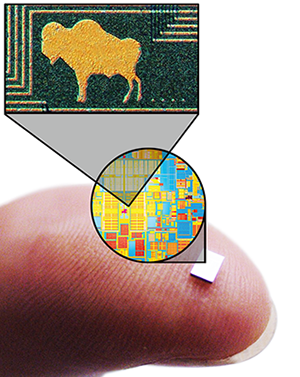
Chip art, also known as silicon art, chip graffiti or silicon doodling, refers to microscopic artwork built into integrated circuits, also called chips or ICs. Since ICs are printed by photolithography, not constructed a component at a time, there is no additional cost to include features in otherwise unused space on the chip.
Designers have used this freedom to put all sorts of artwork on the chips themselves, from designers’ simple initials to rather complex drawings. Given the small size of chips, these figures cannot be seen without a microscope. Chip graffiti is sometimes called the hardware version of software easter eggs (an intentional hidden message or feature).
read more »
Posted in Art, Humor, Technology |
Leave a Comment »
June 28, 2011

The Digital Millennium Copyright Act (DMCA) is a US copyright law that implements two 1996 treaties of the World Intellectual Property Organization. It criminalizes production and dissemination of technology, devices, or services intended to circumvent measures (commonly known as digital rights management or DRM) that control access to copyrighted works. It also criminalizes the act of circumventing an access control, whether or not there is actual infringement of copyright itself. In addition, the DMCA heightens the penalties for copyright infringement on the Internet.
Passed in 1998 by a unanimous vote in the United States Senate and signed into law by President Bill Clinton, the DMCA amended Title 17 of the United States Code to extend the reach of copyright, while limiting the liability of the providers of on-line services for copyright infringement by their users. The law is currently unsettled with regard to websites that contain links to infringing material; however, there have been a few lower-court decisions which have ruled against linking in some narrowly prescribed circumstances. One is when the owner of a website has already been issued an injunction against posting infringing material on their website and then links to the same material in an attempt to circumvent the injunction.
Posted in Money, Politics, Technology |
Leave a Comment »
June 28, 2011

In typography, rivers, or rivers of white, are gaps appearing to run down a paragraph of text, due to a coincidental alignment of spaces. They can occur regardless of the spacing settings, but are most noticeable with wide inter-word spaces caused by full text justification or monospaced fonts.
Typographers try to minimize or eliminate the river effect. They can test for rivers by turning a proof sheet upside down (top to bottom) to examine the text. From this perspective, the eye is less likely to recognize words and the type can be viewed more readily as an overall pattern. Other related terms are ‘lakes’ and ‘holes,’ which refer to a cluster of adjacent or intertwined rivers that create a lighter area within a block of type.
Posted in Language, Money, Technology |
Leave a Comment »