April 11, 2011
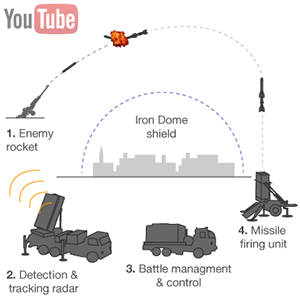
Iron Dome is an Israeli mobile air defense system in development by Rafael Advanced Defense Systems designed to intercept short-range rockets and artillery shells. The system was created as a defensive countermeasure to the rocket threat against Israel’s civilian population on its northern and southern borders, and was declared operational and initially deployed in the first quarter of 2011.
It is designed to intercept very short-range threats up to 70 kilometers in all-weather situations. On April 7, 2011, the system successfully intercepted a Grad rocket launched from Gaza, marking the first time in history a short-range rocket was ever intercepted.
Posted in Technology, War |
Leave a Comment »
April 11, 2011

An internet Surf Club is a group site (usually a blog) where artists and others link to ‘surfed’ or ‘surfable’ items on the Web and also post some of their own creative work. ‘Nasty Nets Internet Surfing Club’ was the first to use the words ‘surfing club’ (ironically) and others followed the form or adopted the word ‘club’ to sound relevant. The original clubs were never true clubs but there has been much rancor over the issue of invited membership in the supposedly open and democratic web that still exists outside Facebook-like commercial enclaves.
Dump.fm is a real-time image sharing website that has many aspects of a surf club; however, anyone can sign up for Dump. The core surf clubs (Nasty, Double Happiness, Loshadka) are barely active now—their heyday was 2006-2009, which could be called the ‘surf club era.’ Arguably the widely-used, configurable tumblr, and other a microblogging platforms have made surf clubs obsolete.
Posted in Art, Humor, Technology |
Leave a Comment »
April 7, 2011
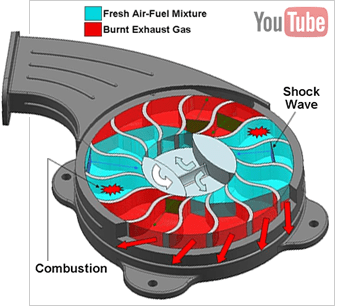
A wave-disk engine is an innovative internal combustion engine design being worked on by teams at Michigan State University and Warsaw Institute of Technology led by Norbert Müller. The first prototype was demonstrated in March 2011. The wave-disk engine has no valves, pistons or gear trains but utilizes a rotating disk to produce shock waves that compress an air fuel mixture. As the burning mixture expands it pushes against curved blades set into the rotor disk causing it to spin. The turning of the disk itself opens and closes inlet and outlet ports at appropriate times to introduce the air/fuel mixture and exhaust the combustion products.
It potentially shows savings in weight and better energy efficincy compared to normal internal combustion engine designs. Combustion engines are not very efficient, turning only 15% to 20% of the gasoline into propulsion. The rest of the energy in the gasoline is lost as waste heat. Wave disk engines promises to be 3.5x more efficient, 20% lighter, 30% cheaper to manufacture, and reduce emissions by 90 percent.
Posted in Money, Technology |
Leave a Comment »
April 7, 2011
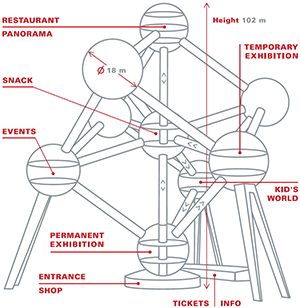
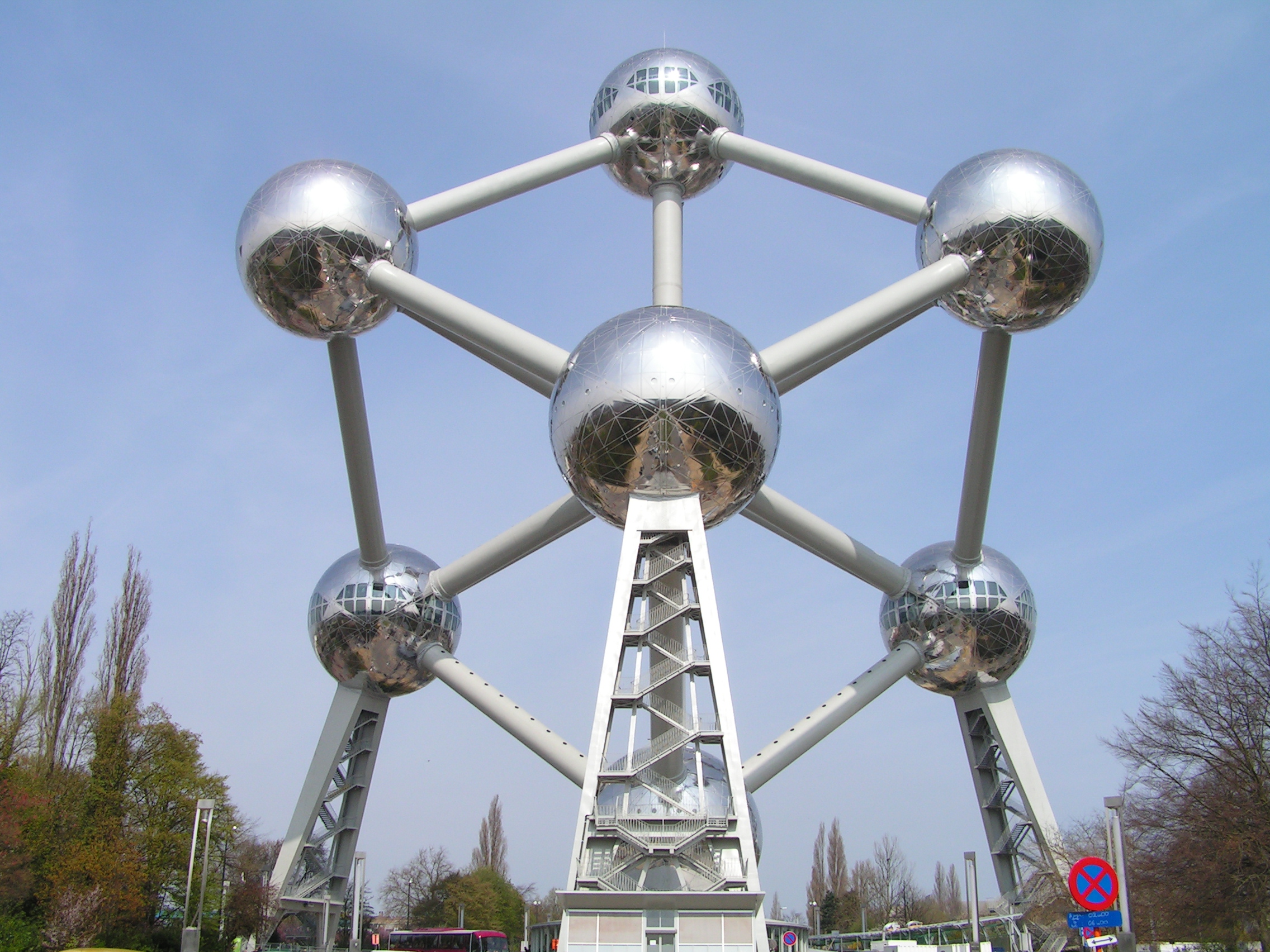
The Atomium is a monument in Brussels, originally built for Expo ’58, the 1958 Brussels World’s Fair. Designed by Belgian engineer, André Waterkeyn, it stands 102-metres (335 ft) tall. It has nine steel spheres connected so that the whole forms the shape of a unit cell of an iron crystal magnified 165 billion times. Tubes connect the spheres along the 12 edges of the cube and all eight vertices to the center. They enclose escalators connecting the spheres containing exhibit halls and other public spaces. The top sphere provides a panoramic view of Brussels. Each sphere is 18 meters in diameter.
Three of the four uppermost spheres lack vertical support and hence are not open to the public for safety reasons, although the sphere at the pinnacle is open to the public. The original design called for no supports; the structure was simply to rest on the spheres. Wind tunnel tests proved that the structure would have toppled in an 80 km/h wind. Support columns were added to achieve enough resistance against overturning.
Posted in Art, Technology, World |
1 Comment »
April 7, 2011
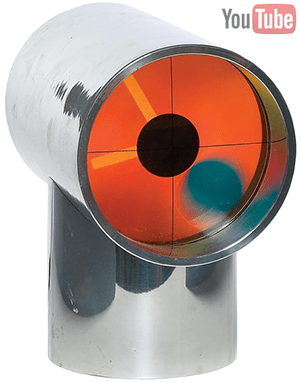
The Aurora Clock has been in production for over 40 years. There are continuously changing colors and surprising color ‘shifts’ when the secondhand disk overlaps the minute & hour hands, and the colors change depending on your viewing angle. The color changes have to do with polarized light and a phenomenon called bi-refractance. Vectors of light are being rotated as they pass through each material which is very different from color filtering.
The first Aurora clocks were made by Rathcon and called the Spectrum. Then they were manufactured by Kirsch-Hamilton. Next, in the late 80’s, Hampton Haddon had a version made in Japan, but abandoned the clock around 1991. In 1993 we at ChronoArt started manufacturing Luminas (a different polarized light clock) and then a year later started also manufacturing new Auroras.
Posted in Art, Technology |
Leave a Comment »
April 7, 2011

A virtual retinal display (VRD) is a display technology that draws a raster display (like a television) directly onto the retina of the eye. The user sees what appears to be a conventional display floating in space in front of them.
To create an image with the VRD a photon source (or three sources in the case of a color display) is used to generate a coherent beam of light (such as a laser diode). The resulting modulated beam is then scanned to place each image point, or pixel, at the proper position on the retina.
Posted in Money, Technology |
Leave a Comment »
April 7, 2011
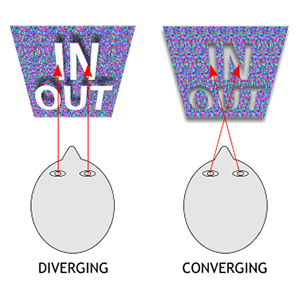
An autostereogram [aw-toh-ster-ee-uh-gram] is a stereogram (an optical illusion of depth created from flat images), designed to create the visual illusion of a three-dimensional scene from a two-dimensional image in the human brain.
In order to perceive 3D shapes in these autostereograms, the brain must overcome the normally automatic coordination between focusing and vergence (the simultaneous movement of both eyes in opposite directions to obtain or maintain single binocular vision).
read more »
Posted in Art, Games, Technology |
Leave a Comment »
April 7, 2011

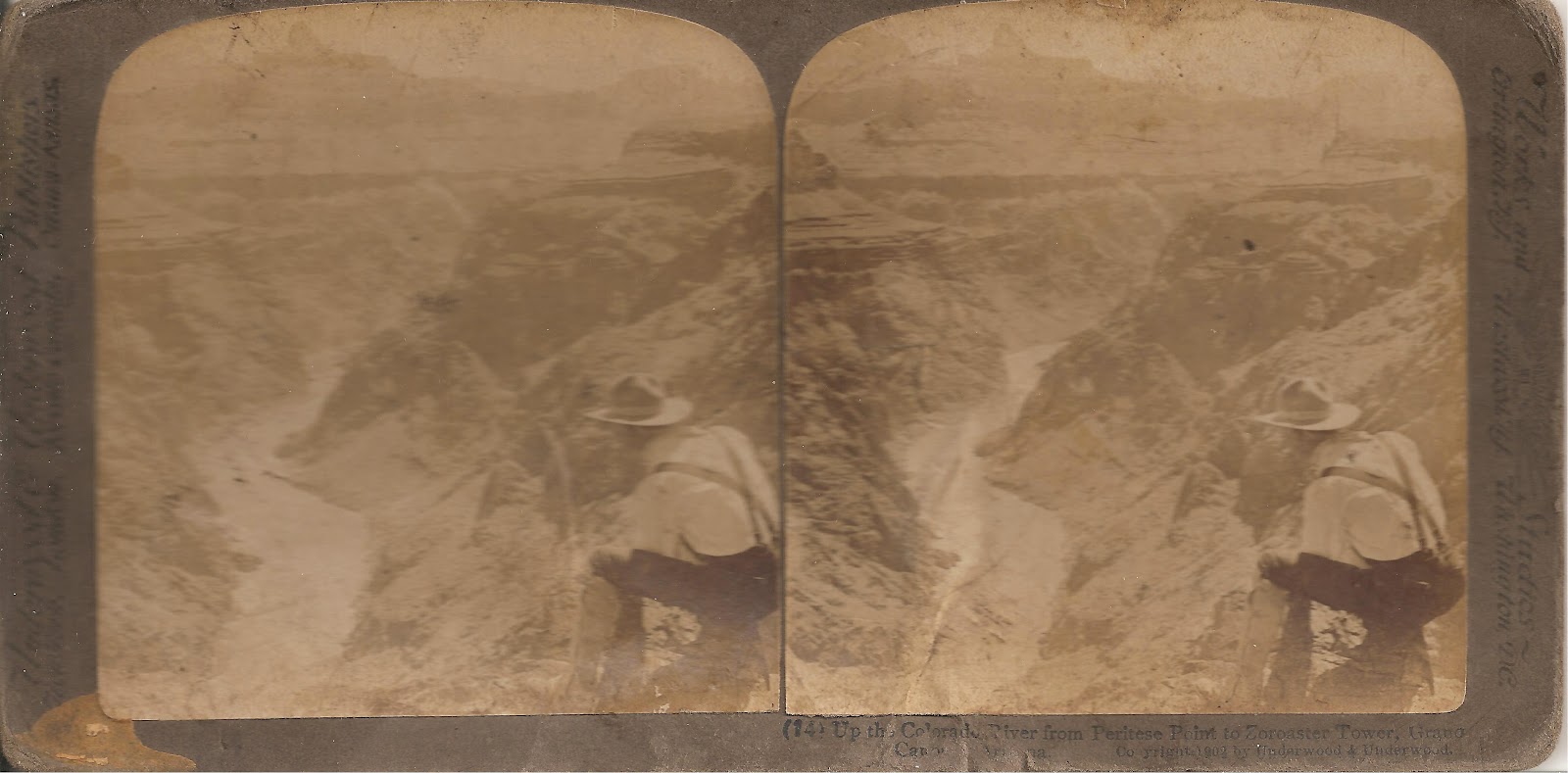
A stereogram [ster-ee-uh-gram] is an optical illusion of depth created from flat, two-dimensional image or images. Originally, the term referred to a pair of stereo images which could be viewed using a stereoscope. Other types of stereograms include anaglyphs and autostereograms. The stereogram was discovered by Victorian scientist, Charles Wheatstone in 1838. He found an explanation of binocular vision which led him to construct a stereoscope based on a combination of prisms and mirrors to allow a person to see 3D images from two 2D pictures. A stereoscope presents 2D images of the same object from slightly different angles to the left eye and the right eye, allowing the brain to reconstruct the original object via binocular disparity.
Oliver Wendell Holmes, Sr. invented an improved form of stereoscope in 1861, which had no mirrors and was inexpensive to produce. These stereoscopes were immensely popular for decades. Salvador Dalí created some impressive stereograms in his exploration in a variety of optical illusions. Stereograms were re-popularized by the creation of autostereograms on computers, wherein a 3D image is hidden in a single 2D image, until the viewer focuses their eyes correctly. The Magic Eye series is a popular example of this. Magic Eye books refer to autostereograms as stereograms, leading most people to believe that the word stereogram is synonymous with autostereogram.
Posted in Art, Technology |
Leave a Comment »
April 7, 2011
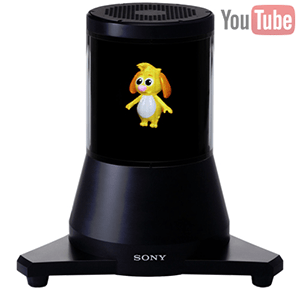
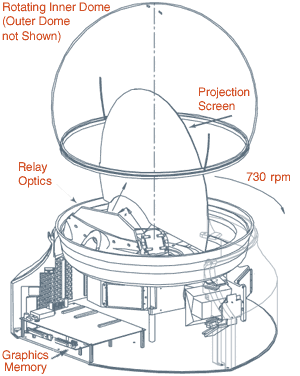
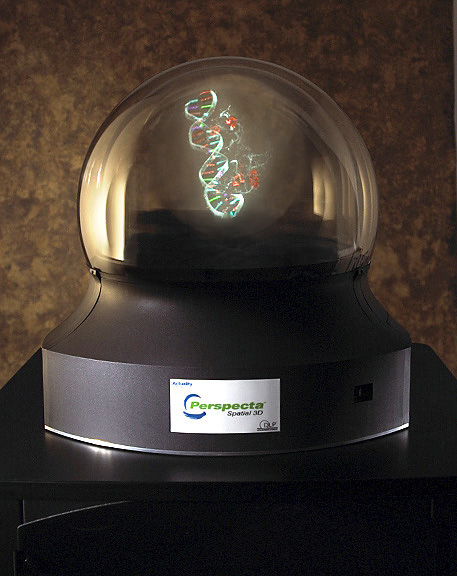
A volumetric [vol-yuh-me-trik] display is a device that forms a visual representation of an object in three physical dimensions, as opposed to the planar image of traditional screens that simulate depth through a number of different visual effects. One definition offered by pioneers in the field is that volumetric displays create 3-D imagery via the emission, scattering, or relaying of illumination from well-defined regions in (x,y,z) space. Though there is no consensus among researchers in the field, it may be reasonable to admit holographic and highly multiview displays to the volumetric display family if they do a reasonable job of projecting a three-dimensional light field within a volume.
Although first postulated in 1912, and a staple of science fiction, volumetric displays are still under development, and have yet to reach the general population. With a variety of systems proposed and in use in small quantities — mostly in academia and various research labs — volumetric displays remain accessible only to academics, corporations, and the military.
Posted in Money, Technology |
Leave a Comment »
April 7, 2011

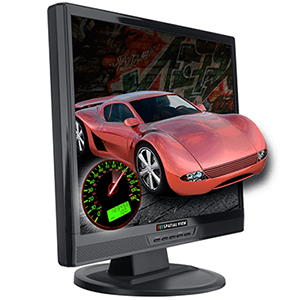
Autostereoscopy [aw-toh-ster-ee-os-kuh-pee] is any method of adding the perception of 3D depth without the use of special glasses on the part of the viewer. Because headgear is not required, it is also called ‘glasses-free 3D.’
The technology also includes two broad approaches used in some of them to accommodate motion parallax (the perceived change in location of an object seen from two different places) and wider viewing angles: those that use eye-tracking, and those that display multiple views so that the display does not need to sense where the viewers’ eyes are located. Examples of autostereoscopic displays include parallax barrier, lenticular, volumetric, electro-holographic, and light field displays.
read more »
Posted in Money, Technology |
Leave a Comment »
April 6, 2011

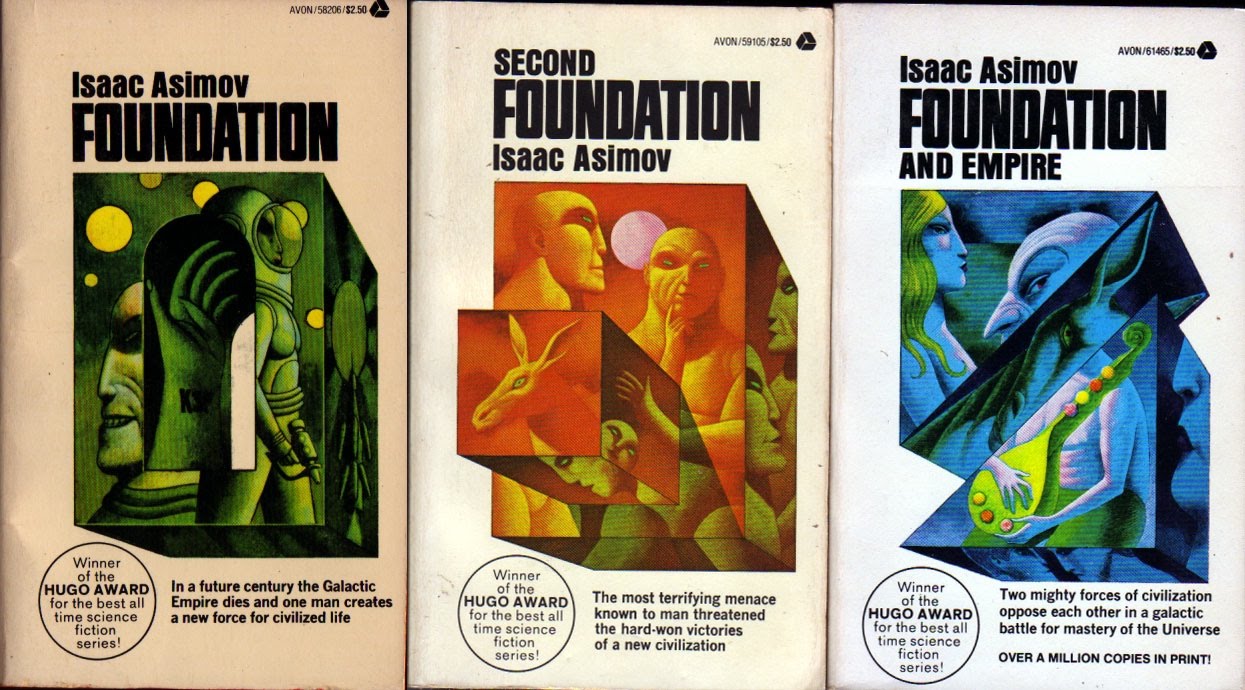
Foundation is the first book in Isaac Asimov’s Foundation Trilogy (and later Foundation Series). Foundation is a collection of five short stories, which were first published together as a book in 1951. It also appeared in 1955 under the title ‘The 1,000-Year Plan.’ The novel tells the story of a group of scientists who seek to preserve knowledge as the civilizations around them begin to regress. The first story is set on Trantor, the capital planet of the 12,000-year-old Galactic Empire. Whilst the empire gives the appearance of stability, beneath this façade it is suffering a slow decay. Hari Seldon, a mathematician, has developed ‘psychohistory,’ which equates all possibilities in large societies to mathematics, allowing predictable long term outcomes.
Seldon discovers a horrifying truth to the Empire’s decay, but his results are considered treasonable. On trial, Seldon shares the discoveries made through psychohistory, such as the collapse of the Empire within 500 years, followed by a 30,000-year period of barbarism. Seldon proposes an alternative to this future; one that would not avert the collapse but shorten the interregnum period to a mere 1000 years. But this plan would require a large group of people to develop a compendium of all human knowledge, titled the Encyclopedia Galactica. A still skeptical commission, not wanting to make a martyr of Seldon, exile him and his group of ‘Encyclopedists’ to a remote planet Terminus. There, they will carry out the Plan under an imperial decree, while Seldon would remain barred from returning to Trantor.
Posted in Art, Language, Technology |
Leave a Comment »
April 5, 2011
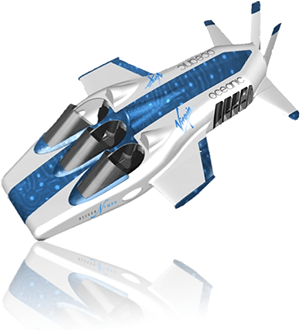
Virgin Oceanic, formerly Virgin Aquatic is a proposed undersea leisure venture of Sir Richard Branson’s Virgin Group. Currently the offering is limited to shallow water craft such as the Deep Flight Merlin (an open cockpit, three person submersible), named ‘Necker Nymph’ after Branson’s private island in the British Virgin Islands. Virgin plans to launch a deep sea version to carry passengers to extreme ocean depths.
Posted in Games, Money, Technology |
Leave a Comment »