March 23, 2011
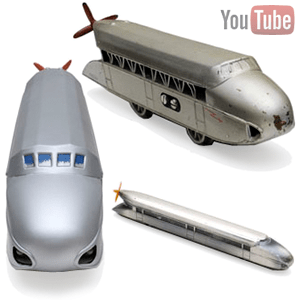
The Schienenzeppelin (‘rail zeppelin’) was an experimental railcar which resembles a zeppelin airship. It was designed and developed by the German aircraft engineer Franz Kruckenberg in 1929. Propulsion was by means of a propeller located at the rear, it accelerated the railcar to 230 km/h (140 mph) setting the land speed record for a petrol powered rail vehicles. Only a single example was ever built, which due to safety concerns remained out of service and was finally dismantled in 1939.
Anticipating the design of the Schienenzeppelin, the earlier Aerowagon, an experimental Russian high-speed railcar, was also equipped with an aircraft engine and a propeller. The chassis of Schienenzeppelin was designed aerodynamically having some resemblance to the era’s popular Zeppelin airships and it was built of aluminum in aircraft style to reduce weight. The interior of the railcar was spartan and designed in Bauhaus-style.
Posted in Technology, World |
Leave a Comment »
March 22, 2011


Kenneth Robert Howard (1929 – 1992), also known as Von Dutch, was a motorcycle mechanic, artist, pinstriper, metal fabricator, knifemaker and gunsmith. His father, Wally Howard, was a Los Angeles sign painter, and by the age of ten Kenny was able to paint and letter at a professional level. Some of his famous works include the flying eyeball and a custom Kenford truck.
Among many custom car and motorcycle enthusiasts, he is thought of as one of the fathers of Kustom Kulture (an aesthetic born out of the hot rod culture of Southern California of the 1960s). Dutch’s lifelong alcoholism led to major medical issues later in life, and he died from alcohol related complications. His daughters sold the ‘Von Dutch’ name to Michael Cassel and Robert Vaughn, who used it to form a clothing brand.
Posted in Art, Money, Technology |
Leave a Comment »
March 22, 2011

Kustom Kulture is an an aesthetic and lifestyle born out of the hot rod culture of Southern California of the 1960s, associated with artists such as Kenny Howard (also known as Von Dutch), custom car builders such as ‘Big Daddy’ Ed Roth and Dean Jeffries, hot rod and lowrider customizers such as the Barris Brothers, along with numerous tattoo artists, automobile painters, and movies and television shows such as ‘American Graffiti,’ ‘Happy Days,’ ‘The Munsters’ and ‘The Monkees.’
Kustom Kulture is usually identified with the greasers of the 1950s, the drag racers of the 1960s, and the lowriders of the 1970s. Other subcultures that have had an influence on Kustom Kulture are the Skinheads, mods and rockers of the 1960s, the punks of the 1970s, metal and rockabilly music, the scooterboys of the 1980s, and psychobilly of the 1990s. Each has its own style, but common themes include wild pinstriped paintjobs, choptop Mercurys, custom Harley-Davidson and Triumph Motorcycles, metalflake and black primer paint jobs, and monster movies.
Posted in Art, Politics, Technology |
1 Comment »
March 22, 2011
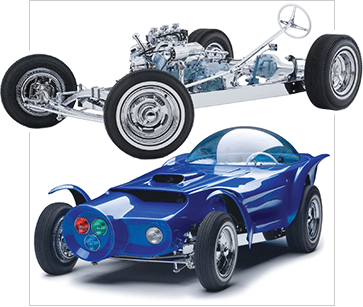
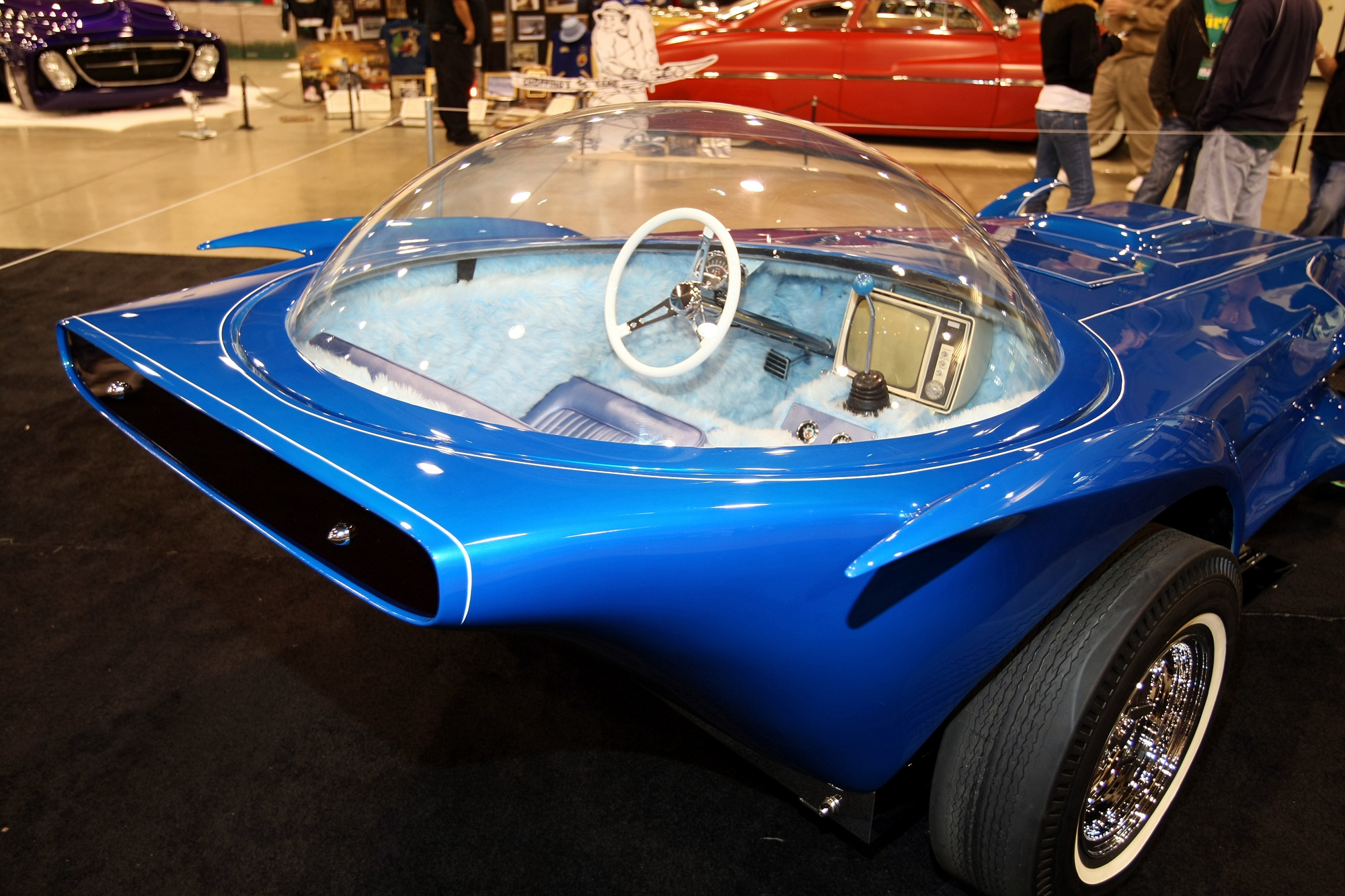
The Orbitron is a custom car built by Ed Roth and feared lost until its rediscovery in Mexico in 2007. Built in 1964, the vehicle was powered by a 1955 or 1956 Chevrolet V8 and was backed by a Powerglide automatic transmission. The body was hand-laid fiberglass which actually hid Roth’s extensive chrome work to the chassis.
The cockpit, set at the extreme rear of the vehicle in the manner of a dragster, was lined with fake fur and featured a General Electric portable television inserted in the console. Topping the cockpit was a custom-made, hydraulically operated plexiglass bubble top. One of a series of ordinary doorbell switches atop the hood activated the top from the outside.
read more »
Posted in Art, Money, Technology |
Leave a Comment »
March 21, 2011

Multivac is the name of a fictional supercomputer in many stories by Isaac Asimov. Like most of the technologies Asimov describes in his fiction, Multivac’s exact specifications vary among appearances. In all cases, it is a government-run computer that answers questions, usually buried deep underground for security purposes. However, Asimov never settles on a particular size for the computer except for mentioning it is very large.
Unlike the artificial intelligences portrayed in his ‘Robot’ Series, Multivac’s interface is mechanized and impersonal, consisting of complex command consoles few humans can operate. Though the technology depended on bulky vacuum tubes, the concept – that all information could be contained on computer(s) and accessed from a domestic terminal – constitutes an early reference to the possibility of the Internet.
Posted in Art, Language, Technology |
1 Comment »
March 21, 2011

‘The Last Question‘ is a science fiction short story by Isaac Asimov. It first appeared in the November 1956 issue of Science Fiction Quarterly. It was Asimov’s favorite short story of his own authorship, and is one of a loosely connected series of stories concerning a fictional computer called Multivac. In conceiving Multivac, Asimov was extrapolating the trend towards centralization that characterised computation technology planning in the 1950s to an ultimate centrally managed global computer.
The story deals with the development of computers called Multivacs and their relationships with humanity through the courses of seven historic settings, beginning in 2061. In each of the first six scenes a different character presents the computer with the same question; namely, how the threat to human existence posed by the heat death of the universe can be averted.
Posted in Art, Technology |
Leave a Comment »
March 21, 2011

Virgin Galactic is a company within Richard Branson’s Virgin Group which plans to provide sub-orbital spaceflights to the paying public, along with suborbital space science missions and orbital launches of small satellites. Further in the future Virgin Galactic hopes to offer orbital human spaceflights as well. Tickets are priced at $200,000 per person with a $20,000 deposit. The vehicle is a six passenger, two pilot craft. Test launches are planned to take place from the Mojave Spaceport, where Scaled Composites is constructing the spacecraft.
The spacecraft, SpaceShipTwo, will be carried to about 16 kilometers or 52000 ft by a carrier aircraft, White Knight II. At that point, when the carrier aircraft reaches its maximum height, the SpaceShipTwo vehicle will separate and continue to over 100 km (the Kármán line, a common definition of where ‘space’ begins). The time from liftoff of the White Knight booster carrying SpaceShipTwo until the touchdown of SpaceShipTwo after the sub-orbital flight will be about 3.5 hours. The sub-orbital flight itself will only be a small fraction of that time. The weightlessness will last approximately 6 minutes.
Posted in Money, Technology |
Leave a Comment »
March 21, 2011

The 2suit is a garment designed to facilitate intimacy in weightless environments such as outer space, or on planets with low gravity. It was invented by American novelist, actress Vanna Bonta in 2006 after an experience in microgravity in 2004 when she flew with the National Space Society.
The garment is made of two components flight suits designed to be worn alone or attached to another 2S model for the purpose of intimacy or sex in space. The 2suit is equipped to fasten to a stable surface. The roominess within the garment is adjustable from within. It also is lined with inner harnesses for optional use that can regulate the garment to adjust proximity of various points of the bodies to one another.
Posted in Sex, Technology |
Leave a Comment »
March 21, 2011

Vernor Vinge (b. 1944) is a computer scientist and science fiction author. He is best known for his Hugo Award-winning novels and novellas A Fire Upon the Deep (1992), as well as his 1993 essay ‘The Coming Technological Singularity,’ in which he argues that the creation of superhuman artificial intelligence will mark the point at which ‘the human era will be ended,’ such that no current models of reality are sufficient to predict beyond it.
Vinge came to prominence in 1981 with his novella ‘True Names,’ perhaps the first story to present a fully fleshed-out concept of cyberspace, which would later be central to cyberpunk stories by William Gibson, Neal Stephenson and others.
read more »
Posted in Art, Technology |
Leave a Comment »
March 19, 2011
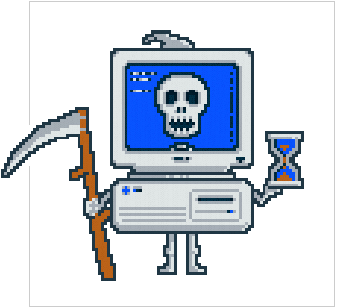
In many computer operating systems a special type of error message will display onscreen when the system has experienced a fatal error. Computer users have dubbed these messages screens of death as they typically result in unsaved work being lost and often indicate serious problems with the system’s hardware or software.
Screens of death are usually the result of a ‘kernel panic’ (an action taken by an operating system upon detecting an internal fatal error from which it cannot safely recover), although the terms are frequently used interchangeably. Most screens of death are displayed on an even background color with a message advising the user to restart the computer.
Posted in Death, Humor, Technology |
Leave a Comment »
March 19, 2011

A kill screen is a stage or level in a video game (often an arcade game) that stops the player’s progress due to a programming error or design oversight. Rather than ‘ending’ in a traditional sense, the game will crash, freeze, or behave so erratically that further play is impossible. Pac-Man has a famous kill screen often referred to as the ‘Pac-Man Bomb Screen.’ The game’s level counter was a single 8-bit byte and could therefore store only 256 distinct values. Reaching the 256th level causes the counter that is used while drawing the fruit to overflow to zero, causing 256 fruits and seven blank spaces to be drawn.
Kill screens were much more common during the Golden Age of Arcade Games. Games from this era were often written with the assumption that the player would stop playing long before the numerical limits of the game code were reached; most games from this period were intended to continue until the players lost all of their lives. Additionally, the limited hardware of these early machines often meant that programmers could not spend memory on logical checks of the game state.
Posted in Games, Language, Technology |
Leave a Comment »
March 19, 2011

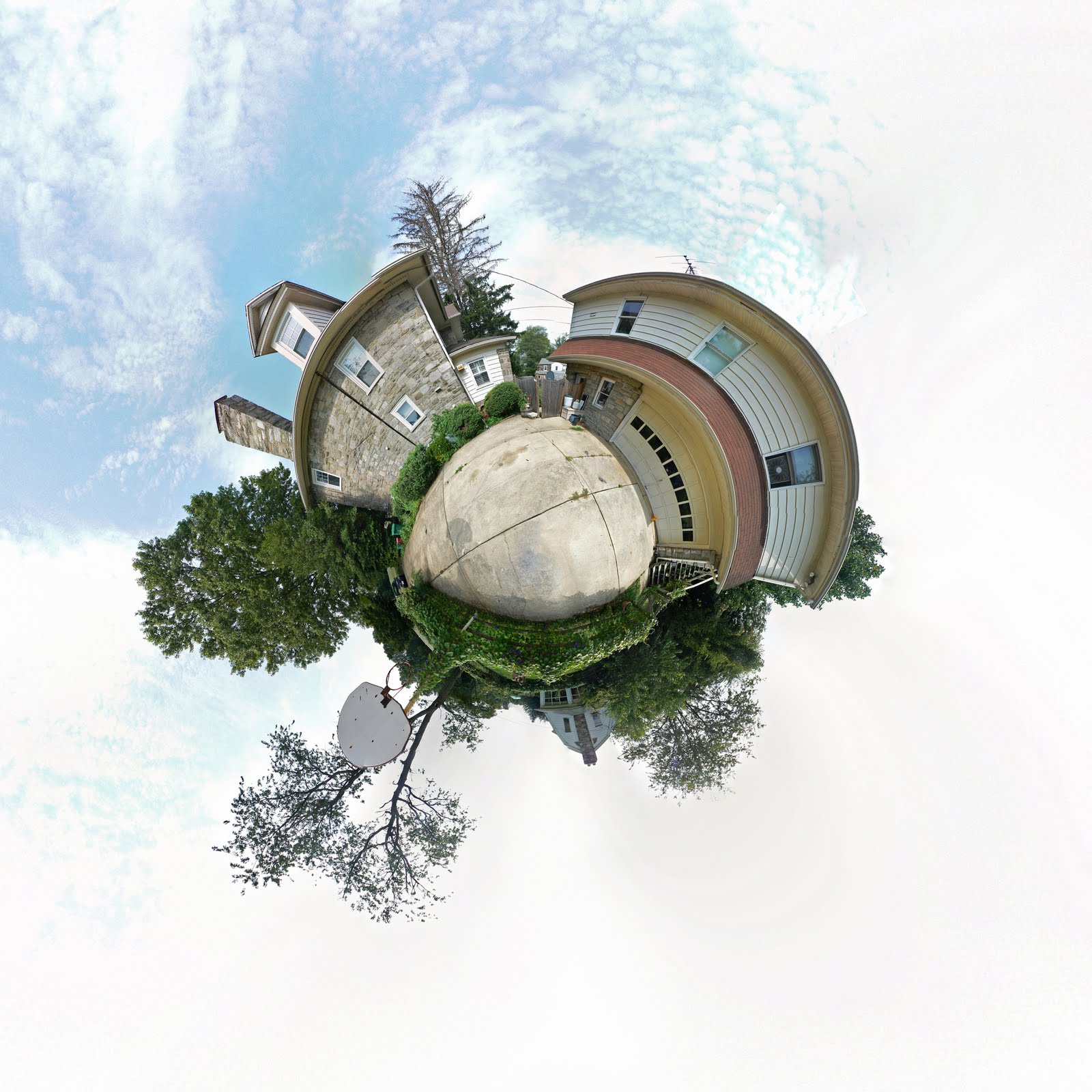
The stereographic projection, in geometry, is a particular mapping that projects a sphere onto a plane. The projection is defined on the entire sphere, except at one point — the projection point. Intuitively, then, the stereographic projection is a way of picturing the sphere as the plane, with some inevitable compromises. Because the sphere and the plane appear in many areas of mathematics and its applications, so does the stereographic projection; it finds use in diverse fields including complex analysis, cartography, geology, and photography.
The projection has been used to map spherical panoramas. This results in interesting effects: the area close to the point opposite to the center of projection becomes significantly enlarged, resulting in an effect known as little planet (when the center of projection is the nadir) and tube (when the center of projection is the zenith).
Posted in Art, Technology |
Leave a Comment »