April 3, 2012

In linguistics, an idiolect [id-ee-uh-lekt] is a variety of a language unique to one individual person. It is manifested by patterns of vocabulary or idiom selection (the individual’s lexicon), grammar, or pronunciations that are unique to the individual. Every individual’s language production is in some sense unique.
Linguists disagree about exactly what is shared, in terms of the underlying knowledge of the language, among speakers of the same language or dialect. According to this view, a language is an ‘ensemble of idiolects… rather than an entity per se.’ Continue reading →
Posted in Language |
Leave a Comment »
April 3, 2012

Estuary English is a dialect of English widely spoken in South East England, especially along the River Thames and its estuary. Phonetician John C. Wells defines Estuary English as ‘Standard English spoken with the accent of the southeast of England.’
Some people adopt the accent as a means of ‘blending in,’ appearing to be more working class, or in an attempt to appear to be ‘a common man’ – sometimes this affectation of the accent is derisively referred to as ‘Mockney.’ A move away from traditional Received Pronunciation accents is almost universal among middle class young people. Continue reading →
Posted in Language, Money, World |
1 Comment »
April 3, 2012

Mockney (a portmanteau of ‘mock’ and ‘Cockney’) is an affected accent and form of speech in imitation of Cockney or working class London speech, or a person with such an accent. A stereotypical Mockney comes from a middle or upper-middle class background in England’s Home Counties (the counties encircling London).
Mockney is distinct from Estuary English by being the deliberate affectation of the working-class London (Cockney) accent. A person speaking with a Mockney accent might adopt Cockney pronunciation but retain standard grammatical forms where the Cockney would use non-standard forms (e.g. negative concord / double negative). The first published use of the word according to the Oxford English Dictionary was in 1989. Continue reading →
Posted in Language, Money, Politics |
Leave a Comment »
April 3, 2012
U and non-U English usage, with U standing for upper class, and non-U representing the aspiring middle classes, were part of the terminology of popular discourse of social dialects (sociolects) in 1950s Britain and New England. The debate did not concern itself with the speech of the working classes, which in many instances used the same words as the upper class.
For this reason, the vocabulary list can often appear quite counter-intuitive: the middle class prefers ‘fancy’ or fashionable words (even neologisms), often euphemisms, in an attempt to make themselves sound more refined, while the upper class in many cases sticks to the same plain and traditional words that the working classes also use, as they have no need to make themselves sound more refined, conscious of their status.
Continue reading →
Posted in Language, Money, Politics |
Leave a Comment »
April 3, 2012


The Deep Web (also called the Invisible Net, the Deep Web, Undernet, or the hidden Web) refers to World Wide Web content that is not part of the Surface Web, which is indexable by standard search engines. It should not be confused with the ‘dark Internet,’ the computers that can no longer be reached via Internet, or with the distributed filesharing network ‘Darknet,’ which could be classified as a smaller part of the Deep Web.
Mike Bergman, founder of ‘BrightPlanet,’ credited with coining the phrase, has said that searching on the Internet today can be compared to dragging a net across the surface of the ocean: a great deal may be caught in the net, but there is a wealth of information that is deep and therefore missed. Most of the Web’s information is buried far down on dynamically generated sites, and standard search engines do not find it. Traditional search engines cannot ‘see’ or retrieve content in the deep Web—those pages do not exist until they are created dynamically as the result of a specific search. The deep Web is several orders of magnitude larger than the surface Web. Continue reading →
Posted in Money, Technology, World |
1 Comment »
April 3, 2012


Simian Mobile Disco are an electronic music duo and production team from London, formed in 2005 by James Ford and Jas Shaw. Musically, they are known for their analog production. In addition to his work with Simian Mobile Disco, Ford is a producer and has worked with artists such as Florence and the Machine, Peaches, Arctic Monkeys, and Klaxons. Simian Mobile Disco originally formed as a DJ duo, on the side of their early four-piece band Simian. They released a number of early tastemaker singles, such as ‘The Mighty Atom / Boatrace / Upside Down’ on I’m a Cliché and ‘The Count’ on Kitsuné, but gained more fame for their remixes of artists such as Muse, Klaxons, The Go! Team, Air, and others.
In 2006, Kitsuné released the duo’s underground hit ‘Hustler,’ which features guest vocals from New York singer Char Johnson. The band’s debut album, ‘Attack Decay Sustain Release’ was released in 2007 on Wichita Recordings. The lead single, ‘It’s the Beat,’ features Ninja from UK indie band The Go! Team on vocals. Their sophomore studio album, ‘Temporary Pleasure’ was released in 2009, and featured many guests including Gruff Rhys of Super Furry Animals, Alexis Taylor of Hot Chip, Beth Ditto of Gossip, and Chris Keating of Yeasayer.
Posted in Art, Technology |
Leave a Comment »
April 2, 2012

UV tattoos are tattoos made with a special ink that is visible under an ultraviolet light (blacklight). Depending upon the ink, they can be nearly invisible in non-UV environments, thus they are a popular consideration for people seeking a subtler tattoo. They are particularly popular in the raver subculture. Although the tattoos are sometimes considered invisible in normal light, scarring from the tattoo machine in the application process may remain, and therefore still show.
A UV tattoo becomes visible under blacklight, when it glows in colors ranging from white to purple, depending on the ink chosen. Colored ink is also available, where the ink is visible in normal light (as with a regular tattoo) but the ink will glow vividly under UV light. However, some UV inks are not as bright under normal light as normal tattoo ink and are considered not as vibrant.
Posted in Art, Health, Technology |
Leave a Comment »
April 2, 2012
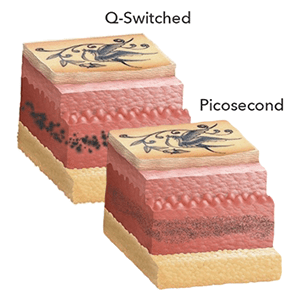
InfinitInk is a tattoo ink, which allows for easier tattoo removal, with removal up to three times faster than conventional inks. It is produced by Freedom2, Inc., and is available as of 2009 in limited release in the United States. It is currently only available in black and red, with other colors planned. The initial ink formulation consisted of inert plastic beads, containing bioremovable dyes. Laser application ruptures the beads, allowing the ink to leak out and be removed by the body.
The concept for this ink arose initially from potential medical uses, such as in reconstructive surgery and in radiation oncology. However, it was clear that a permanent and safe, yet more removable ink would also find use by some artists for decorative tattooing.
Posted in Money, Technology |
Leave a Comment »
April 2, 2012
Seven generation sustainability is an ecological concept that urges the current generation of humans to live sustainably and work for the benefit of the seventh generation into the future.
It originated with the Iroquois – Great Law of the Iroquois – which holds appropriate to think seven generations ahead (a couple hundred years into the future) and decide whether the decisions they make today would benefit their children seven generations into the future. ‘In every deliberation, we must consider the impact on the seventh generation… even if it requires having skin as thick as the bark of a pine.’
Posted in Money, Politics, World |
Leave a Comment »
April 2, 2012
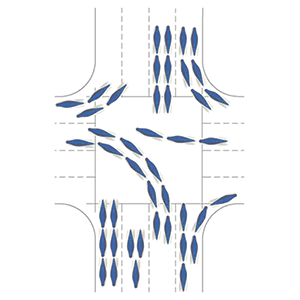
Grouping vehicles into platoons is a method of increasing the capacity of roads. An automated highway system is a proposed technology for doing this. Platoons decrease the distances between cars using electronic, and possibly mechanical, coupling. This capability would allow many cars to accelerate or brake simultaneously. Instead of waiting after a traffic light changes to green for drivers ahead to react, a synchronized platoon would move as one, allowing up to a fivefold increase in traffic throughput.
This system also allows for a closer headway between vehicles by eliminating reacting distance needed for human reaction. Platoon capability might require buying new cars, or it may be something that can be retrofitted. Drivers would probably need a special license endorsement on account of the new skills required and the added responsibility when driving in the lead. Smart cars with artificial intelligence could automatically join and leave platoons. In the automated highway system proposal, cars organize themselves into platoons of eight to twenty-five.
Posted in Technology |
Leave a Comment »
April 2, 2012


A concept vehicle or show vehicle is a car made to showcase new styling and or new technology. They are often shown at motor shows to gauge customer reaction to new and radical designs which may or may not have a chance of being produced. General Motors designer Harley Earl is generally credited with inventing the concept car, and did much to popularize it through its traveling Motorama shows of the 1950s.
Concept cars never go into production directly; in modern times all would have to undergo many changes before the design is finalized for the sake of practicality, safety and cost. A ‘production-intent’ vehicle, as opposed to a concept vehicle, serves this purpose. Continue reading →
Posted in Money, Technology |
Leave a Comment »
April 2, 2012

The Nissan NV200 is a light commercial vehicle first shown as a concept car at the 2007 Tokyo Motor Show. Though it is an alternative to the Nissan Vanette, it is only available as a van model. ‘NV’ stands for New generation Vehicle, or sometimes ‘New Vanette’ by fans.
It was launched in Japan in 2009. The NV200 was one of three finalists (alongside the Karsan V-1 and Ford Transit Connect) for New York City’s Taxi of Tomorrow competition. The Nissan was announced as the winner in 2011 and is expected to be awarded a 10-year contract to provide the city exclusively with some 13,000 yellow cabs, starting in 2013. A fully electric version of the Nissan NV200 may be available by 2017 for the NYC Taxi fleet.
Posted in Money, Technology |
1 Comment »



