February 19, 2012
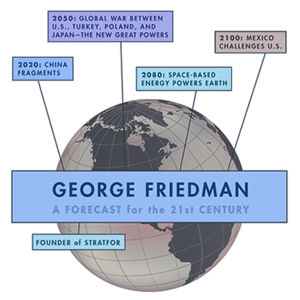
The Next 100 Years is a 2009 non-fiction book by American political scientist George Friedman. In the book, Friedman attempts to predict the major geopolitical events and trends of the 21st century. Friedman also speculates in the book on changes in technology and culture that may take place during this period. Friedman predicts a second American cold war with Russia in the 2010s. Friedman asserts that around 2015, the United States will become a close ally to some Eastern European countries, who will be dedicated to resisting Russian geopolitical threats during this period.
Friedman speculates in the book that the United States will probably become a close ally of Poland, the Czech Republic, Hungary, and Romania, who may form a military alliance during this period. According to Friedman’s prediction, around the year 2020, Russia will collapse, fragment, and disintegrate from the economic and political pressure of a second cold war. Continue reading →
Posted in Language, Politics, War |
Leave a Comment »
February 18, 2012

The Limits to Growth is a 1972 book modeling the consequences of a rapidly growing world population and finite resource supplies, commissioned by the Club of Rome (a global think tank) and firstly presented at the 3. St. Gallen Symposium (an annual conference taking place at the University of St. Gallen in Switzerland, aimed at fostering intergenerational and intercultural dialogue between the decision makers of today and tomorrow). The book echoes some of the concerns and predictions of the Reverend Thomas Robert Malthus in ‘An Essay on the Principle of Population’ (1798).
Its authors were Donella H. Meadows, Dennis L. Meadows, Jørgen Randers, and William W. Behrens III. The book used World3, a computer model to simulate the consequence of interactions between the Earth’s and human systems. Five variables were examined in the original model, on the assumptions that exponential growth accurately described their patterns of increase, and that the ability of technology to increase the availability of resources grows only linearly. These variables are: world population, industrialization, pollution, food production and resource depletion. Continue reading →
Posted in Politics, Technology, World |
Leave a Comment »
February 18, 2012

‘In the Year 2525 (Exordium and Terminus)’ is a hit song from 1969 by American pop-rock duo Zager and Evans. It opens with the words ‘In the year 2525, If man is still alive, If woman can survive, They may find…’ Subsequent verses pick up the story at 1,010-year intervals from 2525 to 6565. Disturbing predictions are given for each selected year. In the year 3535, for example, all of a person’s actions, words and thoughts will be preprogrammed into a daily pill. Then the pattern as well as the music changes, going up a half step in the key of the song, after two stanzas, first from A flat minor, to A minor, and, then, finally, to B flat minor, and verses for the years 7510, 8510 and 9595 follow.
The overriding theme, of a world doomed by its passive acquiescence to and overdependence on its own overdone technologies, struck a resonant chord in millions of people around the world in the late 1960s. The song describes a nightmarish vision of the future as man’s technological inventions gradually dehumanize him. It includes a colloquial reference to the Second Coming (In the year 7510, if God’s a-coming, He ought to make it by then.), which echoed the zeitgeist of the Jesus Movement.
Posted in Art, Politics, Technology |
1 Comment »
February 18, 2012


The Race of the Future theory states that due to the process of miscegenation, the mixing of different races, especially in marriage, cohabitation, or sexual relations, all the races are blending to become one single new race in the future. Count Richard Nikolaus von Coudenhove-Kalergi distinctly advocated race mixing in his 1925 book ‘Practical Idealism’: ‘The man of the future will be of mixed race. Today’s races and classes will gradually disappear owing to the vanishing of space, time, and prejudice. The Eurasian-Negroid race of the future, similar in its appearance to the Ancient Egyptians, will replace the diversity of peoples with a diversity of individuals.’
The same scenario had been envisaged, with rather less enthusiasm, by Madison Grant in his 1916 book ‘The Passing of the Great Race,’ calling for an eugenics program to prevent this development, and in a similar ideological context in Lothrop Stoddard’s ‘The Rising Tide of Color Against White World-Supremacy’ in 1920. In the United States, the proportion of Multiracial American children is growing. Interracial partnerships are rising, as are transracial adoptions.
Posted in Politics, Sex, World |
Leave a Comment »
February 18, 2012

The melting pot is a metaphor for a heterogeneous society becoming more homogeneous, the different elements ‘melting together’ into a harmonious whole with a common culture. It is particularly used to describe the assimilation of immigrants to the United States; the melting-together metaphor was in use by the 1780s.
After 1970 the desirability of assimilation and the melting pot model was challenged by proponents of multiculturalism, who assert that cultural differences within society are valuable and should be preserved, proposing the alternative metaphor of the mosaic or salad bowl – different cultures mix, but remain distinct.
Continue reading →
Posted in Language, Politics, World |
Leave a Comment »
February 18, 2012

Feral pigeons are derived from domestic pigeons that have returned to the wild. The domestic pigeon was originally bred from the wild Rock dove, which naturally inhabits sea-cliffs and mountains. Feral pigeons find the ledges of buildings to be a substitute for sea cliffs, and have become adapted to urban life and are abundant in towns and cities throughout much of the world.
All pigeons are one species (columba livia). Pigeons breed when the food supply is good, which in cities can be any time of the year. Laying of eggs can take place up to six times per year. Pigeons mate for life, and are often found in pairs during the breeding season, but usually the pigeons are gregarious preferring to exist in flocks of from 50 to 500 birds.
Continue reading →
Posted in Politics, Science, World |
Leave a Comment »
February 17, 2012

A solar roadway is a road surface, that generates electricity by solar photovoltaics. One current proposal is for panels including solar panels and LED signage, that can be driven on. Parking lots, driveways, and eventually highways are all targets for the panels. If the entire United States Interstate Highway system were surfaced with Solar Roadways panels, it would produce more than three times the amount of electricity currently used nationwide.
The United States Department of Transportation awarded Solar Roadways Incorporated a $100,000 research contract in 2009. This Small Business Innovation Research (SBIR) contract enabled Solar Roadways to prototype Solar Road Panels. After successful completion of the Phase I SBIR contract, it was awarded it a follow-up $750,000 Phase II contract to take it to the next step: a solar parking lot. Constructed out of multiple 12′ x 12′ panels, this smart parking lot will also warm itself in cold weather to melt away snow and ice. Continue reading →
Posted in Money, Politics, Technology |
1 Comment »
February 17, 2012

VitaliV (or ‘Vitali V,’ real name Vitali Vinogradov) is a Soviet-born painter and sculptor now living in the United Kingdom, who has developed an artistic style based on the designs of computer microchips. Some works have been laser-cut in relief and then hand-painted as 3D objects.
His style, ‘Via Art,’ was created in the late 90’s while attempting to imprint an unusual, digital circuit-like pattern upon jewelry. In appreciation of the simplicity and logic of digital circuits, the artist decided to use the pattern as the structural basis for a new style. The following decade led to the creation of over 1000 designs including jewelry, furniture sketches, fashion collections, and hundreds of porcelain wares. The essence of the Via Art style are simple geometrical patterns—circles and lines connected at 45° angles.
Posted in Art, Technology |
2 Comments »
February 17, 2012

Wes Anderson (b. 1969) is an American director and screenwriter. Anderson has been called an auteur, as he is involved in every aspect of his films’ production. His films employ similar aesthetics, using a deliberate, methodical cinematography, with mostly primary colors. His soundtracks feature folk and early rock music, in particular classic British rock. Anderson’s films combine dry humor with poignant portrayals of flawed characters – often a mix of the wealthy and the working class. He is also known for working with many of the same actors and crew on varying projects, particularly Owen Wilson (who co-wrote three of Anderson’s feature films), Bill Murray, and Jason Schwartzman. Other frequent collaborators include writer Noah Baumbach, who co-wrote ‘The Life Aquatic with Steve Zissou’ and ‘Fantastic Mr. Fox,’ with Anderson co-producing his film ‘The Squid and the Whale.’
Anderson went to India to film his 2007 film ‘The Darjeeling Limited’ partly as a tribute to the legendary Indian filmmaker Satyajit Ray, whose ‘films have also inspired all my other movies in different ways’ (the film is dedicated to him). Jason Schwartzman reunited with Anderson for it, acting as well as co-writing the script with Anderson and Roman Coppola. In 2006, following the disappointing commercial and critical reception of ‘The Life Aquatic with Steve Zissou,’ Steely Dan’s Walter Becker and Donald Fagen released a tongue-in-cheek ‘letter of intervention’ of Anderson’s artistic ‘malaise.’ Proclaiming themselves to be fans of ‘World Cinema’ and Anderson in particular, they offered Anderson their soundtrack services for his ‘The Darjeeling Limited,’ including lyrics for a title track.
Posted in Art |
1 Comment »
February 17, 2012

The Ganzfeld effect (German: ‘complete field’) is a phenomenon of visual perception caused by staring at an undifferentiated and uniform field of color. The effect is described as the loss of vision as the brain cuts off the unchanging signal from the eyes. The result is ‘seeing black’ – apparent blindness. In the 1930s, research by psychologist Wolfgang Metzger established that when subjects gazed into a featureless field of vision they consistently hallucinated and their electroencephalograms changed. The Ganzfeld effect is the result of the brain amplifying neural noise in order to look for the missing visual signals. The noise is interpreted in the higher visual cortex, and gives rise to hallucinations. This is similar to dream production because of the brain’s state of sensory deprivation during sleep.
The Ganzfeld effect has been reported since ancient times. The adepts of Pythagoras retreated to pitch black caves to receive wisdom through their visions, known as the prisoner’s cinema. Miners trapped by accidents in mines frequently reported hallucinations, visions and seeing ghosts when they were in the pitch dark for days. Arctic explorers seeing nothing but featureless landscape of white snow for a long time also reported hallucinations and an altered state of mind.
Posted in Health, Philosophy, Science |
Leave a Comment »
February 16, 2012

The three individuals most closely associated with the birth of Detroit techno as a genre are Juan Atkins, Kevin Saunderson and Derrick May, also known as ‘The Belleville Three.’ High school friends from Belleville, Michigan, the trio created electronic music tracks in their basement(s). Eventually, they were in demand at local dance clubs, thanks in part to seminal Detroit radio personality ‘The Electrifying Mojo.’
Ironically, Derrick May once described Detroit techno music as being a ‘complete mistake…like George Clinton and Kraftwerk caught in an elevator, with only a sequencer to keep them company.’ The location of Belleville was key to the formation of the three as musicians. Because the town was still ‘pretty racial at the time,’ according to Saunderson, ‘we three kind of gelled right away.’ Continue reading →
Posted in Art, Technology |
1 Comment »
February 16, 2012

Emil Schult (b. 1946) is a German painter, poet and musician. He is most famous for his collaborations with the electronic music band Kraftwerk. He has created most of their sleeve designs since 1973. He also co-wrote the lyrics of some famous Kraftwerk songs.
For a short while around 1973, Schult also played guitar in the group; this was to be short-lived, since Schult by his own admission is not quite good enough to be a professional musician, and since the group had started to develop its synth-based sound it no longer had any use for a guitarist.
Posted in Art |
Leave a Comment »




