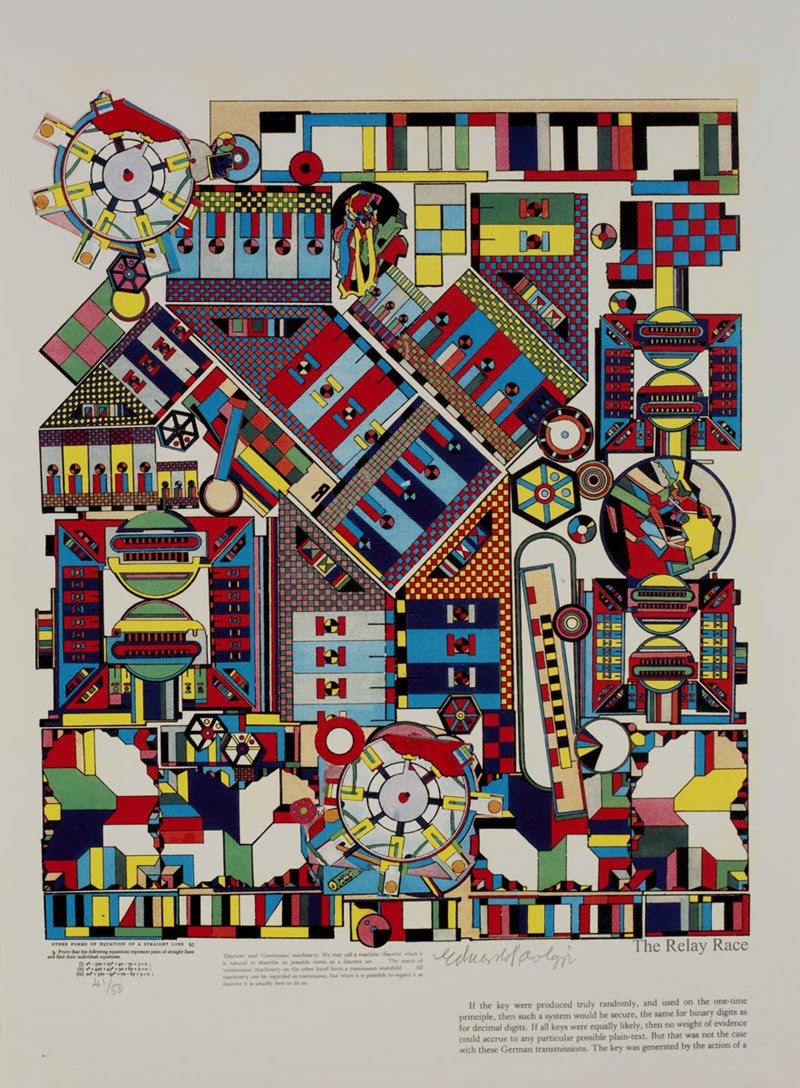
February 5, 2012

Parachuting Rat is an artwork in Melbourne, Australia created by Banksy in 2003. In 2010 it was painted over by council contractors, leading to local and international coverage and debate on the nature of street art and its preservation, and new measures for its protection. Parachuting Rat is a purple rat with aviator glasses descending by parachute. Banksy’s oeuvre is largely directed towards anti-capitalist and anti-war themes.
Banksy’s work is described as distinctive in style, satirical, and provocative. Banksy himself has written, in connection with his works involving rats, ‘they exist without permission. They are hated, hunted and persecuted … if you are dirty, insignificant and unloved then rats are the ultimate role model’; that ‘you can win the rat race but you’re still a rat’; and also that he had been painting rats for three years before someone told him that the word is an anagram of art.
Continue reading →
Posted in Art, Money, Politics |
3 Comments »
February 5, 2012
King Robbo is an English underground graffiti artist who became more widely known following a graffiti war with Banksy. Robbo painted his first train in 1985 and the ‘Merry Christmas’ train of 1988, a joint piece created with ‘Drax WD,’ received coverage in the British media.
His feud with Banksy burnished Robbo’s profile and he entered the commercial art world with a number of gallery shows and commissions in 2010. In 1985 King Robbo painted a large full color graffiti piece called ‘Robbo Incorporated’ on a wall beside Regent’s Canal in London which was only accessible by water. Over the years it became degraded with a few small pieces of graffiti over the top.
Continue reading →
Posted in Art, Money |
Leave a Comment »
February 4, 2012
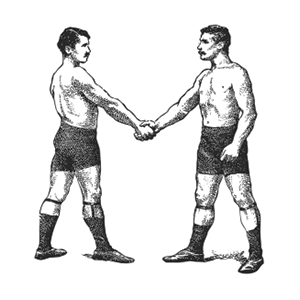
A gentlemen’s agreement is an informal agreement between two or more parties. It is typically oral, though may be written, or simply understood as part of an unspoken agreement by convention or through mutually beneficial etiquette.
The essence of a gentlemen’s agreement is that it relies upon the honor of the parties for its fulfillment, rather than being in any way enforceable. It is, therefore, distinct from a legal agreement or contract, which can be enforced if necessary. A variation on the gentlemen’s agreement is the gentlemen’s bet, wherein there is nothing to win or lose through the bet, other than the honor of winning and shame of losing.
Continue reading →
Posted in Language, Money, Politics |
Leave a Comment »
February 4, 2012
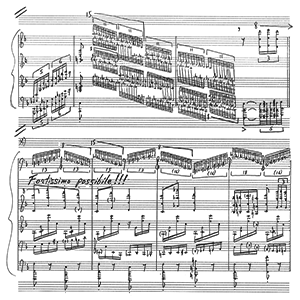
Circus Galop is a piece for player piano written by Marc-André Hamelin. It was composed between 1991 and 1994 and it is dedicated to Beatrix and Jürgen Hocker, piano roll makers. Its duration is approximately 4–5 minutes. Scores of this piece are available through the Sorabji Archive. Piano rolls of this piece are available from Wolfgang Heisig and Jürgen Hocker, who have recorded all three of Hamelin’s player piano pieces on the MDG label, which were released in 2008.
It is impossible for a single human to play, as at some points all the piano staves are played at the same time, and up to 21 notes simultaneously. It is used to test MIDI software to drive it to its maximum potential, such as Synthesia, or PianoMIDI.
Posted in Art, Technology |
Leave a Comment »
February 4, 2012

Zugzwang [tsook-tsvahng] (German: ‘compulsion to move’) is a term usually used in chess which also applies to various other games. The term finds its formal definition in combinatorial game theory, and it describes a situation where one player is put at a disadvantage because he has to make a move when he would prefer to pass and make no move. The fact that the player must make a move means that his position will be significantly weaker than the hypothetical one in which it was his opponent’s turn to move.
In game theory, it specifically means that it directly changes the outcome of the game from a win to a loss. The term is used less precisely in games such as chess. For instance, it may be defined loosely as ‘a player to move cannot do anything without making an important concession.’ Putting the opponent in zugzwang is a common way to help the superior side win a game.
Posted in Games |
Leave a Comment »
February 3, 2012
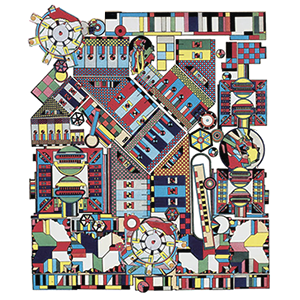
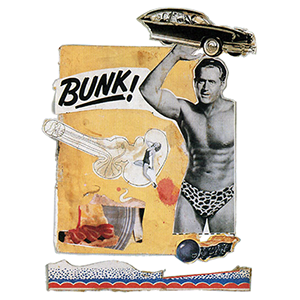
Eduardo Paolozzi [pow-laz-zi] (1924 – 2005), was a Scottish sculptor and artist. Paolozzi investigated how we can fit into the modern world to resemble our fragmented civilization through imagination and fantasy. By the dramatic juxtaposition of ideas in his work, he let us see the confusion as well as the inspiration. Paolozzi’s ‘I was a Rich Man’s Plaything’ (1947) is considered the first standard bearer of Pop Art and first to display the word ‘pop.’ Paolozzi showed the collage in 1952 as part of his groundbreaking ‘Bunk!’ series presentation at the initial Independent Group meeting in London.
He established his first studio in Chelsea, London; a workshop filled with hundreds of found objects, models, sculptures, materials, tools, toys and stacks of books. Paolozzi was interested in everything and would use a variety of objects and materials in his work, particularly his collages. He came to public attention in the 1950s by producing a range of striking screenprints and ‘Art Brut’ sculpture. Paolozzi was a founder of the Independent Group in 1952, which is regarded as the precursor to the mid 1950s British and late 1950s American Pop Art movements.
Posted in Art |
Leave a Comment »
February 3, 2012
The Independent Group (IG) met at the Institute of Contemporary Arts (ICA, an artistic and cultural center on The Mall in London). The IG consisted of painters, sculptors, architects, writers, and critics who wanted to challenge prevailing modernist approaches to culture. They introduced mass culture into debates about high culture, re-evaluated modernism and created the ‘as found’ or ‘found object’ aesthetic. Currently the subject of renewed interest in our post disciplinary age, the IG was the topic of a two-day, international conference at the Tate Britain in 2007. The Independent Group is regarded as the precursor to the Pop Art movement in Britain and the United States.
The Independent Group had its first meeting early in 1952 which consisted of artist and sculptor Eduardo Paolozzi feeding a mass of colorful images from American magazines through an epidiascope (early image projector). These images, composed of advertising, comic strips and assorted graphics, were collected when Paolozzi was resident in Paris from 1947-49. Much of the material was assembled as scrapbook collages and formed the basis of his ‘BUNK!’ series of screenprints (1972) and the ‘Krazy Kat’ Archives now held at the V & A Museum. In fact, Paolozzi’s seminal 1947 collage ‘I was a Rich Man’s Plaything was the first such ‘found object’ material to contain the word ‘pop’ and is considered the initial standard bearer of ‘Pop Art.”
Posted in Art, World |
Leave a Comment »
February 3, 2012
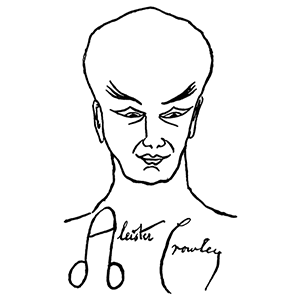
Eroto-comatose lucidity is a technique of sex magic known best by its formulation by English author and occultist Aleister Crowley, but which has several variations and is used in a number of ways by different spiritual communities.
A common form of the ritual uses repeated sexual stimulation (but not to orgasm) to place the individual in a state between full sleep and full wakefulness as well as exhaustion, allowing the practitioner to commune with their god. The rite may end in one of two ways. The ritualist may simply sink into total sleep. Or they may achieve orgasm and then sink into a deep and ‘undisturbable’ sleep.
Posted in Philosophy, Sex |
2 Comments »
February 3, 2012

Erotic sexual denial is a practice in which a heightened state of sexual arousal is maintained for an extended length of time without orgasm, and is commonly practiced in association with BDSM and sexual bondage. Erotic sexual denial can be another name for or variant of orgasm control.
Erotic sexual denial is a form of sexual play. One form of erotic sexual denial is the reduction or deprivation of all genital stimulation. To ensure a complete absence of genital stimulation, a chastity device may be used as a physical barrier to genital touch and/or full erection.
Continue reading →
Posted in Sex |
Leave a Comment »
February 3, 2012

Blue balls is a slang term for the condition of temporary fluid congestion (vasocongestion) in the testicles and prostate region, accompanied by acute testicular pain, or a prolonged dull aching pain emanating from the prostate, caused by prolonged and unsatisfied sexual arousal in the human male. The term is thought to have originated in the United States, first appearing in 1916. Some urologists call the condition ‘epididymal hypertension.’ The condition is not universally experienced by all males.
Although widely discussed, there has been scant information in the medical research literature until a 2000 article by Chalett and Nerenberg in ‘Pediatrics’ which found little formal data regarding the condition but concluded that ‘the treatment is sexual release, or perhaps straining to move a very heavy object—in essence doing a Valsalva maneuver,’ a moderately forceful attempted exhalation against a closed airway.
Posted in Health, Sex |
Leave a Comment »
February 3, 2012
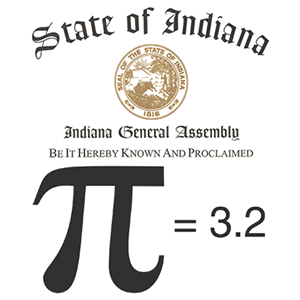
The Indiana Pi Bill is the popular name for bill #246 of the 1897 sitting of the Indiana General Assembly, one of the most famous attempts to establish scientific truth by legislative fiat. Despite that name, the main result claimed by the bill is a method to square the circle, rather than to establish a certain value for the mathematical constant π (pi), the ratio of the circumference of a circle to its diameter. However, the bill does contain text that appears to dictate various incorrect values of π, such as 3.2.
The bill never became law, due to the intervention of a mathematics professor who happened to be present in the legislature. The impossibility of squaring the circle using only compass and straightedge, suspected since ancient times, was rigorously proved in 1882 by Ferdinand von Lindemann. Better approximations of π than those inferred from the bill have been known since ancient times. Continue reading →
Posted in Humor, Politics, Science |
1 Comment »
February 3, 2012

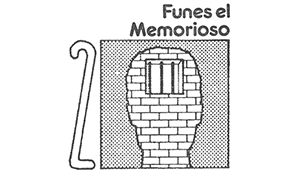
Hyperthymesia [hi-per-thy-mee-zee-uh], also known as piking, is a condition in which the individual possesses a superior autobiographical memory, meaning they can recall the vast majority of personal experiences and events in their lives.
The term ‘hyperthymesia’ is derived from the Greek words thymesis, meaning ‘remembering’ and hyper meaning ‘excessive.’ As first described in a 2006 ‘Neurocase’ article, the two defining characteristics of hyperthymesia are ‘the person spends an abnormally large amount of time thinking about his or her personal past, and the person has an extraordinary capacity to recall specific events from his or her personal past.’ Continue reading →
Posted in Health |
Leave a Comment »