January 9, 2013
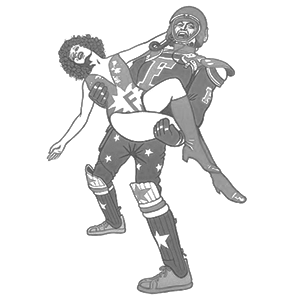
Mr. Freedom is a 1969 film by the expatriate American photographer and filmmaker William Klein. Starring the popular French actor Delphine Seyrig, this anti-imperialist satirical farce has cameos by the well-known actors Donald Pleasence and Philippe Noiret, as well as the musician Serge Gainsbourg. Under the command of Dr. Freedom, the crass superhero Mr. Freedom (John Abbey) goes to France to stave off the advances of the mysterious French Anti-Freedom (FAF) organization.
He joins forces with the femme fatale Marie-Madeleine to lead his own anti-communist Freedom organization. The Freedom mission is complicated by the machinations of communist foes — the Stalinist Moujik Man and the ferocious Maoist Red China Man (portrayed as a giant inflatable dragon). France, refusing to see the FAF as a threat, rebuffs Freedom, leading to an escalation of Cold War tactics. In the end, betrayed, Mr. Freedom destroys himself trying to save the ‘unappreciative’ nation.
read more »
Posted in Humor, Politics, World |
Leave a Comment »
January 9, 2013
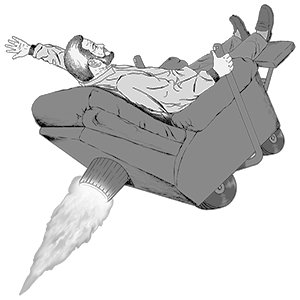
In 2009, Dennis LeRoy Anderson of Minnesota received widespread media attention for being arrested in a DWI case involving a motorized recliner. Riding a recliner which he had fitted with a motor, Anderson crashed into a car after leaving a local bar, where he had drunk a number of beers. The driver was convicted and the chair was confiscated by the police. The police auctioned the recliner away on Do-Bid.com for $3,700. 62-year-old Dennis LeRoy Anderson fitted his recliner with a lawnmower engine, wheels and steering wheel, which allowed the chair to reach up to 20 miles per hour. He had also installed a stereo, cup holders, headlights and a power antenna.
According to Minnesota law, a ‘motor vehicle’ is taken to mean ‘every vehicle that is self-propelled and every vehicle that is propelled by electric power obtained from overhead trolley wires. This means that a driver of any motorized vehicle, even a recliner, is liable under DWI legislation. Anderson’s blood alcohol content was three times over the legal limit for the state. In addition to this, vehicles can also be confiscated if the driver has a blood alcohol level over 0.2, or has a prior DWI conviction from the last 10 years. Anderson, in addition to having a blood alcohol level well over that limit, also had a prior conviction.
Posted in Humor, Politics, Technology |
Leave a Comment »
January 8, 2013

Fear and Loathing: On the Campaign Trail ’72 is a collection of articles covering the 1972 presidential campaign written by Hunter S. Thompson and illustrated by Ralph Steadman. The articles were first serialized in ‘Rolling Stone’ magazine throughout 1972 and later released as a book in early 1973. The book focuses almost exclusively on the Democratic Party’s primaries and the breakdown of the party as it splits between the different candidates.
Of particular focus is the manic maneuvering of the George McGovern campaign during the Miami convention as they sought to ensure the Democratic nomination despite attempts by the Hubert Humphrey campaign and other candidates to block McGovern. Thompson began his coverage of the campaign in December 1971, just as the race toward the primaries was beginning, from a rented apartment in Washington, DC (a situation he compared to ‘living in an armed camp, a condition of constant fear’). Over the next 12 months, in voluminous detail, he covered every aspect of the campaign, from the smallest rally to the raucous conventions.
read more »
Posted in Humor, Language, Politics |
Leave a Comment »
January 1, 2013
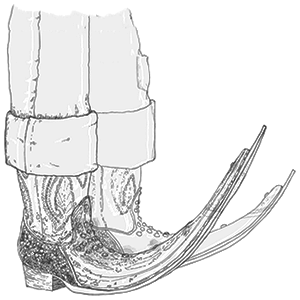
Mexican pointy boots (botas picudas mexicanas) are a style of pointed fashion boots made with elongated toes. The boots are said to have originated in Matehuala in the Mexican state of San Luis Potosí. The came to popularity at the same time as ‘tribal guarachero’ music (‘a mixture of Pre-Columbian and African sounds mixed with fast cumbia bass and electro-house beats’). and the boots have become a preferred footwear for the all-male troupes that dance to the tribal music. They are made by elongating normal boots by as much as 5 feet (1.5 m), causing the toes to curl up toward the knees. Decorative alterations incorporate paint and sequins and can go as far as adding flashing LED lights, disco balls and even mirrors.
Boys and men that wear the pointy boots have formed all-male troupes to compete in danceoffs at local nightclubs to tribal music. Participants in the contests spend weeks choreographing their dance moves and fabricating their outfits which commonly include ‘matching western shirts and skinny jeans to accentuate their footwear.’ In Matehuala, prize money ranges from $100 to $500. The prize often includes a bottle of whiskey. The dance troupes have reportedly become so popular that they are being ‘hired to dance at weddings, for quinceañeras, celebrations of the Virgin of Guadalupe, bachelorette parties, and even rosary ceremonies for the dead.’
Posted in Art, Humor, World |
Leave a Comment »
December 23, 2012

Culture jamming is a tactic used by many anti-consumerist social movements to disrupt or subvert media culture and its mainstream cultural institutions, including corporate advertising. It purports to ‘expose the methods of domination’ of mass society to foster progressive change.
Culture jamming is a form of subvertising (subversive advertising. Many culture jams are intended to expose apparently questionable political assumptions behind commercial culture. Common tactics include re-figuring logos, fashion statements, and product images as a means to challenge the idea of ‘what’s cool’ along with assumptions about the personal freedoms of consumption.
read more »
Posted in Humor, Money, Politics |
Leave a Comment »
December 11, 2012

‘How to Rob‘ is a 1999 song by American hip hop recording artist 50 Cent. The song serves as his debut single and the lead single from his album ‘Power of the Dollar’ (officially unreleased but heavily bootlegged).
The album, which was originally set for a 2000 release, was supposed to be his debut with Columbia Records, but was cancelled after 50 Cent was dropped from the label when Columbia discovered that he had been shot. ‘How to Rob’ was produced by Tone & Poke of Trackmasters and features D-Dot, also known as The Madd Rapper. The song was also included on the soundtrack to the 1999 film ‘In Too Deep,’ staring LL Cool J and Omar Epps.
read more »
Posted in Art, Humor, Money |
Leave a Comment »
December 2, 2012
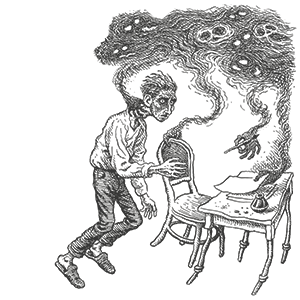
Introducing Kafka, also known as Kafka for Beginners, is a 1993 illustrated biography of Franz Kafka by David Zane Mairowitz and Robert Crumb. The book includes comic adaptations of some of Kafka’s most famous works including ‘The Metamorphosis,’ ‘A Hunger Artist,’ ‘In the Penal Colony,’ and ‘The Judgment,’ as well as brief sketches of his three novels ‘The Trial,’ ‘The Castle,’ and ‘Amerika.’
The book also details Kafka’s biography in a format that is part illustrated essay, part sequential comic panels. The book was released as part of the ‘Introducing…’ series by Totem Books which also features a volume each on Sigmund Freud and Wilhelm Reich. The popularity of Crumb’s renditions of Kafka’s works led to additional printings under the title ‘R. Crumb’s Kafka.’
Posted in Art, Humor, Language |
1 Comment »
December 2, 2012

Internet Killed Television is a web series which documents the lives of Charles Trippy, his wife Alli and their dogs Zoey and Marley. The show consists of episodes averaging around one to twenty minutes that are filmed, edited, and then aired every day onto YouTube by mid-afternoon Eastern Standard Time. The series was originally planned to last for only one year; however, after the success of the first season, the couple have decided to continue.
The YouTube series has now reached its fourth year and every year, so far, they have reached out to their audience, the CTFxC(ers) to create a montage featuring the main events that had occurred that year.
read more »
Posted in Art, Humor, Technology |
1 Comment »
November 30, 2012
David Rees (b. 1972) is a cartoonist and humorist whose best-known work combines bland clip art with outrageous ‘trash talk’ to incongruous effect. The comic strips have achieved wide popularity and some controversy.
Rees grew up in Chapel Hill, North Carolina and was an avid reader of ‘Rex Morgan, M.D.’ comics. He is a graduate of Oberlin College, and drew comics for the school’s newspaper. His office-cubicle humor is partly inspired by his experience working in a basement for Citicorp; he was later a part time fact-checker for ‘Maxim’ magazine and ‘Martha Stewart Weddings’ magazine, until he was laid off. Rees’s best-known and most controversial comic is ‘Get Your War On.’
read more »
Posted in Humor, Language, Money |
Leave a Comment »
November 30, 2012

Heisenbug is a whimsical computer programming jargon term for a software bug (glitch) that seems to disappear or alter its behavior when one attempts to study it.
The term is a pun on the name of Werner Heisenberg, the physicist who first asserted the observer effect of quantum mechanics, which states that the act of observing a system inevitably alters its state.
read more »
Posted in Humor, Technology |
1 Comment »
November 30, 2012

‘Rapture of the Nerds’ is a derisive term for the technological singularity (a theorized future period of superhuman intelligence). Some critics assert that no computer or machine will ever achieve human intelligence, while others hold that the definition of intelligence is irrelevant if the net result is the same.
Cognitive scientist Steven Pinker stated in 2008, ‘There is not the slightest reason to believe in a coming singularity. The fact that you can visualize a future in your imagination is not evidence that it is likely or even possible. Look at domed cities, jet-pack commuting, underwater cities, mile-high buildings, and nuclear-powered automobiles—all staples of futuristic fantasies when I was a child that have never arrived. Sheer processing power is not a pixie dust that magically solves all your problems.’
read more »
Posted in Humor, Technology |
Leave a Comment »
November 30, 2012

The South Butt, LLC was a clothing and accessories company founded in 2007 by Jimmy Winkelmann, a then 16-year-old student at Chaminade College Preparatory School. The company dissolved in 2011.
Winkelmann claimed the company was a parody of the The North Face, an American outdoor product company.
read more »
Posted in Humor, Money, Politics |
Leave a Comment »


 The Daily Omnivore