March 14, 2013
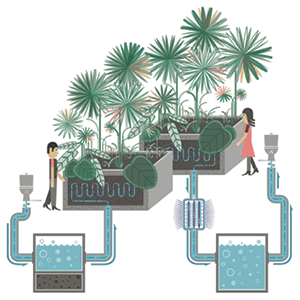
Living Machine is a trademark and brand name for a patented form of ecological wastewater treatment designed to mimic the cleansing functions of wetlands. Also known as Solar Aquatics Systems, the latest generation of the technology is based on fixed-film ecology and the ecological processes of a natural tidal wetland, one of nature’s most productive ecosystems.
The Living Machine is an intensive bioremediation system that can also produce beneficial byproducts, such as reuse-quality water, ornamental plants and plant products—for building material, energy biomass, animal feed.
read more »
Posted in Money, Science, Technology |
1 Comment »
March 14, 2013
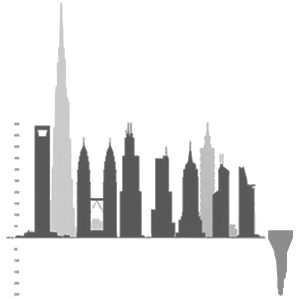
A seascraper, also known as a waterscraper, is a proposed large building which will function as a floating city. It would generate its own energy through wave, wind, current, and solar energy, and produce its own food through farming, aquaculture, and hydroponics. Architect Koen Othuis of the Netherlands specializes in ‘amphibious’ buildings, some floating and some using other systems to adapt to wet environments.
In 2010 Sarly Adre bin Sarkum of Malaysia proposed a building about the size of the Empire State Building which would float in the ocean with only the top few stories out of water. It would house thousands of people and be self-contained, growing its own food and generating its own energy. Another design concept for a mostly submerged structure is ‘The Gyre,’ which would stretch 400 meters deep and over a kilometer across. It is designed to house over 2000 people, and be completely self-sufficient, producing its own food and electricity. It was designed by the firm Zigloo, as a submission to eVolo’s Skyscraper Design Competition in 2009.
Posted in Technology |
Leave a Comment »
March 13, 2013

An Identicon is a visual representation of a hash value, usually of an IP address, that serves to identify a user of a computer system as a form of avatar while protecting the users’ privacy.
The original Identicon was a 9-block graphic, and the representation has been extended to other graphic forms by third parties.
read more »
Posted in Language, Technology |
Leave a Comment »
March 9, 2013


A smart mob is a group that, contrary to the usual connotations of a mob, behaves intelligently or efficiently because of its exponentially increasing network links, enabling people to connect to information and others, allowing a form of social coordination. Parallels are made to, for instance, slime molds.
The concept was introduced by author and cultural critic Howard Rheingold in his 2002 book ‘Smart Mobs: The Next Social Revolution.’ According to Rheingold, smart mobs are an indication of the evolving communication technologies that will empower the people. Smart mobs sometimes are manipulated by the dispatchers who control the ‘mobbing system’ (i.e., those who own the contact list and the means to forward instant messages to a group) and are induced to cause distress and aggravation to individuals who have been targeted or singled out for whatever reason. There is a tendency to keep the dynamics of smart mobbing ‘covert,’ and not to discuss such incidents on the internet.
read more »
Posted in Technology |
Leave a Comment »
March 9, 2013

An ideas bank is a website where people post, exchange, discuss, and polish new ideas. Some ideas banks are used for the purpose of developing new inventions or technologies. Many corporations have installed internal ideas banks to gather the input from their employees and improve their ideation process. Some ideas banks employ a voting system to estimate an idea’s value. In some cases, ideas banks can be more humor-oriented than their serious counterparts.
The underlying theory of an ideas bank is that if a large group of people collaborate on a project or the development of an idea that eventually said project or idea will reach perfection in the eyes of those who worked on it. Many ideas banks are provided as free of charge, or set around certain companies in general to work out new inventions. Although ideas are provided by a community of people, problems can arise when people take the ideas of the site and begin developing them. There is no possible way to prove that the idea on the ideas bank was original and not taken from something else.
read more »
Posted in Money, Technology |
Leave a Comment »
March 9, 2013

Neurowear is a gadget project organization in Japan founded on the concept of the ‘Augumented Human Body.’ The group’s first project, known as necomimi (‘cat ears’) is a headband with a brain wave sensor and motorized cat shaped ears programmed to turn up or down based on the wearer’s thoughts. It runs for 4 hours on 4 AAA batteries and has interchangeable Cat, Dog, and Devil Horn ears. ‘Brain Disco’ is a collaboration between neurowear and Qosmo that measures audience ‘attention.’ The DJ must hold the audience’s ‘attention’ or get ejected. The first Brain Disco experiment was held in July 2012 at Gallery KATA Ebisu.
neurowear demonstrated their new prototype Shippo (‘tail’) at the Tokyo Game Show in September 2012. Shippo was developed with Kiluck Inc. Kiluck failed to fund a similar tail ‘Tailly’ on Kickstarter but is trying again on Indiegogo. The tail wags like a dog based on the user’s mood communicated from the headset wirelessly via Bluetooth. neurowear also showed an iPhone app that uploads the user’s mood to social media complete with geotagging. neurowear presented ‘Neuro Turntable’ in late 2012.
Posted in Games, Humor, Technology |
Leave a Comment »
February 27, 2013
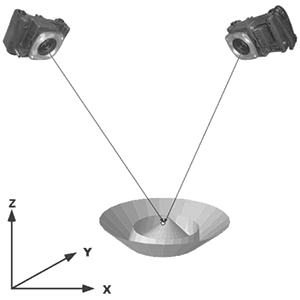
Photogrammetry [foh-tuh-gram-i-tree] is the practice of determining the geometric properties of objects from photographic images. Photogrammetry is as old as modern photography and can be dated to the mid-nineteenth century.
Photogrammetry is used in different fields, such as topographic mapping, architecture, engineering, manufacturing, quality control, police investigation, and geology, as well as by archaeologists to quickly produce plans of large or complex sites and by meteorologists as a way to determine the actual wind speed of a tornado where objective weather data cannot be obtained. It is also used to combine live action with computer-generated imagery in movie post-production; ‘The Matrix’ is a good example of the use of photogrammetry in film.
Posted in Technology |
Leave a Comment »
February 27, 2013
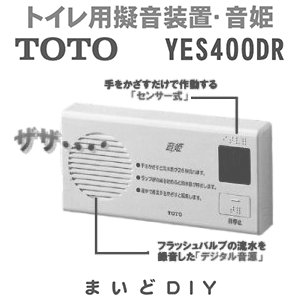
Many Japanese women are embarrassed at the thought of being heard by others during urination. To cover the sound of bodily functions, many women used to flush public toilets continuously while using them, wasting a large amount of water in the process.
As education campaigns did not stop this practice, a device was introduced in the 1980s that, after activation, produces the sound of flushing water without the need for actual flushing. A Toto brand name commonly found is the ‘Otohime’ (literally ‘Sound Princess‘ also homophone with a legendary goddess Otohime). This device is now routinely placed in most new public women’s rooms, and many older public women’s rooms have been upgraded.
Posted in Money, Technology |
Leave a Comment »
February 26, 2013
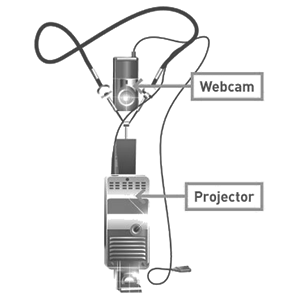
SixthSense is a wearable gestural interface device by Pranav Mistry, a PhD candidate in the Fluid Interfaces Group at the MIT Media Lab. The SixthSense technology comprises of a pocket projector, a mirror, and a camera contained in a pendant-like, wearable device. Both the projector the camera and sensors are connected to a mobile computing device in the user’s pocket. The projector projects visual information enabling surfaces, walls and physical objects around us to be used as interfaces; while the camera recognizes and tracks users’ hand gestures and physical objects using computer-vision based techniques.
The software program processes the video stream data captured by the camera and tracks the locations of the colored markers (visual tracking fiducials) at the tips of the user’s fingers. The movements and arrangements of these fiducials are interpreted into gestures that act as interaction instructions for the projected application interfaces. SixthSense supports multi-touch and multi-user interaction.
Posted in Technology |
Leave a Comment »
February 26, 2013
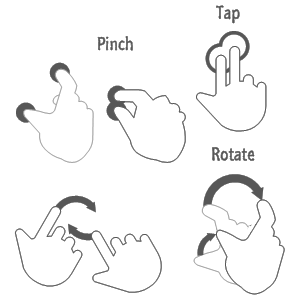
Gesture recognition is a topic in computer science and language technology with the goal of interpreting human gestures via mathematical algorithms. Gestures can originate from any bodily motion or state but commonly originate from the face or hand. Current focuses in the field include emotion recognition from the face and hand gesture recognition. Many approaches have been made using cameras and computer vision algorithms to interpret sign language.
However, the identification and recognition of posture, gait, proxemics (culture-specific, personal boundaries), and human behaviors is also the subject of gesture recognition techniques. Gesture recognition can be seen as a way for computers to begin to understand human body language, offering richer interaction between machines and humans than that afforded by a mouse and keyboard.
read more »
Posted in Language, Technology |
Leave a Comment »
February 26, 2013

The Peel P50 is a three-wheeled microcar originally manufactured from 1962 to 1965 by the Peel Engineering Company on the Isle of Man in the Irish Sea. It currently holds the record for the smallest automobile to go into production.
It has no reverse gear, but a handle at the rear allows the very lightweight car to be physically maneuvered when required. Designed as a city car, it was advertised as capable of seating ‘one adult and a shopping bag.’ The vehicle’s only door was on its left side, and equipment included a single windscreen wiper and only one headlight. Standard colors were Daytona White, Dragon Red, and Dark Blue. The 1963 model retailed for £199 when new. 50 of them were produced, and only 27 of them are known to be still in existence.
read more »
Posted in Humor, Technology |
Leave a Comment »
February 19, 2013

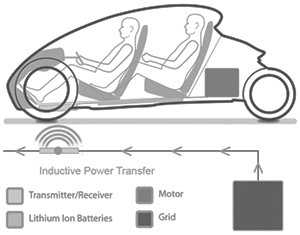
Wireless power or wireless energy transmission is the transmission of electrical energy from a power source to an electrical load without man-made conductors. Wireless transmission is useful in cases where interconnecting wires are inconvenient, hazardous, or impossible. The problem of wireless power transmission differs from that of wireless telecommunications, such as radio. In the latter, the proportion of energy received becomes critical only if it is too low for the signal to be distinguished from the background noise.
With wireless power, efficiency is the more significant parameter. A large part of the energy sent out by the generating plant must arrive at the receiver or receivers to make the system economical. The most common form of wireless power transmission is carried out using direct induction followed by resonant magnetic induction. Other methods under consideration are electromagnetic radiation in the form of microwaves or lasers and electrical conduction through natural media.
read more »
Posted in Technology |
Leave a Comment »


 The Daily Omnivore