February 6, 2012
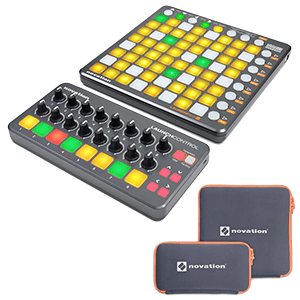
Hugo Leclercq (b. 1994), known by his stage name Madeon, is a French electropop producer. He started composing music at the age of 11, and adopted a nu-disco style under the name Madeon in 2010. In the fall of that year, he gained popularity for his award-winning remix of ‘The Island’ by Pendulum.
In the summer of 2011, a YouTube video of his live mashup ‘Pop Culture’ went viral, which combines 39 pop hits into one song. He is known to use Novation’s Launchpad, a MIDI controlled monome, and FL Studio (FruityLoops).
Posted in Art, Technology |
Leave a Comment »
February 4, 2012
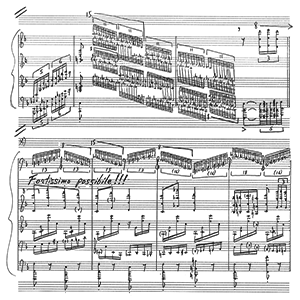
Circus Galop is a piece for player piano written by Marc-André Hamelin. It was composed between 1991 and 1994 and it is dedicated to Beatrix and Jürgen Hocker, piano roll makers. Its duration is approximately 4–5 minutes. Scores of this piece are available through the Sorabji Archive. Piano rolls of this piece are available from Wolfgang Heisig and Jürgen Hocker, who have recorded all three of Hamelin’s player piano pieces on the MDG label, which were released in 2008.
It is impossible for a single human to play, as at some points all the piano staves are played at the same time, and up to 21 notes simultaneously. It is used to test MIDI software to drive it to its maximum potential, such as Synthesia, or PianoMIDI.
Posted in Art, Technology |
Leave a Comment »
February 3, 2012


Larry Cuba (b. 1950) is a computer-animation artist who became active in the late 1970s and early 80s. Born in Atlanta, he did his Master’s Degree at California Institute of the Arts which includes parallel schools of Dance, Music, Film, Theater, Fine Arts, and Writing.
In 1975, early computer animator John Whitney, Sr. invited Cuba to be the programmer on one of his films. The result of this collaboration was ‘Arabesque.’ Subsequently, Cuba produced three more computer-animated films: ‘3/78 (Objects and Transformations),’ ‘Two Space,’ and ‘Calculated Movements.’ Cuba also provided computer graphics for ‘Star Wars Episode IV: A New Hope’ in 1977. His animation of the Death Star is shown to pilots in the Rebel Alliance.
read more »
Posted in Art, Technology |
Leave a Comment »
February 3, 2012


John Whitney (1917 – 1995) was an American animator, composer and inventor, widely considered to be one of the fathers of computer animation. Whitney was born in Pasadena, California and attended Pomona College. His first works in film were 8 mm movies of a lunar eclipse which he made using a homemade telescope. In 1937-38 he spent a year in Paris, studying twelve-tone composition under French composer Rene Leibowitz. In 1939 he returned to America and began to collaborate with his brother James on a series of abstract films.
During the 1950s Whitney used his mechanical animation techniques to create sequences for television programs and commercials. In 1952 he directed engineering films on guided missile projects. One of his most famous works from this period was the animated title sequence from Alfred Hitchcock’s 1958 film ‘Vertigo,’ which he collaborated on with the graphic designer Saul Bass.
read more »
Posted in Art, Technology |
Leave a Comment »
February 2, 2012

Goldbricking, in today’s terms, generally refers to staff who use their work internet access for personal reasons while maintaining the appearance of working, which can lead to inefficiency. The term originates from the confidence trick of applying a gold coating to a brick of worthless metal. Some employees do two non-work activities at once, a practice known as multishirking. In modern usage, the practice is also known as cyberslacking, cyberloafing or cyberbludging.
Instances of goldbricking have increased markedly since broadband Internet connections became commonplace in workplaces. Before that the slow speed of dial-up connections meant that the practice was rarely worthwhile. Many firms employ surveillance software to track employees’ Internet activity in an effort to limit liability and improve productivity. Other methods used to reduce goldbricking include installation of proxy servers to prevent programs from accessing resources like Internet Relay Chat, AOL Instant Messenger, or some online gambling services, strict disciplinary measures for employees found goldbricking, and carrot and stick measures like providing free or subsidized Internet access for employees outside of working hours.
read more »
Posted in Language, Money, Technology |
Leave a Comment »
February 2, 2012
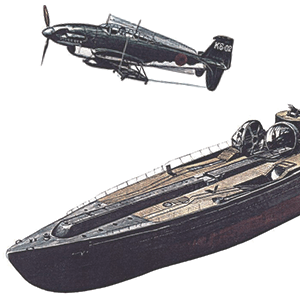
Submarine aircraft carriers are submarines equipped with fixed wing aircraft for observation or attack missions. These submarines saw their most extensive use during World War II, although their operational significance remained rather small.
The most famous of them were the Japanese I-400 class submarine and the French submarine Surcouf, although a few similar craft were built by other nations’ navies as well. Except for the I-400, submarine aircraft carriers used their aircraft in a supporting role (usually for reconnaissance), unlike the typical surface aircraft carrier, which describes a ship whose main function is serving as a base for combat aircraft.
read more »
Posted in Technology, War, World |
Leave a Comment »
February 2, 2012
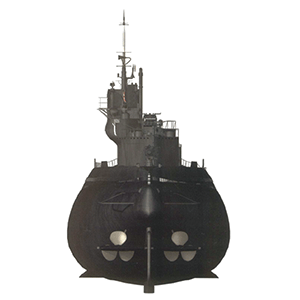
The Sen Toku I-400-class Imperial Japanese Navy submarines were the largest submarines of World War II and remained the largest ever built until the construction of nuclear ballistic missile submarines in the 1960s. They were submarine aircraft carriers able to carry three Aichi M6A Seiran aircraft underwater to their destinations. They were designed to surface, launch the planes then dive again quickly before they were discovered. They also carried torpedoes for close-range combat. The I-400-class was designed with the range to travel anywhere in the world and return. A fleet of 18 boats was planned in 1942, of which only three were completed.
Located approximately amidships on the top deck was a cylindrical watertight aircraft hangar, 31 m (102 ft) long and 3.5 m (11 ft) in diameter. The outer access door could be opened hydraulically from within or manually from the outside by turning a large hand-wheel connected to a rack and spur gear. The door was made waterproof with a 51-millimeter-thick (2 in.) rubber gasket.
Posted in Technology, War, World |
Leave a Comment »
January 30, 2012
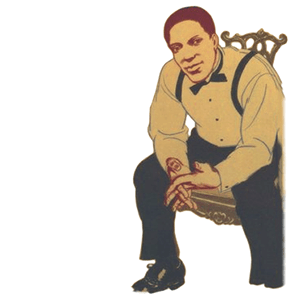
Six degrees of separation refers to the idea that everyone is on average approximately six steps away, by way of introduction, from any other person on Earth, so that a chain of, ‘a friend of a friend’ statements can be made, on average, to connect any two people in six steps or fewer.
It was originally set out by Hungarian author Frigyes Karinthy and popularized by a play written by John Guare.
read more »
Posted in Art, Science, Technology, World |
Leave a Comment »
January 26, 2012

Derek Vincent Smith (b. 1983), better known as Pretty Lights, is an American electronic music artist. Smith wrote and produced hip hop music while attending high school in Fort Collins, Colorado, but the music of such artists as Aphrodite attracted him to American raves. After graduating from high school, he attended University of Colorado at Boulder, but dropped out during his freshman year to focus instead on his music. Smith’s music relies heavily on digital sampling and crosses many genres, forming a combination of ‘glitchy hip-hop beats, buzzing synth lines, and vintage funk and soul samples, sometimes grime.’
Pretty Lights’ sound is generated by synthesizing samples and organic beats using the Novation X-Station, monome, and the Akai MPD32. Smith uses these digital controllers to program the music production software Ableton Live 8. Due to the sample-based nature of his music, Smith releases all his music for free with a recommended donation, so as to avoid having to clear samples. When performing live, Smith uses two Macbook Pros running Ableton Live 8 and two Akai MPD32s.
Posted in Art, Technology |
Leave a Comment »
January 26, 2012
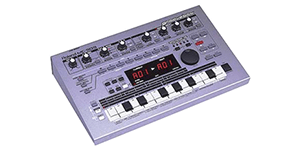
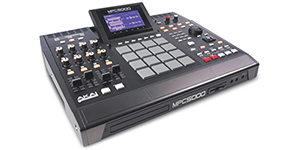
The term Groovebox was originally used by Roland corporation to refer to its MC-303 mobile music synthesizer, but the term has since entered into general use. It refers to a self-contained instrument for the production of live, loop-based electronic music with a high degree of user control facilitating improvisation.
A groovebox consists of three integrated elements: one or more sound sources, such as a drum machine, a synthesizer or a sampler, a music sequencer (recorder), and a control surface, i.e. a combination of knobs (potentiometer or rotary encoder), sliders and buttons, and display elements (LED and/or LCD).
read more »
Posted in Art, Money, Technology |
Leave a Comment »
January 26, 2012


Livetronica, a portmanteau of the words ‘live’ and ‘electronica,’ is a sub-genre of the jam band movement that blends such musical styles as rock, jazz, funk, and electronica. It consists primarily of instrumental music. The terms ‘Jamtronica’ and ‘Trance fusion’ are also used to refer to this style of music.
Artists like the Disco Biscuits, Lake Trout, and The New Deal are credited as founding fathers of the genre, but recently up-and-coming bands such as The Werks, Pnuma Trio, and the Histronic of Minneapolis have started to inject new life and young blood into the scene.
Posted in Art, Technology |
Leave a Comment »
January 25, 2012

Culturomics is a form of computational lexicology that studies human behavior and cultural trends through the analysis of digitized texts. Researchers data mine large digital archives to investigate cultural phenomena reflected in language and word usage. The term is an American neologism first described in a 2010 ‘Science’ article called ‘Quantitative Analysis of Culture Using Millions of Digitized Books,’ co-authored by Harvard researchers Jean-Baptiste Michel and Erez Lieberman Aiden. Michel and Aiden helped create the Google Labs project Google Ngram Viewer which uses n-gram’s to analyze the Google Book digital library for cultural patterns in language use over time.
In another study called ‘Culturnomics 2.0,’ Kalev H. Leetaru examined news archives including print and broadcast media (television and radio transcripts) for words that imparted tone or ‘mood’ as well as geographic data. The research was able to retroactively predict the 2011 Arab Spring and successfully estimate the final location of Osama Bin Laden to within 124 miles.
Posted in Language, Science, Technology |
Leave a Comment »




