November 30, 2011
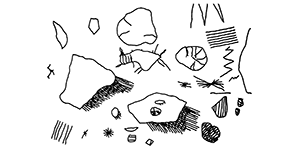

Generative art refers to art that has been generated, composed, or constructed in an algorithmic manner through the use of systems defined by computer software algorithms, or similar mathematical or mechanical or randomized autonomous processes.
Generative art is a system oriented art practice where the common denominator is the use of systems as a production method. To meet the definition of generative art, an artwork must be self-contained and operate with some degree of autonomy. The workings of systems in generative art might resemble, or rely on, various scientific theories such as Complexity science and Information theory.
read more »
Posted in Art, Technology |
Leave a Comment »
November 30, 2011
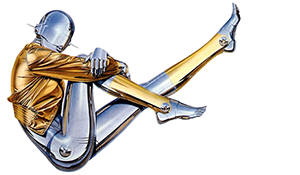

A gynoid refers to female robots. Android is a gender neutral term for humanoid robots, but which has male connotations. The term ‘gynoid’ was used by Gwyneth Jones in her 1985 novel ‘Divine Endurance’ to describe a robot slave in a futuristic China, that is judged by her beauty.
The tongue-in-cheek portmanteau ‘fembot’ (female robot) was used in the ‘Austin Powers films,’ a cultural play on the fembots originating in the TV series ‘The Bionic Woman.’ Robotess is the oldest gender-specific term, originating in 1921 from the same source as robot, a 1920 Czech play: ‘R.U.R. (Rossum’s Universal Robots).’
read more »
Posted in Politics, Sex, Technology |
Leave a Comment »
November 30, 2011
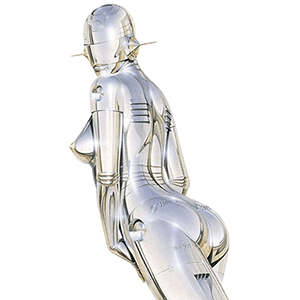
Hajime Sorayama (b.1947) is a Japanese illustrator, known for his precisely detailed, erotic airbrush portrayals of women and feminine robots. Sorayama’s work ‘Sexy Robot,’ published by Genko-sha in 1983, made his organic robotic forms famous around the world.
For the work, he used ideas from pin-up art, which in the book then appear as chrome-plated gynoids in suggestive poses. His next book, ‘Pin-up’ (1984), continues in the same line. A number of his other works similarly revolve around figures in suggestive poses, including highly realistic depictions in latex and leather. His pinups appeared frequently in the pages of ‘Penthouse’ magazine.
Posted in Art, Language, Technology |
1 Comment »
November 30, 2011

Nobukazu Takemura (b. 1968) is a Japanese musician whose style has run from jazz to house to drum and bass to chamber music to electronic glitch within less than a decade. Born in Osaka he became interested in punk and New Wave music when young. At high school, after a record store job that exposed him to Jazz and Hip hop, he had regular gigs as a battle DJ. In 1990, Takemura founded Audio Sports with Yamatsuka Eye (of The Boredoms) and Aki Onda. Their first album, ‘Era of Glittering Gas,’ was released in 1992 (after which Onda subsequently took control of the project), the same year as Takemura’s first solo album, under the name DJ Takemura. He has also released material with Spiritual Vibes (since 1993) and as Child’s View (since 1994). He is currently paired with Childisc vocalist/composer Aki Tsuyuko under the touring name of Assembler.
He founded the Lollop and Childisc labels; his voluminous releases, remixes, and collaborations make a comprehensive discography difficult, and his music often defies any easy categorization. He emerged in the US after the release of ‘Scope’ on the Thrill Jockey label in 1999, an album that features delicate melodies blossoming from oceans of white noise and staccato electronics. His unique and complex approach to melody and instrumentation has generated a catalog of collaborations with critically acclaimed artists including Issey Miyake, Zu, Steve Reich, DJ Spooky, Yo La Tengo, and Tortoise. Takemura was responsible for the sound design of Sony’s robotic dog AIBO.
Posted in Art, Technology, World |
Leave a Comment »
November 30, 2011

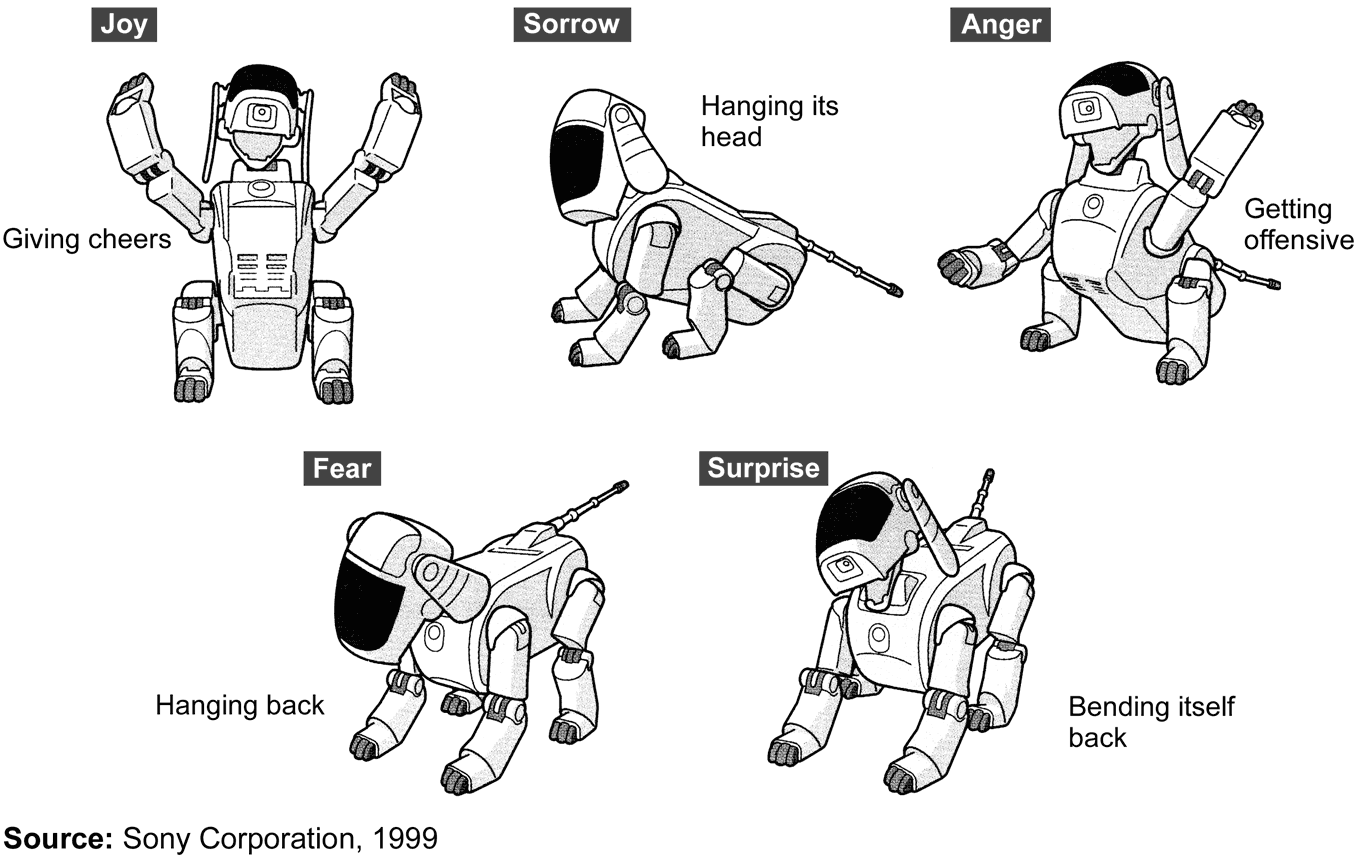
Roblog is a neologism for a blog written by a robot with no human intervention. Roblogs were made possible with a new generation of robots which are capable of uploading images and texts automatically to the Web. The first roblogs to appear, late 2005, were written by AIBO robots, the dog-like robotic pets once manufactured by Sony.
AIBO diaries are roblogs produced by AIBO model ERS-7, running a bundled software called Mind in either version 2 or 3. Depending on the language of the Mind software, the AIBO blogs in either English or Japanese. To be able to blog on its own, an ERS-7M2 or ERS-7M3 must be linked to the Internet through its Wi-Fi connection capability, and its e-mail sending capability must be correctly configured, for which an SMTP server not requiring authentication nor alternate ports is needed. Posts, consisting of pictures taken with the AIBO’s color camera built into its nose, are then sent by e-mail to the blog.
Posted in Humor, Technology |
Leave a Comment »
November 30, 2011

AIBO was one of several types of robotic pets designed and manufactured by Sony from 1999 to 2006. AIBO is able to walk, ‘see’ its environment via camera and recognize spoken commands in Spanish and English. AIBO are autonomous robots since they are able to learn and mature based on external stimuli from their owner, their environment, and from other AIBOs. Artist Hajime Sorayama created the initial designs for the AIBO. AIBO’s sounds were programmed by Japanese DJ/avant-garde composer Nobukazu Takemura. The International AIBO Convention takes place every year at Sony Robotics Tower in the Shinjuku prefecture.
AIBO runs AIBOware on a pink Memory Stick, which allows the robot to be raised from pup to fully grown adult while going through various stages of development as its owner interacts with it. AIBOware allows the owner to interact with a fully mature robot able to understand (though not necessarily willing to obey) 100 voice commands. Without the AIBOware, the AIBO will run in what is called ‘clinic mode’ and can only perform basic actions. Many AIBO owners enjoy teaching their pets new behaviors by reprogramming them in Sony’s special ‘R-CODE’ language. AIBO’s complete vision system uses the SIFT algorithm, to recognize its charging station. The newest versions are equipped with a Wi-Fi connection, allowing them to send the pictures they take via email which led to the Roblog.
Posted in Games, Money, Technology |
Leave a Comment »
November 30, 2011


In telecommunications, 4G is the fourth generation of cellular wireless standards. It is a successor to the 3G and 2G families of standards. Speed requirements for 4G service is 100 Mbit/s for high mobility communication (such as from trains and cars) and 1 Gbit/s for low mobility communication (such as pedestrians and stationary users). By comparison, 3G’s speed requirement is 200 kbit/s (0.2 Mbit/s). The International Telecommunication Union (ITU), an agency within the UN sets requirements for what is marketed as 4G. ITU recognized that current versions of LTE, WiMax and other evolved 3G technologies that do not fulfill the requirements could nevertheless be considered ‘4G,’ provided they represent ‘a substantial level of improvement in performance and capabilities with respect to the initial third generation systems now deployed.’
The nomenclature of the generations generally refers to a change in the fundamental nature of the service, non-backwards compatible transmission technology, higher spectral bandwidth and new frequency bands. New generations have appeared about every ten years since the first move from 1981 analog (1G) to digital (2G) transmission in 1992. This was followed, in 2001, by 3G multi-media support, spread spectrum transmission and at least 200 kbit/s, in 2011 expected to be followed by 4G, which refers to all-IP packet-switched networks, gigabit speed, and multi-carrier transmission.
Posted in Money, Technology, World |
Leave a Comment »
November 29, 2011
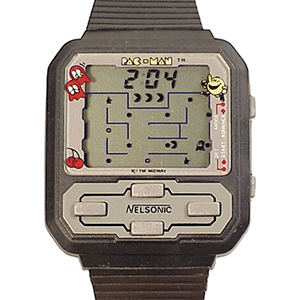
Nelsonic Industries is the name of an electronics manufacturing and development company that operated from Queens, NY in the early 1980s and throughout the 1990s when it was acquired by the watch-manufacturer, M.Z. Berger. Nelsonic produced numerous toy-themed wrist-watches during their existence, often targeting younger audiences with likenesses of characters from popular franchises such as Barbie, the Ghostbusters, and Mario. Nelsonic became notable during the early mid-1980s for being the first electronics company in the United States to produce game-watches (multi-purpose electronic devices capable of functioning as both a time-piece and as a typically electronic game). Today the original Nelsonic Game Watch line has entered the secondary market and individual Game Watches have become highly sought-after collectibles that often fetch high prices on online auction websites.
Throughout its existence, Nelsonic produced pop-culture-themed wrist-watches for children and young adults. The chronograph digital watches, typically made of molded plastic, invariably featured an alarm and utilized LCD display-screens to display the time for their wearers. In time the company began manufacturing multi-purpose units that used the LCD screen to combine time display functions with simple video game functions. These simple video games were variations on the theme of the Calculator watch.
Posted in Games, Money, Technology |
Leave a Comment »
November 29, 2011

A calculator watch is a watch with a calculator built into it. Calculator watches first appeared in the Mid 1970s introduced by Pulsar and Hewlett Packard. Several watch manufacturers have made calculator watches over the years, but the Japanese electronics company Casio produced the largest variety of models. In the mid-1980s, Casio created the Data Bank calculator watch, which not only performed calculator functions, but also stored appointments, names, addresses, and phone numbers. The modern eData version of its Data Bank watch has greater memory and the ability to store computer passwords.
When mass produced calculator watches appeared in the early 1980s (with the most being produced in the middle of the decade), the high-tech community’s demand created a ‘feature war’ of one-up-manship between watch manufacturers. However, as the novelty of this new electronic fad watch wore off, they became, much like pocket protectors and thick glasses, associated with nerds and today are no longer considered to be in vogue. Recently, they have come back in style and are worn ‘ironically’ by hipsters.
Posted in Humor, Money, Technology |
Leave a Comment »
November 29, 2011
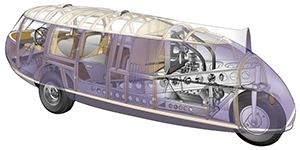

The Dymaxion [dahy-mak-see-uhn] car was a concept car designed by U.S. inventor and architect Buckminster Fuller in 1933. The word Dymaxion is a brand name that Fuller gave to several of his inventions, to emphasize that he considered them part of a more general project to improve humanity’s living conditions. The car had a fuel efficiency of 30 mpg, and could transport 11 passengers.
While Fuller claimed it could reach speeds of 120 miles per hour, the fastest documented speed was 90 miles per hour. Japanese American artist Isamu Noguchi was involved with the development of the Dymaxion car, creating plaster wind tunnel models that were a factor in determining its shape, and during 1934 drove it for an extended road trip through Connecticut with congresswoman Clare Boothe Luce and actress Dorothy Hale.
read more »
Posted in Money, Technology |
1 Comment »
November 29, 2011

Pin striping is the application of a very thin line of paint or other material called a pin stripe, and is generally used for decoration. Freehand pin stripers use a specialty brush known as a pinstriping brush. Fine lines in textiles are also called pin stripes. Automotive, bike shops, and do-it-yourself car and motorcycle mechanics use paint pin striping to create their own custom look on the automotive bodies and parts. Pin striping can commonly be seen exhibited on custom motorcycles, such as those built by Choppers Inc., Indian Larry, and West Coast Choppers.
The decorative use of pin striping on motorcycles as it is commonly seen today was pioneered by artists Kenny Howard (aka Von Dutch), and Dean Jeffries, Dennis ‘Gibb’ Gibbish, and Ed ‘Big Daddy’ Roth, are considered pioneers of the Kustom Kulture lifestyle that spawned in the early 1950s, and are widely recognized as the ‘originators of modern pin striping.’
read more »
Posted in Art, Technology |
1 Comment »
November 29, 2011

A jalopy [juh-lop-ee] (also clunker or hooptie or beater) is a decrepit car, often old and in a barely functional state. A jalopy is not a well kept antique car, but a car which is mostly rundown or beaten up.
As a slang term in American English, ‘jalopy’ was noted in 1924 but is now slightly passé. The term was used extensively in the book ‘On the Road’ by Jack Kerouac, first published in 1957, although written from 1947. The equivalent English term is old banger, often shortened to banger, a reference to older poorly maintained vehicles’ tendency to backfire.
read more »
Posted in Language, Money, Technology |
1 Comment »