January 6, 2013

A typical chain letter consists of a message that attempts to convince the recipient to make a number of copies of the letter and then pass them on to as many recipients as possible. Common methods used in chain letters include emotionally manipulative stories, get-rich-quickly pyramid schemes, and the exploitation of superstition to threaten the recipient with bad luck or even physical violence or death if he or she ‘breaks the chain’ and refuses to adhere to the conditions set out in the letter.
Chain letters started as actual letters that one received in the mail. Today, chain letters are generally no longer actual letters. They are sent through email messages, postings on social network sites, and text messages.
read more »
Posted in Language, Money, Technology |
Leave a Comment »
January 6, 2013

Viral phenomena are objects or patterns able to replicate themselves or convert other objects into copies of themselves when these objects are exposed to them.
The concept of something, other than a biological virus, being viral came into vogue just after the Internet became widely popular in the mid-to-late 1990s. An object, even an immaterial object, is considered to be viral when it has the ability to spread copies of itself or change other similar objects to become more like itself when those objects are simply exposed to the viral object.
read more »
Posted in Health, Language, Technology |
Leave a Comment »
January 6, 2013

Memetic [meh-met-ik] engineering is a term developed and coined by Leveious Rolando, John Sokol, and Gibran Burchett while they researched and observed the behavior of people after being purposely exposed (knowingly and unknowingly) to certain memetic themes. The term is based on Richard Dawkins’ theory of memes (a proposed basic unit of cultural information).
Memetic engineering refers to the process of developing memes, through ‘meme-splicing’ and ‘memetic synthesis,’ with the intent of altering the behavior of others in society or humanity; the process of creating and developing theories or ideologies based on an analytical study of societies, cultures, their ways of thinking and the evolution of their minds; and the process of modifying human beliefs, thought patterns, etc.
read more »
Posted in Language, Science, Technology |
Leave a Comment »
January 6, 2013
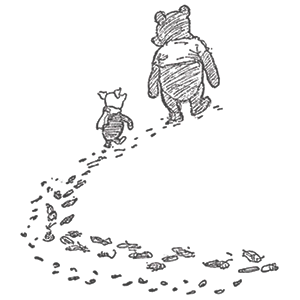
Woozle effect, also known as evidence by citation, or a woozle, occurs when frequent citation of previous publications that lack evidence mislead individuals, groups and the public into thinking or believing there is evidence, and nonfacts become urban myths and factoids (statements presented as a fact, but with no veracity).
Woozle effect is a term coined by criminologist Beverly Houghton in 1979. It describes a pattern of bias seen within social sciences and which is identified as leading to multiple errors in individual and public perception, academia, policy making and government. A woozle is also a claim made about research which is not supported by original findings.
read more »
Posted in Education, Language, Science |
Leave a Comment »
January 6, 2013
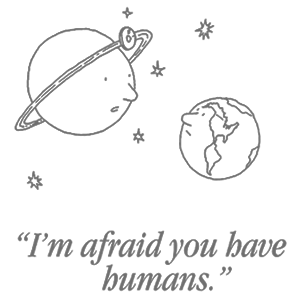
Cosmicism [koz-mih-siz-uhm] is the literary philosophy developed and used by the American writer H. P. Lovecraft in his fiction. Lovecraft was a writer of philosophically intense horror stories that involve occult phenomena like astral possession and alien miscegenation, and the themes of his fiction over time contributed to the development of this philosophy.
The philosophy of cosmicism states that there is no recognizable divine presence, such as a god, in the universe, and that humans are particularly insignificant in the larger scheme of intergalactic existence, and perhaps are just a small species projecting their own mental idolatries onto the vast cosmos, ever susceptible to being wiped from existence at any moment. This also suggested that the majority of undiscerning humanity are creatures with the same significance as insects and plants in a much greater struggle between greater forces which, due to humanity’s small, visionless and unimportant nature, it does not recognize.
read more »
Posted in Language, Philosophy, World |
1 Comment »
January 6, 2013

Criticism of atheism is criticism of the concepts, validity, or impact of atheism, including associated political and social implications.
Criticism of atheism is complicated by the fact that there exist multiple definitions and concepts of atheism (and little consensus among fellow atheists), including practical atheism (apatheism), theoretical atheism (ignosticism), negative and positive atheism, implicit and explicit atheism, and strong and weak atheism, with critics not always specifying the subset of atheism being criticized. Arguments for atheism range from the philosophical to the social to the historical.
read more »
Posted in Philosophy, Politics |
Leave a Comment »
January 6, 2013

Fried Coke is frozen Coca-Cola-flavored batter that is deep-fried and then topped with Coca-Cola syrup, whipped cream, cinnamon sugar, and a cherry. It was introduced by inventor Abel Gonzales, Jr., a 36-year-old computer analyst from Texas, at the 2006 State Fair of Texas. The concoction won the title of ‘Most Creative’ in the second annual judged competition among food vendors.
It proved very popular in Texas, selling 10,000 cups in the first two weeks. It quickly spread to other states, appearing in at least 47 state fairs in 2007. In 2009, Fried Coke was featured on the Travel Channel’s ‘Bizarre Foods with Andrew Zimmern.’ Fried Coke is estimated to have 830 Calories per cup. Since its introduction in 2006, several variations have appeared, using different types of soda and different toppings.
Posted in Food |
Leave a Comment »
January 4, 2013
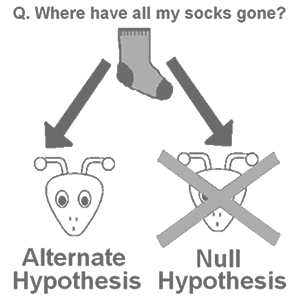
In statistics, a null hypothesis is the ‘no-change’ or ‘no-difference’ hypothesis. The term was first used by English geneticist Ronald Fisher in his book ‘The design of experiments.’ A hypothesis is a proposed explanation for some event or problem. Every experiment has a null hypothesis. If you do an experiment to see if a medicine works, the null hypothesis is that it doesn’t work.
If you do an experiment to see if people like chocolate or vanilla ice-cream better, the null hypothesis is that people like them equally. If you do an experiment to see if either boys or girls can play piano better, the null hypothesis is that boys and girls are equally good at playing the piano. The opposite of the null hypothesis is the alternative hypothesis (a difference does exist: this medicine makes people healthier, people like chocolate ice-cream better than vanilla, or boys are better at playing the piano than girls).
read more »
Posted in Education, Language, Science |
Leave a Comment »
January 4, 2013
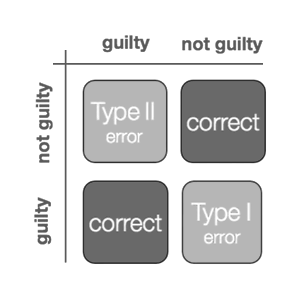
In statistics, Type I and type II errors are errors that happen when a coincidence occurs while doing statistical inference, which gives you a wrong conclusion. A Type I error is saying the original question is false, when it is actually true (e.g. a jury finding an innocent person guilty, a ‘false positive’); a Type II error is saying the original question is true, when it is actually false (e.g. a jury finding a guilty person not guilty, a ‘false negative’ or simply a ‘miss’).
Usually a type I error leads one to conclude that a thing or relationship exists when really it doesn’t: for example, that a patient has a disease being tested for when really the patient does not have the disease, or that a medical treatment cures a disease when really it doesn’t. Examples of type II errors would be a blood test failing to detect the disease it was designed to detect, in a patient who really has the disease; or a clinical trial of a medical treatment failing to show that the treatment works when really it does.
read more »
Posted in Language, Philosophy, Science |
Leave a Comment »
January 3, 2013

Hierarchical [hahy-uh-rahr-ki-kuhl] incompetence is the often observed inability of organizations to achieve the aims set for them. This can be due to the oversimplification of issues and the loss of tacit knowledge about issues as they ascend a hierarchical organization.
There is often an inbuilt tendency for people up the hierarchy to discount information coming from those lower down, particularly if it questions conventional wisdom of the hierarchy. There is a tendency for lateral communication across the various departments, fiefdoms, etc. to be stifled either actively by management, or by self-imposed isolation.
read more »
Posted in Money |
Leave a Comment »
January 3, 2013

Tacit knowledge (as opposed to formal or explicit knowledge) is the kind of knowledge that is difficult to transfer to another person by means of writing it down or verbalizing it. For example, stating to someone that London is in the United Kingdom is a piece of explicit knowledge that can be written down, transmitted, and understood by a recipient.
However, the ability to speak a language, use algebra, or design and use complex equipment requires all sorts of knowledge that is not always known explicitly, even by expert practitioners, and which is difficult to explicitly transfer to users. While tacit knowledge appears to be simple, it has far reaching consequences and is not widely understood.
read more »
Posted in Education, Language, Science |
Leave a Comment »
January 3, 2013
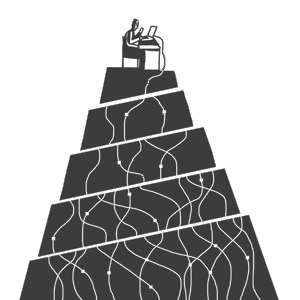
Diffusion of Innovations is a theory that seeks to explain how, why, and at what rate new ideas and technology spread through cultures. Everett Rogers, a professor of rural sociology, popularized the theory in his 1962 book ‘Diffusion of Innovations.’ He said diffusion is the process by which an innovation is communicated through certain channels over time among the members of a social system.
The origins of the diffusion of innovations theory are varied and span multiple disciplines. Rogers espoused four main elements that influence the spread of a new idea: the innovation, communication channels, time, and a social system.
read more »
Posted in Language, Science, World |
Leave a Comment »


 The Daily Omnivore